

In an age where a single tweet can spark a crisis, reputation management is no longer the preserve of PR teams. In this episode, Lucy is joined by Lis Anderson, founder of the award-winning PR agency Ambitious, to explore how HR can (and must) play a bigger role in shaping, protecting and enhancing an organisation’s reputation.
They delve into the shifting dynamics of trust, the power of employee advocacy, and why the most credible voices about your culture aren’t your leaders – but your people. Lis also shares what often goes wrong when HR and comms don’t collaborate, and offers practical ideas to help HR teams get ahead of reputational risks, not just clean them up.
Whether it’s Glassdoor reviews, crisis planning, or understanding digital reputational threats, this episode is packed with insights to help HR step confidently into its growing communications role.
Connect with Lis Anderson Website: www.ambitiouspr.co.uk
LinkedIn: Lis Anderson
00:03 – Lucy Adams (Host)
Welcome to HR Disrupted with me, Lucy Adams. Each episode will explore innovative approaches for leaders and HR professionals and challenge the status quo with inspiring but practical people strategies. So if you’re looking for fresh ideas, tips and our take on the latest HR trends, subscribe wherever you get your podcasts. So, in an age where a single tweet, glass door review or leadership misstep can spiral into a headline, managing your organisation’s reputation isn’t just the job of the PR team. It’s increasingly part of HR’s role. You know culture, behaviour, crisis response, employee activism it all feeds into how the world sees us. So I am really delighted that I’m joined today by someone who’s at the forefront of helping organisations navigate this complex landscape. So Liz Anderson, founder of the award winning PR agency, Ambitious, and she’s an expert in brand reputation, crisis communications and strategic storytelling. Welcome, Liz.
01:23 – Lis Anderson (Guest)
Thanks very much, lucy, really looking forward to today’s session.
01:28 – Lucy Adams (Host)
Oh well, I’m really delighted having you here, because it’s an area where ordinarily HR and PR we’ve kind of historically didn’t mix quite so much, and now increasingly we do, and we’re going to get into all of that in a bit. But I want to find more out more about you. You work with companies across various sectors and you help them protect, promote and sometimes repair their reputations. Is that right?
01:56 – Lis Anderson (Guest)
Yeah, absolutely, and very much kind of our focus and my focus for many years has been working sort of in the business to business and corporate space and it is a fascinating space.
02:08 – Lucy Adams (Host)
How did you get into it? How did you get into this line of work?
02:11 – Lis Anderson (Guest)
So my background all for now 30 plus years, has always been agency side. I love the juggle of that. I like that the nothing ever stays the same sort of pace of that, and I think realistic demands for clients.
02:26 – Lucy Adams (Host)
You love all of that.
02:27 – Lis Anderson (Guest)
Yeah, we need it yesterday no day the same and just kind of a window on lots of different industries. Um, I’m really interested in sort of current affairs business news generally, so it kind of gives a spotlight on all sorts of things from financial services to cyber security.
02:44 – Lucy Adams (Host)
So yeah, and so how did you end up running your own agency, and an award-winning agency?
02:50 – Lis Anderson (Guest)
award-winning agency. Yeah, so really proud of that and certainly in terms of um, very apt for today, um sort of one of our awards, um award track record, is around sort of people and culture in the business which we’re very proud of. So I set the business up uh be 13 years ago this year. Oh, congratulations.
03:09 – Lucy Adams (Host)
I set mine up years ago this year, yeah, and I think you know, it’s just. It feels such a massive achievement, doesn’t it? You know, I’m sure when you set out similar to me, you don’t imagine you’re still going to be doing it this. You know this many years later, but it’s a fantastic achievement, well done well, thank you.
03:26 – Lis Anderson (Guest)
Yeah, so we’re sort of 25 strong now, um sort of bristol based, but working for clients um sort of nationally and sort of internationally, um, and very much kind of offering quite a range of sort of services, because comms has become such an integral part of sort of business now, um, as well as, yeah, kind of just general day-to-day sort of running a business, so we get involved in lots of different things all right, let’s get into it.
03:50 – Lucy Adams (Host)
And um, and we’re going to start with the basics. Really, how would you define reputation in today’s world, and has that changed at all over, say, the last decade?
04:03 – Lis Anderson (Guest)
yeah, so I think I mean, in a nutshell, reputation is the thing that ultimately drives opinion um and perception. But certainly kind of over the last 10 years, reputation, more than ever before, is absolutely about real time. It’s multi-dimensional um and I think kind of very much kind of overlooked is absolutely employee driven um. So whilst you’re looking at kind of the wider stakeholders um, certainly kind of with the onset of things like sort of social media, um sort of employee voice is really is really sort of key to that in terms of reputation of a business um or an organization, and it’s no longer what the brand says about itself, it’s about what people are experiencing, what they’re sharing. Yeah, and that’s very much part of the change over the last sort of five to ten years and of course we’ve seen, haven’t we in in recent years, these fantastic brands?
04:59 – Lucy Adams (Host)
I was listening to a podcast about abercrombie and fitch, for example, and of course that was very much. Their reputational demise was was very much about the leader and what. What the you know the leader was up to um, but we’ve equally seen, you know, reputations that have been brilliant for a number of years, suddenly decline rapidly, damaged, irreparably, and it just feels to me it’s one of those things that it’s so precious, you spend so long building it and it can be lost so quickly absolutely, and I think you know where you’re talking about.
05:35 – Lis Anderson (Guest)
A decade ago, reputation was very much top down. Now it’s crowd sourced yeah so the, the lens has completely changed and the pace and speed in which information is is available and the scale of that, because the channels have changed.
05:52 – Lucy Adams (Host)
There’s so much more um sort of channels available to kind of voice an opinion, um change, perception, influence, which I think is a positive thing in pr, but it’s hard for businesses to manage and keep on top of all of the things. More as an opportunity, but also needs to be mindful that it’s out there and it doesn’t matter what their careers website is saying about them and how brilliant they are. Ultimately, if employees are well, let’s deal with it now. Because, yeah, you know, I mean I, you know, I’m very familiar with glass door. I’m sure you’re familiar with it.
06:37
It’s just one avenue, but it always amazes me, you know, when I speak to hr leaders or people who are in recruitment for a particular organization and they’re not aware of what Glassdoor is saying about them or they’re ignoring it because they think, oh well, it’s the outliers. You know, we know who that person was. They were a pain when they worked here and now they’re saying horrible things about us. But if they’re not doing actively working to do something about changing that, that’s the only thing that’s out there, isn’t it that outliers that pain in the backside employee. You know, the people reading that don’t know the history.
07:16 – Lis Anderson (Guest)
No, and maybe that is around a step change around understanding why reputation is important for HR. It’s not just PR and I think, kind of certainly where you’re looking at sort of employees, they are the loudest, the most credible advocates of your brand, better than any supplier, better than any customer. And I think, certainly in terms of from an HR perspective, the HR sort of team or individual has access to so many touch points related to kind of employees, whether that is to say, policies, onboarding, offboarding, internal communications to gather sentiment, to help shape story, to help shape narrative. That is above and beyond process, shape story, to help shape narrative. That is above and beyond process. Um, it’s about maybe kind of using those touch points and using that sort of process to to drive more than just, I guess, a process of whether you know staff are happy, not right on to the next, that there’s much more power, um, in what hr has got and have access to for sure, I was always fascinated by um.
08:24 – Lucy Adams (Host)
I haven’t looked at it for a year or so, but the um, the edelman pr trust barometer, that they put out every year and, uh, for, for listeners who may not be aware of this, it’s a.
08:37
It’s a free piece of research that comes out every year. They take one issue, which is the issue of trust. I think it comes out in January every year and they have done for for over a decade, I think. Now, and what was fascinating to me was that trust in corporations, business leaders, governments, the kind of traditional voices of authority that we would trust because they were our seniors, our so-called betters and so on, that that has just declined and declined and declined, but that the trust in people like us has gone up and up and up. The trust in people like us has gone up and up and up.
09:14
So I suppose it’s the same as you know why I would trust a TripAdvisor review from somebody I’ve never met and I’m going to believe them more than I would believe the restaurant’s website. And it’s the same with employers, isn’t it? You know it’s that, as you say, actually, employee advocacy for good or ill is this huge, hugely powerful tool. And if we’re not alive to that, then we’re either missing out on the opportunities to to really get our brand messaging and our reputation messaging out there, or we’re just leaving it to chance, and I think that’s that’s an issue. What do you, what do you think HR could be doing more to, to kind of harness those, those touch points then yeah.
10:04 – Lis Anderson (Guest)
So I think often in the point that you sort of make there very much around kind of top down is reputation, the role of just the C-suite kind of feels incredibly, sort of outdated. And so that link between building an authentic culture, which has to be above and beyond C-suite into then sort of the voice of an organization or the culture or the whole sort of heartbeat, and I think quite often that sort of whether that sort of middle management almost kind of um, miss, miss those guys out at your peril um because because there’s a there’s a disconnect.
10:44
It can’t be to kind of pull together and help build reputation, can’t be something that is crafted and delivered as a statement from the top and then hope that that sort of is sort of taken on board through a series of words. It’s about how you live and breathe, your culture, and every employee has a role to play in that. So the piece that is about linking HR because they have access to, quite, quite rightly, all of the touch points, um, concerning sort of employees and how that interacts with sort of internal comms big can be an incredible powerful, incredibly powerful mix to get those right, but it’s often very much overlooked and I think also we we sometimes prevent our employees from being our best advocates.
11:34 – Lucy Adams (Host)
I remember doing some work with a bank um some time ago and they were. They’d got this fantastic offer and their staff were really proud of it. I can’t I think it was like you got money back on your bills or something if you paid by direct debit through this particular bank and it was a great offer and the staff were really really proud of it But’re not harnessing the good that our employees could do. And I really like the approach. I think it’s Gap, intel, ford. They have much lighter touch approaches to social media guidelines for their people. They say things like play nice, use common sense, if you mess up up, take it down.
12:36 – Lis Anderson (Guest)
But they are empowering their people to get on social media and talk about the organization yeah, and I think because that’s that the, the, the brands or the culture of the business is quite clear and that is a sort of a skill about bringing that to life through then a policy or then an approach which is essentially kind of almost sort of walking the walk. So you know, kind of, if employees don’t believe the experience that they’re experiencing, that’s not going to happen, um, and I think you know that’s. That’s absolutely about making that right for the brand or the business that employers are working in. So if that’s a highly regulated industry such as financial services, of course there’s got to be process related to that. But if that’s a particular brand, like you’ve mentioned, sort of on a retail side, and that is the culture of the business, it’s about how that’s sort of brought to life.
13:30
But very much, I think, it’s about really understanding kind of how authentic the employees find that. Because if they don’t believe, um, kind of in what the business stands for or the culture, then you’re you’re never going to kind of engage. Engage and that’s certainly something that we find when we’re kind of coming on board and there might be a north star or a vision, um, and that’s looking then to roll out which is like right, but maybe a lot of the employees aren’t really experiencing that in their sort of day-to-day and yeah, and sometimes that is about really sort of digging deep across the team above and beyond kind of the leaders in in the business yeah, we’ve all seen those horrendous values roll out where you’re being told you’re given the values you know and these are the new values of the organization.
14:20 – Lucy Adams (Host)
Um, I also think there’s something about um understanding who your influencers are. We tend to always think that leaders should have more responsibility for the advocacy and the getting the message out there, but actually there are people who probably would have called them office gossips in the past, you know, but the kind of the ones who love to communicate, who use about it. Um, and I think that kind of identifying our influences, that and legitimizing their role and giving them the tools and giving them the messages if they want to get stuff out there on linkedin or x or whatever it’s being called this week yeah, absolutely.
14:59 – Lis Anderson (Guest)
I think kind of by that taking that sort of inside out sort of approach and celebrating the advocates, not everybody’s going to come on board and and support that as a strategy. That’s okay, because within an organization there will be people that really champion, that enjoy doing that, see that as a key part of their sort of role, and I think that that’s about kind of embracing those that are keen to do that first, and HR’s got a really important job as far as sort of identifying and encouraging that within a business organisation have a chat about HR, the HR team and the comms team, and sometimes it’s not always clear where communications PR should sit, because you know I’ve had comms teams reporting into me and I’ve not had comms teams reporting into me and there’s pros and cons to both.
15:50 – Lucy Adams (Host)
You know it’s always tricky. But I just wondered sort of how do you think HR and communications or PR typically collaborate in a crisis? You know what can get in the way.
16:06 – Lis Anderson (Guest)
Yeah, I think I mean sometimes that that is around sort of structure and you’re absolutely right, I think, and certainly sort of looking back at sort of you know 10 sort of 15 years ago, um kind of pr comms often sort of reported into hr. So you’d have a, an hr director, now a cpo, that sort of sits on on the board and actually still in quite a lot of large organizations comms, um as a discipline, can often sort of report into that sort of role above and beyond maybe kind of sort of brand or marketing sort of sales. So I think kind of that’s not so much maybe HR having an identity crisis. That’s around kind of where comms sits in an organization. So I think certainly kind of structurally within a business, that’s important to understand kind of where that sort of sits.
17:02
And I think certainly kind of what I’ve sort of observed over the years is quite often the relationship between the two is quite ad hoc, it’s not planned. There isn’t sort of a need to look at how those work together until something goes wrong. Um and silos often then sort of exist between hr and comms with a we do this and you do that, yeah, when actually in reality those two sort of um departments should be working absolutely sort of hand in hand because there is so much um sort of crossover um and then maybe you know kind of it’s about understanding and respecting who does what. So hr absolutely understands compliance, which is essential within business, whereas kind of comms is much more around the optics, maybe the sentiment, maybe understanding kind of what’s going on outside to bring sort of inside um. So yeah, kind of very much around sort of getting those basic things and a bit of mutual respect.
18:02 – Lucy Adams (Host)
I the kind of clashes that that I sometimes had with the PR comms team were typically in a couple of areas. One was around pace and speed and the PR comms team typically wanted to move a lot more quickly than I’d be comfortable with. Yeah, because I had stakeholders I needed to get on board or whatever, and actually they were so mindful of the pace, of how things would happen and the need to move at lightning speed.
18:57 – Lis Anderson (Guest)
And then I suppose the second piece was I was always very concerned that our people within the organization, as far as you possibly could, should know before the external, because sometimes it would be impacting their jobs or it would be impacting their area of responsibility, or I just wondered whether you’ve come across those situations before where perhaps you know, maybe the hr team hasn’t appreciated the need for speed and the and the and the pace in which the comms world moves compared to the hr world yeah, absolutely, and I think kind of part of that is the grounding in terms of, certainly from an hr perspective, the responsibility there is the empathy barometer, that the care and support for sort of employees and governance compliance is absolutely kind of within that field.
19:55
And I think where you’re looking then at sort of PR comms or in some organizations, press office there is a foot inside and outside. So if you’re looking to sort of raise brand awareness, protect reputation, whatever that might be, you are always looking at the environment outside of an organization to either help polish sort of tone Maybe polish isn’t the right word on that, okay um, but yeah, so to look at sort of the tone and how that might you know, sort of land externally, because let’s back up and do that bit again.
20:33 – Lucy Adams (Host)
Okay, so, um, yeah, so uh. Basically, I’ve kind of asked you about where have you come across issues where perhaps PR teams want to move more quickly and HR teams are perhaps wanting to maybe haven’t understood the need to move at pace?
20:51 – Lis Anderson (Guest)
Yeah, yeah.
20:52
So very much kind of see HR as sort of being gatekeepers to the empathy barometer.
20:55
Sort of being gatekeepers to the empathy barometer, they have to deal with compliance with governance, sort of employee rights, all of those sort of really important things, whereas their sort of role in that is around sort of shaping the right sort of message that probably needs consideration, might be working with additional sort of stakeholders, whereas certainly kind of from a PR press office sort of perspective.
21:23
The reason that that often moves at pace is because there is a foot inside and outside of the organization and you are always looking at what the external factors are that might help shape a particular message and when that kind of might be appropriate. And that is very much sort of dictated by kind of news agenda, what’s happening in particular sort of sectors, and so consequently, I think kind of that news approach or that news lend can can be quite alien to, to sort of an hr sort of team because it’s like well, okay, haven’t even got this sorted. It’s like okay, if we’re looking to kind of land that later this week that’s not going to work because of X, y, z, that needs to happen sort of now. So I think it’s around kind of the pace that’s sort of driven from a PR sort of news perspective very much so I remember it’s just as you were talking.
22:17 – Lucy Adams (Host)
Then I was thinking back to one of my clashes with the, the comms team at the BBC, and it was always at pay review time because internally I was wanting to talk up the deal and to say this is a fantastic, beneficial pay deal because there wasn’t much money around and the unions were obviously looking to understand you know, could they get more, etc. Whereas the comms team wanted to get the message out that the BBC was being really tough on pay increases, like being, you know, protective of license fee spending. And it was always really hard to kind of find a message because it had to be the same message.
22:59
We couldn’t have two different messages because there’s no such thing as an internal message and an external message is there. It’s the same message.
23:06 – Lis Anderson (Guest)
Same message yeah.
23:07 – Lucy Adams (Host)
And, and I was just every year, that would be, that would be a real issue.
23:13 – Lis Anderson (Guest)
Yeah, very much, and for some, certainly from a comms lens, you’re dealing with lots of different messages all of the time. So yes, that might be related to an HR sort of issue or a piece of news, but what happens if there’s something that’s happening with a project or service launch or something that’s gone kind of not to plan? So maybe good news in terms of, I don’t know, creating jobs, but actually there’s something else that that’s, you know, not going so well in the channel or within a particular sector. So very much kind of the job of comms is to kind of be spinning all of all of the plates at any one time you mentioned that HR and comms or PR tend to need to work together on an ad hoc basis.
24:00 – Lucy Adams (Host)
What do you think that they could do, perhaps more proactively, so working together, um, in a more um, purposeful, deliberate way to kind of to build a more resilient reputation? How could they perhaps not wait until the crisis but actually be more proactive?
24:19 – Lis Anderson (Guest)
yeah. So my, that’s my observation that it it often is working in an ad hoc basis. I don’t necessarily think that is the way to work. But so I think, even where you’re looking at you know sort of um pulling together a process around how to deal with sort of particular crises or sort of news internally that needs to go externally, how HR and PR is doing that together, so that shared learning whether that’s shared training, whether that’s pulling together a shared playbook, so there is agreement sort of in advance, rather than that sort of being something that gets dealt with at the time.
24:56 – Lucy Adams (Host)
So I think kind of the the pre-planning to that is sort of really important, which certainly goes back to the structure and how the rules of engagement for HR and PR are sort of set to work as true partners within an organisation to get the best results at the end of the day think about the skills then, um, before we wrap up, because, um, you know, I mean I was very fortunate that I had access at the bbc to, you know, the fantastic interviewers, um, and people who were trained in in, you know, helping me prepare for those interviews and I, you know, I ended up doing all the major news broadcasts and political programs and so on, not always very comfortably, but sort of managed to get through them and the training I received at the BBC really helped me.
25:49
But most HR people don’t get that kind of training, do they? Until they’re suddenly in the limelight, or they’re having to answer questions suddenly in the limelight, or they’re having to answer questions either to the media or to politicians. What are the skills you think, either in terms of that crisis management or generally about, you know, brand reputation? What are the skills that HR leaders should be developing to make sure that they’re equipped to handle reputational management?
26:19 – Lis Anderson (Guest)
Yeah, so I think there’s to summarise that I think there’s probably sort of four key areas that I think sort of HR sort of leaders should be taking on sort of board. And the first of that is strategic communication. So that is around understanding and sort of presenting clarity in a very kind of complex environment. So that sort of communication skill is is sort of key, um, the leadership in terms of sort of guiding people through uncertainty. So that’s around sort of approach, understanding kind of the, the guardrails, and how sort of messaging can sort of be part of that. Um, crisis readiness, so very much sort of scenario planning.
27:00
I don’t think there’s enough of that that happens with the organizations. Oh, I couldn’t agree. More message shaping, stakeholder planning that that’s not the, the job, just to sort of pr. And I think the fourth one, and probably the, the most important, that is moving at phenomenal pace, is digital literacy. And certainly that is something that, rather than finding a comms piece, comms, people were trying to keep up on that with, not just the likes of sort of social platforms like Glassdoor or Google with you, but how AI platforms and AI search is coming into that mix and it’s understanding then how news and stories can stick or not stick in the role of sort of that digital and sort of social media channels, part of that HR mix, and I think that in particular, is a really underserved part of sort of HR, but phenomenally important.
27:56 – Lucy Adams (Host)
That’s been brilliant. Thank you so much, liz. That’s been brilliant. Thank you so much, liz. I think you know it’s just a fascinating area and one that HR can no longer just abdicate and kind of leave to people believe about our organization. Um, because that’s ultimately what’s going to get into the uh public consciousness about the black brand reputation and and we can’t separate that out. So you know, it’s that. Um, I think you know, as hr professionals, we do have a huge role to play, not just when things go badly wrong, in the crisis management, but in the proactive management of our brand reputation, particularly through employee advocacy. So thank you so much for joining me today, liz. Great, thank you very much, really enjoyed that. Thank you, yeah, so if you’ve enjoyed this episode, please do leave a review, share it with your network and subscribe so you don’t miss what’s coming next. And, as always, if you’ve got ideas for topics or guests you’d love to hear from, do get in touch with us at hello at disruptivehrcom. Bye for now.

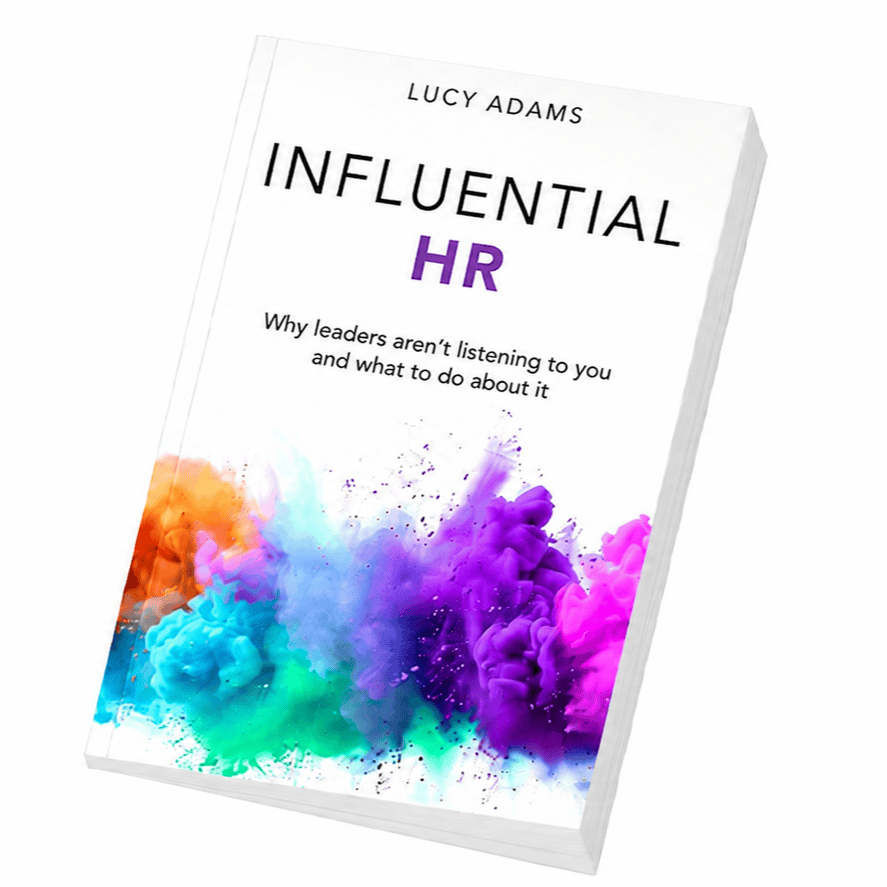
The third book in Lucy Adams’ series for forward-thinking HR professionals explores why HR struggles to influence leaders — and how to build the confidence, credibility and authority to create real change.


