

In this episode Lucy is joined by Matt Brady, Head of People of Tesco Bank talks through his refreshing HR philosophy, which is grounded in insight, commercial savviness, pragmatism, and innovation. Matt shares candid stories from his career at HSBC, Sky and Tesco Bank and shows how a mix of data, empathy, and experimentation can drive meaningful change in the employee experience.
Matt’s take on HR is shaped by his background in economics, where he first learned about human behaviour, motivation, and how to make the most of limited resources—ideas that still guide his work today. In this episode, he and Lucy chat about the value of looking beyond the usual HR playbook, drawing inspiration from areas like marketing, behavioural science, and design thinking to bring in fresh, creative approaches. Matt also talks about the power of using data to tell a story—not just reporting numbers, but connecting the dots between what employees are saying and how the business is performing. And when it comes to being commercially savvy, he makes the case that it’s not about sounding like a finance expert. Instead, it’s about really understanding what matters to leaders and showing how HR can help solve the problems they’re facing.
This episode is a must-listen for HR professionals who want to shake off rigid processes and bring relevance, flexibility, and a human touch back into HR. Whether you’re early in your HR career or leading a people function, Matt’s blend of humility, rigour, and creativity offers practical inspiration for transforming how we do HR.
Chapters
(00:03) Innovative Approaches in Human Resources
(08:44) Connecting Data to Storytelling for Impact
(16:49) Developing Authenticity, Collaboration, and Pragmatism
(24:05) Innovation and Pragmatism in HR
Contact Matt: https://www.linkedin.com/in/bradymatt/
00:03 – Lucy Adams (Host)
Welcome to HR Disrupted with me, Lucy Adams. Each episode will explore innovative approaches for leaders and HR professionals and challenge the status quo with inspiring but practical people strategies. So if you’re looking for fresh ideas, tips and our take on the latest HR trends, subscribe wherever you get your podcasts. So every so often you come across an HR director who delivers the role in of the qualities that you respect and whose vision, ethos and practices you admire, kind of renews your faith and you realise that all the stuff that you know you’ve been spouting for years actually can be achieved, and today’s guest is one such person.
01:04 – Matt Brady (Guest)
So welcome Matt Brady. Thanks, thanks, lucy. Thanks for having me and thanks for the kind words.
01:07 – Lucy Adams (Host)
Oh, it’s really lovely. I know that kind of talking about yourself doesn’t actually feel very comfortable for you, so I’m really grateful that you’ve agreed to come on the podcast, and this podcast is. This episode is going to be slightly different, because normally we dive into a topic I don’t know performance management or talent management but in this episode I just wanted to explore your philosophy around HR and to explore what you bring to the roles that you’ve had, because I think it is a bit different and, if you don’t mind me saying so, I think it’s brilliantly fresh and innovative, and so we’re going to kick things off in the normal way, which is, I’d really love to hear about your HR career and the role that you’re doing now.
01:53 – Matt Brady (Guest)
Brilliant, thank you. I mean I think I’ve thought about this a lot, coming into the, the podcasts, my approach. It’s lovely of you to say it’s refreshing and different. It’s probably similar to an A-level economic student, if you think about which I studied and that’s as far as my economics got, but that was a study of human behavior and the relationship between ends and motivation and scarce resources and a lot of the time in HR. That’s the challenge we face. It’s supply-demand, it’s diminishing marginal returns, it’s how you get motivation and satisfaction in people, and so lots I learned from my A-level economics books, which are still up there I still apply today, tends to flow through a lot in what my team will complain about in terms of data.
02:36 – Lucy Adams (Host)
I think it’s really interesting that often in HR we look to hear and find out about what are other HR people doing, look to hear and find out about what are other HR people doing. And actually, if we look broader than that, if we look at things like you mentioned economics I’ve not heard that before but if we look at marketing, if we look at neuroscience and behavioral science, if we look at the way in which digital products are produced.
03:01
Actually, that’s, I think, where we can get truly innovative in our practices by bringing in these different disciplines.
03:08 – Matt Brady (Guest)
Completely agree, and there’s a great opportunity because we’re talking about humans and human behavior, and whether that’s the products we produce as HR teams or how we work with the business commercially. All of that, I think, lends itself to stealing lots from those different areas. It’s great.
03:30 – Lucy Adams (Host)
So how did you kick off in HR? Did you come through the kind of policy admin route or did you come from another aspect of the business and move over? What was your career path?
03:39 – Matt Brady (Guest)
I started with a role at HSBC in the graduate recruitment team, which is still fondly. I go back and think about how much I enjoyed that that role. It was administration. We were administrating the, the graduate schemes for for the bank at the time, and I spent probably six, seven hours a day scoring on a piece of paper the applications for the management trainee and the branch trainee program. But it was great fun and and things that stuck.
04:05
I mean there’s things as we go through hopefully not my, my career receiving that that really stuck with me for every job I’ve gotten. The one there was the connection between customer and colleague, so every colleague at the time had to have a bank account. That was part of the rules back then at the bank. But it meant whenever anybody rang, you thought about them as a customer before you thought about them as a customer before you thought about them as a colleague and that mindset, that that what that drove into the team in terms of just thinking differently about colleagues. It also meant if you walk past the payroll director’s desk and the phone was ringing, you were expected to pick it up because it was a customer first and foremost. It was a customer of the bank and that really stuck with me. Still to this day.
04:43 – Lucy Adams (Host)
It’s something I talk about with my team oh, that’s interesting, you know, I think sometimes we we have such siloed teams, don’t we in HR, and that kind of sense of well, that’s nothing to do with me because I’m a business partner or because I’m in this center of expertise or I’m in operations, and and actually that sense of if one of our customers has a problem or an issue or a question or a need, it’s you know, we will help them. We might not be able to help them directly, but we can signpost, we can make sure that they feel heard and seen and so on. So what about what happened after that? Where did you go?
05:19 – Matt Brady (Guest)
I moved on to spend a bit of time in the public sector. I worked at the NHS. I was on the agenda for change program guys going back a while, so 20 years ago. That was job evaluation and reward and really where I think I cut my teeth in both change, you know, interactions as you found with the union, building relationships, but also quite a lot of work with with data. It really opened my eyes to how you can manage work and projects and really understand what’s going on in the organization through the use of pivot tables in the main and a couple of access databases yeah, it wasn’t more sophisticated than that there’s not
05:53 – Lucy Adams (Host)
a conversation I can get into without talking pivot tables so I mean, you and I met at sky when you were working at sky and they, they’ve kind of built a reputation around really doing things differently in hr and yeah, they’re kind of built a reputation around really doing things differently in HR and yeah, kind of you know where did that come from, where did that drive to? To think differently about HR come from at Sky.
06:13 – Matt Brady (Guest)
I think that it’s. It runs through Sky and Sky’s DNA. I mean, it sounds a bit cheesy, but Believe in Better genuinely is a purpose and something that was stated. I felt right through the organisation how we thought about products, how we wanted to be disruptive, how we wanted to innovate and push the boundaries and periodically, you know, we would launch new products. Skyq when I was there, we entered the mobile market. We were still working into broadband, but it was just a powerful organisation in terms of pushing, incrementally pushing, and getting better and better and better, and that ran through the HR team as well as looking for ways to improve and again make things better for colleagues a little bit every day.
06:55 – Lucy Adams (Host)
So tell us about the role that you’re doing now.
06:58 – Matt Brady (Guest)
So I’m the head of people now at Tesco Insurance Money Services. We sit as part of Tesco. We look after our insurance and financial services products. So, really proudly, the ATM network within Tesco, travel money, but also four lines of insurance, which is great and actually loads we’re doing there, if you think data, how we can connect that across the broader Tesco ecosystem to deliver more for customers, and lots of similarities to my son at Sky I about believing better. But here with the, every little helps and my translation of that with the team is is very similar in terms of thinking about the marginal gains, the small things we can do.
07:33 – Lucy Adams (Host)
That will not make a difference for colleagues so when we talked about you coming on to the podcast, you very helpfully sent me a kind of you know summary of your HR philosophy. I know that sounds very grand, but you know your approach, that you bring and that underpins the way that you think about HR and the way that you work, and it broke down into four key areas of insight, commercial, now pragmatism and innovation. And I want to just talk about your thoughts in these. In these four areas, um, you know, we hear a lot about commerciality in HR, so I expected that to be there, but some of the other things I think are just a little bit different. So I want to dive into the first one, about being insight driven, because I know a lot of HR people really struggle with this. So what does it look like for you? Why and why is it important?
08:30 – Matt Brady (Guest)
It’s important because in my experience I mean it plays to my strengths, I would say so. It’s where I feel most comfortable and authentic, so tends to be where I start, but also it cuts through the noise with leaders that I’ve worked for over my career better than anything else. I’ve really tried and I think that the magic a lot of the time tends to happen not when you look at data in isolation or insight in isolation, so the levers or the levers and reasons for leaving it is when you connect that to uh, to performance data or data that’s going on or what’s happening in the business. That’s when you start to tell the story and so you know. If I think of examples, you know right now at Tesco, where we’ve looked at our employee satisfaction, what we call our EVM survey, every Voice Matters.
09:15
We’ve been able to shift that, not by what I’ve seen in other organisations where you find an action plan of five pillars and 25 actions and 25-point slide decks that you can never deliver in the six months between a survey yeah by just getting really clear and really focused and we we looked at how, um, how satisfaction changed by tenure and you could see, in the longer tenured colleagues versus the newer starters, just real variations and differences and a lot of the time. Then it’s about creating a consistent colleague experience by just looking at those variations and understanding why. And data is where I start, but it leads into the conversation so it tends to grab attention.
09:53 – Lucy Adams (Host)
Yeah, and that’s, that’s the. That’s the key, isn’t it? I think you know whether it be just stuff around demographics and DEI, or whether it be absenteeism and churn or the engagement survey data, but I didn’t what I didn’t do and I think what you’re describing is and back to marketing again actually is I didn’t use the data to tell a story. I would present the data and then I would find myself getting into arguments about methodology and you know comparative data, and you just lost the point, which is actually this there’s a story under here and that got lost. So I think it’s and is this where pivot tables come in, because we were laughing well, yeah, I mean a little bit.
10:52 – Matt Brady (Guest)
I don’t even know what a pivot table is. Oh listen, I think three of my promotions have been down to being the only person in the team that could do a pivot table, so it’s been absolutely fundamental to my success. Um, look, it’s great. The, the, the storytelling, um, the, the pivot tables always help with my analysis, but the, the storytelling is is a lot of the time within the visualization.
11:16
And and there was a um, actually an editor at sky news where, when I was there, who said something to me and again it stuck with me for the last 10 or 15 years, which is she was the editor of the business news and if you think, the business news, when it’s on, tends to be on in the office and it tends to be on in the background and it tends to be on most of the time with the sound off.
11:35
And they had a rule in the, the, the data team. That was if you show anything, you’ve got to be able to understand it with a sound off. It’s no good if you have to explain it because people haven’t got the sound. It’s in the background, they’re busy at work, and again, that stuck with me as a way of just challenging what I encountered is the same as you that people will try and pick holes in the data or the scale’s not right. Or show me this, if you can understand it, with a sound off, if it takes no explanation about how you did it, that I try and use this expression around shock and awe data as well.
12:12 – Lucy Adams (Host)
I think you know, and I can absolutely see the kind of news headline aspect in that, and you know whether it be Deloitte saying that they discovered that you know two million hours have been spent on performance management. And I think when you can get that big headline, the shock and awe data, that it doesn’t necessarily convince people to immediately change the way they’re doing things, but you at least get given permission to explore, don’t you? Then you know at least there’s a we’ve got to do something. So it just gives you that permission to try something.
12:48 – Matt Brady (Guest)
It absolutely does. And again, the balance I try and strike, particularly working as part of leadership teams. So, whatever my job title, I consider myself a business partner and a lot of the time I think the shock and awe date is a great place to start, but you’ve got to build confidence then it’s achievable. So if something feels so big and so challenging, actually getting the buy in that we could take action that’s going to make a difference can be your next challenge. And so then breaking that down to the two or three things that we can do that will make a difference that will move us forward tends to be the next challenge when you’re using the data.
13:23 – Lucy Adams (Host)
So I want to move on to this next one, which is about commercial savviness. Commercial now, and it should be a given, shouldn’t it? You know, in this, this stage of HR’s evolution, but equally, I do know that that’s one of the criticisms that’s often leveled at HR team is that they don’t seem to be connected to the business, that they doesn’t, they don’t understand the um, the commercial, they don’t make the links to commercial um, and and I always kind of get slightly anxious when hr then tries to demonstrate commercial savviness by trying to apply return on investment to learning programs, trying to adopt the language of finance, because I don’t, for me, I don’t think it’s that how can hr people convey that they have commercial savviness? What does that look like for you?
14:15 – Matt Brady (Guest)
It was a light bulb earlier in my career where I think a lot about influence and facilitation as skills.
14:22
They’re things I practice.
14:23
They’re things that, if I’m honest, haven’t always come naturally to me.
14:28
I work with leaders who just look like they did it effortlessly and very confidently and in a certain way that I tried to replicate, I think, earlier in my career and it wasn’t authentic for me. It wasn’t until I thought about it as a skill and something I needed to practice and learn that it started to really move forward. And from a place of strength, I think the commerciality I think of this as commercial savviness, and so a lot of the time it’s just recognising that leaders right now have got immensely difficult jobs, competing demands, and so when I think of commercial savviness, it’s about finding again the one or two things that connect most with their agenda, rather than try and fill what little bandwidth the leader has with everything that’s on my pad and, if I can connect that with a problem they’ve got within their business area. That’s what I mean by commerciality and savviness and that could be actually starting with the issue they’ve got and working it back to the people root cause, and that might be a talent issue or a gap in succession or a capability gap.
15:31 – Lucy Adams (Host)
But I think again, when you can start to build those connections, you can make real impact and just having the confidence to pause and, instead of leaping into providing an immediate solution to whatever it is, they appear to be asking or telling them what the policy is. Or you know, that kind of classic um where we want to support um and we move into that either sort of nursemaid, compliance officer type role, but actually just pausing and asking great questions and and I’m interested that you say that these are actually skills that you need to work on. So how do you work on them if you, you know there’s somebody junior out there as an HR person and they’re thinking, oh god, but you know, these leaders are quite scary and I’ve got a. You know how on earth do I ask a great question? How have you built up that capability?
16:26 – Matt Brady (Guest)
I mean, it’s honestly, it’s trial and error and, um, the libel went off when I thought about it as a skill. But when I thought about it as a skill and I knew it was something I needed to work on and practice, and so if I feel like I’ve not used facilitation skills, I’ll make a point of going and trying and practicing and, almost a bit like CPD, keeping my hours up is the best way of looking at it. I think the other tip I would give people is and again, it’s a bit cliched, but do it from a place of authenticity and where your strength lies. And so for me, you know, being more introverted and more grounded in data and thinking, and maybe head more than heart. That’s where I start when I think about those things.
17:09
I’m very structured and have a plan. You know, again, again, I used to think people would rock up to a facilitation thing with a bunch of post-it notes and could do these amazing things quite naturally. And there are people who are like that. I’m not one of them. So I plan, I have a plan for the facilitation, I have a plan for two of the sessions just in case it goes wrong and I need to pivot. I’m really thoughtful and planful into that, because that’s the best way I have of feeling confident yeah, and then just practicing, isn’t?
17:33
it exactly yeah absolutely.
17:35 – Lucy Adams (Host)
I mean I, you know I, I’ve kind of worked over my entire career with doing keynote speaking and the first time I ever had to do that was as a teacher in my you know, it was my first job out of uni and I was teaching electrical installation engineers, year one, communication skills, and I was, what you know, 24 or something and terrified. I mean so terrified, and I remember I tried to lift my coffee and my hand was shaking so much that it was bashing against my teeth and and you just think you’re never going to get good at it, you’re never going to be able to be comfortable, and the only, the only option for me is just you keep doing it and you keep doing it and keep doing it and then suddenly you realize you haven’t had to think about it, it’s come naturally.
18:23
And I think that kind of sense of you know work out what are the two or three areas where you want to develop and just keep practicing, keep putting yourself into a situation where you’re uncomfortable and look most people in HR I’ve worked with, I think we’re the hardest critics on ourselves as well.
18:40 – Matt Brady (Guest)
There’s nowhere generally that sets higher standards on ourselves of what we should do and the impact and all the things we should be, that in practice, if you to ask your audience member afterwards it’s, it’s never really as bad as you might be making no, that’s so true.
18:53 – Lucy Adams (Host)
And and you mentioned in that piece around commercial savviness, about collaboration, yeah, and I was interested why, why that sat in the commercial piece. Um, talk to me about how you collaborate. What does does it mean to you?
19:12 – Matt Brady (Guest)
It means I won’t use the model that I trot out, but it generally means new and different. I will get in my soapbox a little bit. I think lots of times people talk about collaboration it’s actually about compromise. When I hear win-win, it’s you know, we had our position, they had their position, we met in the middle and did a bit of both and that a lot of the time is working absolutely right in certain situations.
19:35
But the best examples of collaboration is where I’ve had a position, the person I’m working with at the business has had a position, but actually what we’ve got to as a result of that challenge and the debate is something that’s new and different and better than we would have got to if we’d have just been entrenched in our views and compromised. And so some of the things that have made the the biggest impact in in work and working with business leaders is where we’ve had the debate, had the challenge, but got to something that’s new, different and better as a result of that. And a lot of the time I think we we can be in danger of trying to cascade and roll things out and take things because it’s about implementation. Um, if you can get upstream of that and really think about the problem and work with, with the leader through collaboration, gets something that then has a better chance of being embedded because there’s more buy-in and it’s it’s more fit for purpose and and also builds our credibility, doesn’t it?
20:28 – Lucy Adams (Host)
absolutely yeah yeah, and I think it’s that sense of we’re not just rigidly pushing something out. We’ve listened to the fact that they are special and different. They’re never as special and different as they perhaps think they are. But you know, we hear it they are special and different and um, and we’re trying to work for something that’s going to work for them, rather yeah rigidly stick into our position and there’s this.
20:52 – Matt Brady (Guest)
I mean a ton of real tactical things that I don’t want to shame ugly tactical in most of what I do. But but you know, sometimes when working with leaders, there’s situations recently actually using some of the principles around design thinking, going out of focus grouping that, working with the teams that sit underneath that, again you stand a better chance of buying and and creating something that’s really relevant for what you’re trying to do. And there’s not a hr person I’ve ever worked with that wants to create something that doesn’t work, doesn’t land, that doesn’t make a difference, and so I think through that collaboration, that tends to be where you get some of the best impact, I think and also your point about, you know, keep questioning, keep keep trying to get to what is the root cause and the root issue.
21:35 – Lucy Adams (Host)
It’s not, you know. Sometimes, I think, you know, I’ve been guilty of where the business or leaders have told me that we want x. You know, I always give the example of a pay and grading structure that I came up with, you know, and the business had said, oh, you know, this was, this is what they wanted, and I’d merrily gone away and I think six, seven months, my team and I worked on this and it was a thing of beauty by the time it came out, you know, and just absolutely died, a death because I hadn’t actually really understood what it was that they were trying to achieve and I’d ignored the fact that, you know, there’s me gaily getting rid of grading levels, but actually they like those little promotions, you know, they like. You know, there’s me gaily getting rid of grading levels, but actually they like those little promotions you know, they, like you know, getting rid of titles and that were a bit absurd.
22:18
But actually, in the absence of pay increases at the BBC at the time, it was the only way people felt they were progressing and I’d really not understood the human dimension of it. I’d kind of again. And so commercial savviness is not just about understanding the numbers. It’s genuinely understanding how people think and behave at work.
22:38 – Matt Brady (Guest)
Completely and always a question of relevance. I mean, we had the same thing with another organisation, where we got to the point on performance management in the same way. So, right, let’s blow up the ratings, let’s do some focus groups and some have no ratings, some have it, let’s try different things. And people who were saying we should do that, as they experienced that, were like, well, actually, how do I know I’ve been successful? And yeah, it was the same thing. We did the experimentation, we thought we’d been really brave and really forward-thinking and progressive, but actually, as we worked through it, lots of people said, no, we like it actually, we like these things, we like the rating. It’s how we know we’ve been successful. It’s a great moment for recognition. It’s a great moment to have a conversation about how I’ve performed in my career, and there was lots of benefits from that process that we’d walk past, I think.
23:27 – Lucy Adams (Host)
Yeah, yeah Right. Let’s move on to the third part of your approach, which is about being practical, pragmatic. And again I think this is an area that’s underrated by HR, because it’s not. You know. When you’re asked what are your strengths, you kind of think, well, being pragmatic doesn’t sound terribly sexy or exciting, does it? But so powerful. So again, what does this look like for you?
23:54 – Matt Brady (Guest)
John Rankin I used to work with gave me the best feedback once, which was you can’t spell pragmatic without Matt, and again I just thought that’s nicer. John and he meant it tongue in cheek with gave me the best feedback once, which was um, you can’t spell pragmatic without matt. And again I just thought that’s, that’s nice to john, and he meant it tongue-in-cheek, but, but he was right. It’s around doing what works and for me, I translate that to trying to keep things really simple, doing what works and starting small and scaling up. You know, so often throughout 20 plus years of working, we’ve launched things at scale with a big bang and lots of fanfare and then, nine months down the line, we’re all asking the question about why it’s not embedded, and then we’re having the debate about embedding the work.
24:32
Um, you know, we we had a challenge, as most organizations do, around diversity and inclusion at sky, and when we looked at the data, we thought career and career progression and people from underrepresented groups feeling confident about applying for promotions and putting their hand up for that. We started from a right let’s go big and let’s do something amazing for everybody, and I’m really proud that I fought against that to start with something that was much smaller and so we we did a mentoring program. But we started with a cohort of 10 people we knew that were passionate, they were involved in the networks. We got those connections and we asked them to help us build it and over three or four waves we managed to scale that up to about 300 400 people in in the phases we ran.
25:21
But we got it right because there’s so much we learned from that first phase that yeah you know, um, a bunch of people from quite privileged positions in senior management, design in a mentoring program. It sounds obvious when you play it back isn’t the right thing to do, actually, when you start small and and they helped us and again, the buy-in we got from that. They were real advocates, they acted as, as mentors in in future waves but absolutely helped us build something. Now, if we’d have started with a big bang, we’d have got it horribly wrong, we’d have been added resourcing would have been over promising and under delivering. So that pragmatism really for me is about again going back to a level economics, the marginal gains you can get by starting small and just make things a bit better every day yeah, and I think that thing around.
26:05 – Lucy Adams (Host)
You know, if you say to leaders well, you know, there’s this big initiative, it’s all about transformation and you know people just haven’t got the capacity, no bandwidth, to even contemplate that, have they? Whereas if you say I want you to try asking this question rather than going into your normal, you know, task allocation, just try this question or these small things, that they go, oh, I could probably do that, you know.
26:32 – Matt Brady (Guest)
Yeah.
26:33 – Lucy Adams (Host)
When we work with HR people, a lot of the time they’re saying capacity time, poor managers is the biggest challenge they have. And yet the solutions we’re often presenting involve lots of time or appear to involve lots of time, and sometimes it’s just. You know just the way in which we phrase it, you know, I always think you know the idea of continuous conversations or continuous performance management.
26:58
I mean just, you think I haven’t got time to have a continuous conversation. I might have a time to have the time to have a small conversation I think that’s it.
27:06 – Matt Brady (Guest)
I think um again. I think the capability, the organization I’m in right now at the tesco is pretty good. I think if we could give people a bit more of that capacity, if we could get a leader spending a bit more time with their people and doing what they’re really passionate about doing, we could make an enormous difference now you also say, under this pragmatism, something that um, I’m was delighted to see because I believe in it firmly, but I’d love to hear it from you is about consistency and fairness not being the same thing.
27:35 – Lucy Adams (Host)
And I think again, I know because you know hr professionals tell us all the time that they struggle with this concept. You know it’s drummed into us, isn’t it from our HR infancy that to achieve fairness you’ve got to treat everybody the same, and in our human lives, that’s clearly you know. We wouldn’t treat our 16 year old daughter the same as our eight year old son or you know. We know it in our human lives and yet at work there’s this kind of fear, I think, of worried about being discriminatory or inconsistent experience.
28:11 – Matt Brady (Guest)
Talk to me about how, why you believe that consistency and fairness are not the same thing and and and you know maybe if you’ve got any examples of where you brought that thinking in yeah, I, I think, um, I mean it was some of the early conversations you and I were having around the the bereavement matrix, and I’ve seen that in other organizations as well I I think we’re at such an interesting time as a profession that our search, a lot of the time, is for relevance and how you square the need for and there is a need for consistency, and there is a need in terms of our policies, to set standards and provide guides and to help leaders and managers navigate those complex situations. But a lot of the time, the challenge is also, then, one of relevance and what’s the right thing to do, and so the combination of having something that can act as a guide, but supporting leaders to through you know values and development, to to try and do the right thing. You know, I’m always up with my team for looking at cases and situations and just question and challenging ourselves, but having a debate around, is this the right thing to do? Is it the right thing to do to extend, um, somebody’s private health care if they’re going through an awful situation like, what can we do? And actually, if you look at key moments through the employee life cycle things like returning from maternity leave is a classic that you know. That’s such a powerful moment for people. It’s such a moment of dread you’ve been off for for a year and where organizations can get that right. I was talking to a former colleague who works at spotify and they do things. I mean some amazing tech, but they do things where they create a video from the team that encourages welcome back. They just make it really personal and human.
30:00
Now that’s not we’ve got to return to work. And here’s the maternity policy that’s going well. That can act as a guide. But within that we can do things different. We can create an opportunity and actually you can turn something. That’s a real pain that everybody remembers.
30:13
My wife remembers returning from maternity leave and just how horrible it was and the tech didn’t work and she spent three days doing e-learning and if you can turn that to something else, it’s like it’s a moment that that you go well. I remember that. But the advocacy you can get from that, you know people will talk about that. You’ll share that. You’ll share that with 10 people in a really positive way. It can be powerful. And so, again, I I’m not up for most of the time the work that’s involved in rebranding and recreating lots of policies, but see them as a guide and always remember as a human at the heart of that. And actually, if they’re going through a terrible time, then think about what that’s like and what you can do and how you can do differently. Like consistency and fairness aren’t the same thing.
30:52 – Lucy Adams (Host)
They’re really not completely, completely, and, as I say, I think it’s an area that if we focus less on compliance with the policy and more about equipping managers to help make those judgment calls, and not just make the judgment call but articulate their decision in a way that that is is, uh, that works for the you know the recipient of that. Um, I think that’s just a very different skill set for us.
31:19 – Matt Brady (Guest)
And yet, actually, where our great employee experiences will come from and the things we talk about, you know trust and empowerment and all that goes with that.
31:30 – Lucy Adams (Host)
Again, the real opportunity to demonstrate that, I think so let’s move on to the final area of your ethos. Your your kind of four-part ethos and and I think this is the the one that when I first met you really stood out for me actually which is that kind of bringing innovation into hr. And I think, in a world where we’re often fearful of getting things wrong, being innovative can sometimes feel like you have to be really brave and bold.
31:58
I remember people at the bbc would say, oh, that’s a brave decision, and they didn’t mean that in a in a positive way. That was basically you’re insane trying this and it isn’t always comfortable, is it? And I can you just maybe talk about some examples where you’ve bought innovation, you’ve applied your this philosophy. What does the kind of innovation look like for you?
32:19 – Matt Brady (Guest)
um, innovations. I mean I’m maybe at risk these days the plagiarism it’s like it’s it’s stealing, it’s taking things from. Yeah, we thought it’s about marketing or different industries or different people, or you know some of the conversations we’ve had over the years and taking those and adapting into, maybe, problems we’re facing in the workplace. I would say, in my experience it’s a combination. We talked about collaboration earlier, but it’s always a combination of the leader that you’re working with or partnering in terms of where you want to try it, they’ve got to be up for it. Don’t go where the energy is. Really. If you’ve got somebody that has that mindset, it’s an awful lot easier. If you’re pushing on a blocked door then then you’re on a hiding to nothing. In my experience, um, and I’ve I’ve gone with always playing to my strengths. So the things we’ve talked about earlier, you know, will be around data and what I’m seeing in there and how we can use that to again solve or tackle problems. There’s an example at Sky where we had the performance, the perennial performance challenge, and we were looking again. This was across the contact centres and quite a large, diverse workforce, different demographics, but up and down around the country, of around six, seven thousand people and we we looked at the um, the engagement data, we looked at the different people data, we looked at the performance data we’re getting through through calls and handling time and performance on those goals and the customer experience you got from that. And we we segmented all of that data into four or five different personas that you know it’s going to sound really linear and really easy. Through a lot of trial and error and development then produced something as a prototype that enabled leaders to have five or six different performance conversations and so, again, trying to move away from the consistency is king and here’s a script. And now go and do that same script to 6,000 people and expect all 6,000 people to raise their performance. We just did it based on what we saw as the drivers.
34:28
The biggest determinant of that was how long you’d been in the role. Typically, you know whether you were a new hire, whether you felt you were a bit stuck and maybe engagement and motivation was dipping stuck and maybe engagement and motivation was was dipping. But actually equipping leaders to have a different conversation with people depending on where they were at made an enormous difference to to our results. But it worked because I’d got buy-in from the leadership team and it worked because I got the relationship and the credibility with the leadership team. And it worked because danielle and andrew and peter at the time were were just up for doing something different and we were pushing on an open door.
35:00
And and again, you get those things when, when the planets align a little bit, um, but my wife always says this, like, we’re generally saving pdfs, not lives. That’s something that she’s drilled into me. She also says posters aren’t a replacement for a personality. So, uh, yeah, I try to use those to look interesting, but we’re not. We’re not going to mess anything up. Like you know, if you do something and it’s with the right intent, if it makes a difference, again it’s going to make a difference and and pushes a bit further forward.
35:31
Um, it’s always better to try than than to not, and so I I think when we’ve done that, um, we’ve got some things wrong along the way, but we’ve always had a go and that’s where the best work comes from. No HR person wants to sit doing what they’re doing. It’s generally about where you can find an impact and focusing on a few things one or two problems in a six month or a 12 month period Going after one or two things a year rather than 10 or 12, again allows you to just focus your energy into those things matt, it’s been such a pleasure talking to you likewise I really, really enjoyed it and, uh, I could go on and on and on with you, but, um, let’s draw it to a close, and just uh, where can people reach you?
36:15 – Lucy Adams (Host)
can they reach you on linkedin, is that?
36:17 – Matt Brady (Guest)
linkedin. Yeah, not an avid, avid poster, but I will get into that. So yeah, drop me a message. Do connect, always up for sharing experiences and building my network.
36:27 – Lucy Adams (Host)
So yeah, linkedin please thanks, matt and uh, and I’ll make sure your linkedin um goes. Uh url goes into the show notes. Thank you so much no, thank you lucy, yeah, bye for now bye, take care.

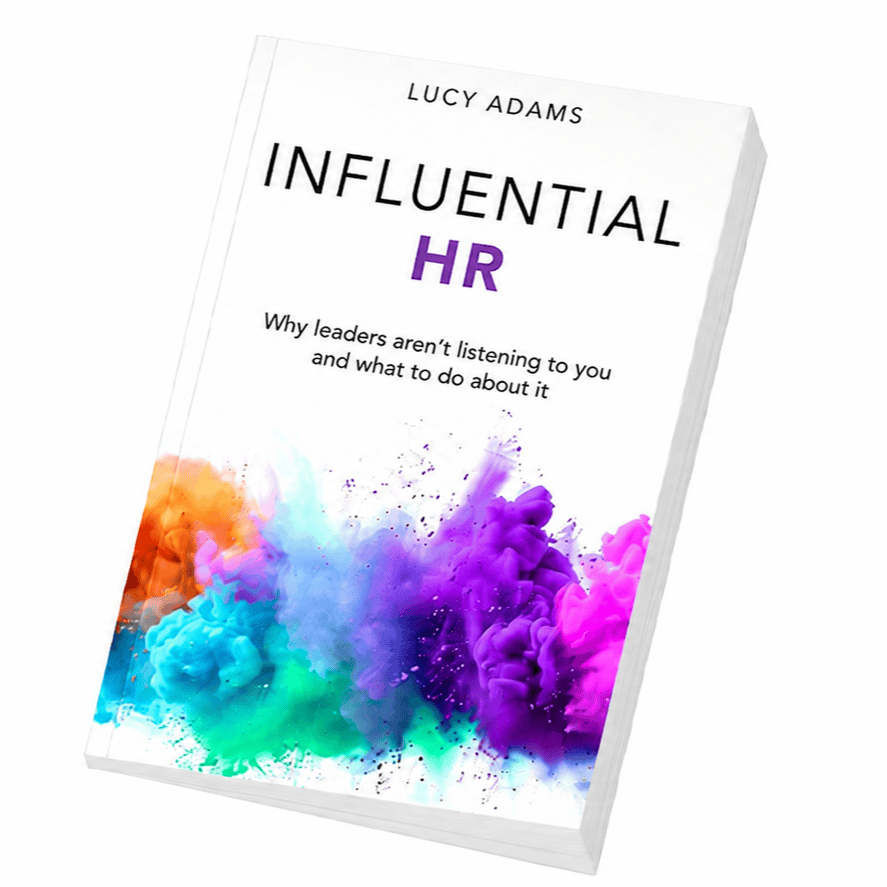
The third book in Lucy Adams’ series for forward-thinking HR professionals explores why HR struggles to influence leaders — and how to build the confidence, credibility and authority to create real change.


