

Hear from Victoria Tomlinson, CEO and founder of NextUp, to explore the concept of “unretirement” and the evolving landscape of age diversity in the workforce. In this episode we challenge the outdated perceptions of older workers, particularly in light of a recent controversial post from a global recruitment company which labelled workers over 55 as being ‘in decline’! Together, we confront these stereotypes and discuss the importance of shifting societal and corporate attitudes towards ageing. Victoria shares her inspiring journey and the role lifelong learning and reinvention have played in her career, offering a compelling case for continuous growth and contribution beyond traditional retirement.
We explore the option of embracing intergenerational workforce diversity, rather than seeing it as a problem and rethinking age diversity in employment. The discussion highlights the responsibilities of both employers and older workers in fostering inclusive workplaces that leverage the skills and experiences of all ages. Together, we advocate for a holistic approach to employee well-being that extends beyond traditional retirement, ensuring continuous learning and purpose for all.
(00:03) – Navigating Unretirement and Career Transitions
(12:11) – Professional Transition Workshops for Women
(15:33) – Embracing Intergenerational Workforce Diversity
(24:20) – Rethinking Age Diversity in Employment
Next-Up https://www.next-up.com/
Website: www.disruptivehr.com
00:03 – Lucy Adams (Host)
Welcome to HR Disrupted with me, lucy Adams. Each episode will explore innovative approaches for leaders and HR professionals and challenge the status quo with inspiring but practical people strategies. So if you’re looking for fresh ideas, tips and our take on the latest HR trends, subscribe wherever you get your podcasts. Hi and welcome to HR Disrupted with me, lucy Adams.
00:34
Now, some of you may have seen, or you might even have commented on it, but there was a recent LinkedIn post by one of the world’s largest recruitment companies called Indeed, and they’d kind of done this post, this infographic, where they’d grouped people by age bands and then given them a kind of career label depending on their age band, and the over 55s were described as being in decline. Now I should say they’ve now taken it down, but it got a huge amount of very negative reactions and I think it’s just. It’s the kind of the outpouring of reaction suggests. It’s an issue that’s pertinent for people. It’s all about people in the later stages of their life and career. Is it a problem for them finding a role, and are companies being unfair in their perceptions of older workers? I don’t even know what to call them, so we’ll perhaps get into that as well.
01:44
But with me today to discuss all of this is someone who spends her time helping people use their skills in new ways to find work or do different things, kind of before and after they leave full-time work. She won’t let me call it retirement. I was going to say retirement, but she won’t let me call it retirement. I was going to say retirement, but she won’t let me call it that. We’ll get into the language, I think. So a big welcome to Victoria Tomlinson, ceo and founder of Next-Up.
02:17 – Victoria Tomlinson (Guest)
Thank you, lucy, and thank you for explaining. We don’t want to use that R. People call it the R word. You know they hate it so much.
02:25 – Lucy Adams (Host)
We’ll get into that. I just was reflecting this morning that you and I first met when, I think, I just turned 30. I think you were just either coming up to 40 or just turned 40, and little did we think that this many years later, you and I would be doing a podcast about older workers, more experienced workers whatever the expression you want us to use um, and we’d be talking about us. We’d be talking, we are those people and we are the older workers, so it’s absolutely lovely to see you again and have you have you on the show. So I’d love to start, though, with a little bit about your journey and how you got to a place where your, your purpose now is focusing on supporting people in this phase. What do you call it? What do you? What do you? How do you describe it? Because I’m just going to tie myself in knots here.
03:21 – Victoria Tomlinson (Guest)
I call it the best time of my life, but that’s helpful. Actually, I don’t know. I still haven’t got the language. We have brainstorms regularly, and I think I’m going to come up with some great uh. In Canada they’re well, there’s there’s difficulty with phrases for everything. What do you call this generation? So? In Canada they’re calling them zoomers, which is a mixture of gen z and boomers. I quite like. It’s not really perfect though, and there’s all sorts of stuff going on out there and I, frankly, none of it’s very good. So you kind of you think I’m going to use that. I call it unretirement. For that stage of life, it’s better than anything else for the time being, because people need to know what you’re talking about. It’s all right coming up with some amazing phrase, but well, what do you know if you’re talking about? So unretirement sort of explains. You know that you you’re of an age, but you’re not really. You’re still doing things right now.
04:15 – Lucy Adams (Host)
We’ve sorted that out, not? Yes, tell me a bit about your journey, because I mean this wasn’t your thing, was it when you started out? You, you’re not, you weren’t interested in kind of coaching and training and development and those kind of apart from as a boss.
04:30 – Victoria Tomlinson (Guest)
But yeah, tell me, tell me about your, your journey well, I start my introductions these days by just saying I’m 69 because everyone’s in world issues, so we’ll just get that out of the way. First of all and I can’t believe it’s I’m going to be 70 next year. That sounds really weird. It doesn’t feel like me at all. But anyway, I’m all about age and relishing it, so I’ve got to get used to that.
04:51
So I’ve had a long career and in many ways, lucy, you and I are examples of what’s happening these days, because we’re not either of us doing anything like we were when we first met. We’ve had all sorts of evolutions since then and I think people forget that you’re going to have some more later on in life. That doesn’t. Life doesn’t stop as you finish full time work. You notice that avoidance of that word, yeah, so I think that’s part of the whole issue these days. In fact, what we were doing, it was the first campaign on lifelong learning, do you remember? That’s right. Yeah, we were talking about the need to keep learning and all the rest of it, and actually that it’s really coming to life now, that you have got to keep reinventing, learning and staying on top of things, and that’s part of the issue where I think too many corporates have low expectations and the world has very low expectations of, I can say, older people you can say older, can we just say older people for now?
05:49 – Lucy Adams (Host)
but um, before we get into those issues, because I do want to explore what those are, you were talking about your kind of your journey, iterations of your career so I it’s been long.
06:01 – Victoria Tomlinson (Guest)
You don’t want the whole decent because.
06:03 – Lucy Adams (Host)
I don’t want your whole.
06:04 – Victoria Tomlinson (Guest)
CV, but I I used to be in in manufacturing. I was. I was very much a pioneer. I was the first graduate trainee female graduate trainee at Plessy Aerospace and then I used to sell banknotes around the world. I went to what’s Now EY as part of their startup marketing. I was quickly promoted and I was on the London leadership team at the age of 32. Then true love came along and I moved to Yorkshire and I had a PR consultancy and I had 30 years doing that. Of course, that kept evolving. I went to Dubai and then I started very early into social media and using it very strategically.
06:41
When people thought I used to I’ve always been on boards and chaired and all sorts of things alongside so people thought I was very odd, that I was sort of quite senior inverted commas but also I was using social media heaven forbid but that I became known as sort of a bit of a LinkedIn guru and gradually I started being sent people who had left full-time work you will notice that I’m avoiding that retired because they didn’t see themselves as retired. Yeah, and they had. They were mostly men, but not exclusively and they said I’ve had a blessed career. Things have come to me all my life I’ve never gone looking for anything and I just thought the same would happen in let’s go retirement. And they weren’t.
07:25
If you push them to say, what did you think? They didn’t really. They haven’t articulated even that much. They just thought they probably would have said non-exec director roles, but it wasn’t even that formed. And then they were left lost and started looking for things, started applying for things and didn’t even get shortlisted, let alone a role of any kind. And I started meeting people who were in a seriously bad place, lucy I mean really really bad place, and they would say to me they came to me to help them with their LinkedIn profile because they’d hated and ignored it. And of course there’s no point doing the LinkedIn profile for who you were. I’m trying to say well, what you’re trying to be, what, what, what does this got to say about you and then realizing they were completely lost, they had no idea, they didn’t know how to brand themselves, to position themselves, and I think that’s really interesting.
08:13 – Lucy Adams (Host)
So they there was a sense that, uh, there would be a tap on the shoulder, um, there would be something that would happen and they would glide from full-time corporate world, yes, through to something which might be, as you say, it might be a plural career, a mix of non-execs, or it might be some consultancy or it. And then it was just this drop, this sheer drop. The phone didn’t ring, correct. They no longer had access to the it at work, correct? They no longer were perhaps that interesting to the people that were used to be in their network. And I and I recognize this with people that I know who have gone from very busy, you know, really kind of amazing, full, rich lives and then feeling. I always remember one of them saying to me I don’t know how to introduce myself, yes, that’s absolutely, you know. It’s like what, what am I? What do I do? I don’t know how to describe it yes, well, you’re spot on with that.
09:16 – Victoria Tomlinson (Guest)
And I gradually realized my god excuse the phrase, am I allowed to say it’s a bit of a shit show. Basically yeah and uh. I thought there’s got to be something, because the ridiculous thing is literally on a friday they were a god, they were being courted by the media, the world’s leaders, they were, they could get, I mean, I think, one person. He said you know, his job was so economically and strategically important to the government he could get a call with you know he could set up a meeting with downing street. Or he went to india. He could get a call with you know, he could set up a meeting with Downing Street. Or he went to India, he could get a meeting with a high commission. And he said, I know that they weren’t my friends, but in his mind they would still take his calls and of course they didn’t and he moves on very quickly, doesn’t it very?
09:56
quickly. So the ridiculous thing is they still got their skills. They weren’t different people from Friday to Monday and I just felt this is ridiculous because they have got so much to offer society and I’ve been getting them since I’ve been piloting all sorts of things. How do we use these skills? It’s all right, by talking about they’ve got value, but what, how? So in particular, I’ve been getting them to mentor tech entrepreneurs and I can’t tell you the buzz when we do that.
10:23
We’ve done it in sort of rooms and all sorts of different ways, and the first time we did it, the youngsters I’m going to call them youngsters, they’re not all very young, but you know they would say I didn’t think the older generation would be interested in what I’ve got to say. And the older ones said I didn’t think the younger ones would be interested in what I’ve got to say. And it couldn’t have been further from the truth. And you know, when I’ve gone around the room listening to some of the conversations the older generations going, can you just talk me through again? I don’t understand your business. What do you do? And they’re in a tech bubble and of course, they need to explain to investors and the older generation. So this has got huge value and they’ve been there and often that I’ve heard the entrepreneur say it’s so nice to talk to somebody who’s not my investor, an employee, a customer or whatever. I don’t have to have my face on that was what one said. I can just be me and say it like it is, and it’s very rare I can go anywhere where somebody doesn’t have an agenda.
11:18
So I think this older generation and it’s not just I started out working with very senior people. Of course, but this isn’t about senior, junior, whatever. I would say that you know somebody who’s been a dinner lady in a primary school. She’s got skills with young people. She can walk into a room of little ease and go. She’ll know who’s a bully, she’ll know who’s being left out, she’ll know how to get them to eat vegetables. She’s just got all sorts of skills that are valuable. So I thought these people were paying us quite a lot of money to help them individually, because they were sent to go and sort yourself out with Tom Linton and then, when I went out to a mass market, oh my God, it was very interesting, because women pay, men don’t. That was quite a lesson. So I thought that’s a bit of a rubbish business model, but alongside that, we’ve been doing all sorts of.
12:04 – Lucy Adams (Host)
Why was that that women were more inclined to pay for that support than men?
12:11 – Victoria Tomlinson (Guest)
I think it’s lots of things. I think women who have because, bearing in mind they were sort of fairly senior, the ones I was working with initially, the ones who are successfully used to getting help, and I suddenly thought, oh, I’ve helped them myself. You know, can I have presentation over the years with my PR company? People would say, can I help with some branding, with presentation, with whatever? I don’t want anybody to know, can you just help me behind the scenes on this? And I think they’re used to doing that and just getting, and they’re not, they’re not having one pride. You know, I just need to get that wherever, whatever, how much, let’s get on with it. So, um, and and in some ways that’s why they’re more successful the men think the women are taking all the roles, but actually it’s more complicated than that. It’s a lot more complicated.
12:46
So, um, where we are now is we are running workshops. I won’t give you the whole painful journey. We had covid. I wasn’t very well for nearly a year. It’s quite a hard battle this, um.
12:57
But where we are now, we’re running workshops for professional firms to help partners pre-retirement and to think about what they’re going to do next. Give them skills, give them loads of ideas and inspiration we’re getting. A hundred percent of partners would recommend us, which is phenomenal. They’re very cynical and skeptical, as you’ll know, lucy. Yeah, um, so that’s amazing, and we’re now talking about all sorts of things collaborations, really expanding that. We have got a platform that we’ve developed because I don’t want to be. This is not an elite subject, it just happens to be. Who will pay for it? So I’ve been determined to be a business, not a charity, and that’s been quite a challenge really. So that’s, we’re still working on the platform. I got a major bank to pilot it with 300 employees, and they loved it, and we’re just developing. How do we get this to the next stage? I loved becoming a tech entrepreneur in my late 60s. Good for you.
13:49 – Lucy Adams (Host)
Good for you. We’ll make sure, obviously, that your contact details are in the are in the podcast post so people can get in touch with you if they’re interested in talking about this. I’d really like to kind of dive into some of the issues and I’m trying to think the best way to do it. Maybe let’s focus first of all on the individuals themselves and what it is that they could and perhaps should be doing, um to ensure that they don’t find themselves, as you described, lost, not knowing um what, what they can do, not knowing where to go for help, not understanding what might be there for them. And because I think you know I’ve been reflecting on this, you know this kind of idea of the retirement and it’s such an old fashioned notion it is, I mean, when we were worked in, you know, when we worked in or worked in factories or on the land or whatever, of course we were burnt out physically so of course there had to come a point where we couldn’t do it anymore.
14:54
And of course there are some people who are still in very physically demanding jobs and I get that, um, but that’s not necessarily in a knowledge economy, that’s not necessarily the case for everybody. So there’s not this kind of physical piece. Then there’s also you. You know, you and I both fans of Linda Grattan and the hundred year life and and the work that she’s done in that area, which is fantastic, which is saying, actually you know we’re going to be living longer. Is, you know, do I get to 60, 65, and then I sit watching daytime TV for the next 30 years? And then I sit watching daytime TV for the next 30 years.
15:31 – Victoria Tomlinson (Guest)
I mean no, and it’s extremely unhealthy, lucy. I mean I’m trying to work out why employers should care about this, because there’s something here about you’re trying to help people to leave successfully, if you like, and there’s an issue here. I would love to have the whole concept of retirement gone. Frankly, I think there’s a pool of talent here that should become. Not everybody’s going to want this and I’m not trying to get everybody to keep working, but you need to keep people active and learning. We’ll come back to your question I won’t forget that about what you need to do. You need to keep active and learning because unless you have a sense of purpose and a reason to get up that’s what a lot of people said I haven’t got a reason to get up in the morning and without that you age by 10 years. You’re two and a half times more likely to get Alzheimer’s. So there’s a massive societal issue and for you individually that you need to have, and it’s really hard to define all of this. I think we, when I’m talking, I think people know what I’m saying, but if you ask me to be really specific, what does that mean? It’s quite difficult, but employers now talk about. They want to have a whole of life, a holistic approach to the employee, that they want to look after people, and I think that should include coming up to and after this flipping retirement bit. So I think this can be one of the worst times of mental health, not just once you’ve left, but actually I’m now discovering, before you know, kind of maybe up to five years before people leave a lot of people are extremely anxious and they don’t talk about it at all. It’s interesting we have a forum for professional services people, retirement I’ve got that in the word. It’s interesting we have a forum for professional services, people in retirement I’ve got that in the word.
17:16
I’m one of the HR directors, a global HR director. I got two people to talk about their experience, two partners. She said I can’t thank you enough. She said I had absolutely no idea that this was such a difficult time. And I think she thought you know partners are well rewarded. You know you and people sort of associate having money with being okay mentally and about life. It doesn’t go together. And she said I had no concept. I thought you were well looked after, that you were looking forward to lying on a beach, relaxing, traveling, whatever, and that was enough, and she just never even got her head around it. Why should you? Because nobody talks about this. Why would anybody know? You’ve got plenty of other priorities and now you’re trying to keep the business sustainable, climate change, employees motivated. This is not a major area for hr people to start thinking about yeah I should have been, and I think I mean I worked with one.
18:07
They referred to the 50 plus generation as permafrost. I could barely finish the call. It wasn’t even said. I can’t bear to say who it is, because I’ve got a lot of respect for what they’re doing. They didn’t even say to me keep it confidential or anything like that. I could barely. These are people. How can you talk about your employees as permafrost? And whose responsibility is that? Why are they permafrost? Because responsibility is that. Why are they permafrost? Because they’ve not been invested in, they haven’t been trained. Nobody’s expecting you to have any ambition. 91 percent of older people are ambitious to to keep going and they want promotion, training, development, just like we all do at every age.
18:44 – Lucy Adams (Host)
Nothing, just to uh play devil’s advocate a bit on this, and I and I absolutely agree with you that calling a group of employees permafrost is insulting and completely disrespectful.
18:54
These have been loyal, hard-working, capable people who have given so much. However, as a prior, previous HR director in another incarnation, there is something about having worked with some leaders, typically more senior people, who have become less curious, who have become less open to change, who aren’t open to the idea of anything that involves reducing money or reducing status, and underneath them you’ve got people who are coming through, who want their chance, who want to progress, yes, and who are now getting frustrated because they feel that, uh, these blockers um, both to their career, but also to their ideas and the way that they can see that the business needs to change. Now, in any conversation like this, we’re going to be stereotyping, and I’m not saying that’s the case for everybody at all. Of course, there were large numbers of people that I worked with at a senior level who remained curious, remained open to change, and so on, but I do think there’s I know you talk about, you know HR helping, employers helping, but there’s also something which is about personal responsibility. Isn’t there staying employable?
20:14 – Victoria Tomlinson (Guest)
well, there’s a whole bunch of stuff in here and I haven’t answered your question. I’m just realizing I will come back probably, but I think some of this is we’ve had quite a lot of complacency in this country, more than many, I think, particularly, but I think it’s a global issue where people have had such status as senior people. There was a period of rapid change, kind of maybe 20 years ago, as digital came in actually a lot of it when I think people, the senior people were really bad at owning what was happening.
20:50
They thought it was naff and they social media, so they saw it as facebook and that kind of that was part of it, but it was also being techie was not kind of they didn’t need to be. So you had tech teams and, let’s be honest, tech teams tend not to be natural collaborators within the business. They don’t kind of say do you realise what we’re doing is going to cut out a thousand jobs next year, and they kind of completely fail to see that within the business you know there’s a lot of silo working going on.
21:21 – Lucy Adams (Host)
Yeah, I think that’s a huge generalisation. Yes, but I get what you’re meaning in terms of some of the communication.
21:27 – Victoria Tomlinson (Guest)
Yeah, and you’re going to tech tech. I’m doing a lot about getting more diversity into the tech job, so, but that that’s another issue. So I think we have had a period when the senior people didn’t understand what was happening in the world enough and if they did, they didn’t know what to do or adapt people. So come back to your question about what do people need to do. I don don’t think organisations, corporates have been very good at training and investing in people to cope with some of those changes. I think it’s catching up now, partly because of the skills shortage, but that’s allowed people to continue in their jobs and not develop themselves. And this whole thing. I really I call people people out when they say I don’t do tech. Of course you can do tech. We saw it in COVID. We had 90-year-olds going online when they had to.
22:18 – Lucy Adams (Host)
Absolutely. My mum and I did Zoom calls every night, you know yeah.
22:22 – Victoria Tomlinson (Guest)
Exactly so. They’re perfectly capable, whatever that means. I don’t do tech or whatever, so we need to change a mindset there and we need to start using the skills of experienced people better. The most successful organisations are intergenerational. This is not about we need more old people, whatever that means. It’s not about we, you know, we want young people or not. It’s about we need everybody. There are skill shortages, so actually this is opportunity, because there’s room for everybody and there will continue to be, and I think your point about multigenerational.
22:57 – Lucy Adams (Host)
You know, whenever I’m talking to HR directors or leaders and, let’s say, I’m doing a keynote speech or running a workshop or something that you know, I’d say what are the key issues for you? And when we’re kind of doing the briefing and this, the multi-generational workforce is very often flagged as a huge challenge. And actually I think I agree with you, I think it could be a fantastic strength. Of course it needs thinking about, of course it needs a bit of facilitation, but actually that kind of the.
23:28
I was talking to a client this week and they’ve got five generations in their in their organization because it’s a retail organization. So you know it lends itself to that very well. So you’ve got five generations and actually this is a huge strength for them. This is such an asset and I think you’re right, it’s about what are the opportunities to not see it as, oh, this is a problem and they’ve just got to kind of understand each other a bit better. Where can they actually work together to really, as you say, you know, perhaps some of the younger ones help them with judgment and bring that experience and, in terms of some of the younger generation, the skills and capabilities that they’ve got, and so I think those reverse mentoring programs, that alignment and bringing people together is great.
24:19 – Victoria Tomlinson (Guest)
Well, I love it. I’m based in the north of England and Leeds is our nearest sort of big centre. We have a fantastic tech ecosystem to use the jargon there, and I was hugely flattered partly because of what we were doing with the tech entrepreneurs that I was invited into it and I was asked to be the first chair for women in Leeds Digital. We’ve become World Digital since and this is all about diversity but I’ve become involved with that whole tech scene, if you like. I’ve become involved with that whole tech scene, if you like, and they are kind enough to say that.
24:51
I know I irritate them, by the way, as well, by asking some sort of common sense questions when they’re all enthusiastic, out the window or whatever. But I used to do supper for a couple of the tech entrepreneurs. I mean, I think they’re young. They say we’re not young, we’re in our 40s, but anyway, I used to do supper and they would come around and say, right, this is what you need to do because of developing a platform, I had no idea where to start. I just couldn’t even envision what was this. I said, right, what do you need to do? We’ll introduce you to our developer and you don’t need to go all spending all this money and it’s been amazing what we’ve done on a shoestring actually, and they got us going.
25:29
But I’ve been mentoring them, they’ve had quite challenging with their investors and others and you know, able to bring sort of some kind of actually some strategies here and you don’t have to accept what people are saying to you. So we’ve got kind of that two generational thing going what people are saying to you. So we’ve got kind of that two-generational thing going. It is amazing bringing I love real diversity and it’s hard sometimes, you know you do get challenged, you think, oh god, but you know real diversity brings about innovation and real energy and I feel younger now than I have ever done. Honestly I and a part of that is all these kids, if you like, who keep me kind of involved. I love it.
26:09 – Lucy Adams (Host)
So there’s something about the individual taking accountability and responsibility for staying curious, keep learning, but with perhaps a particular emphasis on digital AI et cetera, because perhaps that’s something that they haven’t thought about as often. Let’s look at employers now, and there was a report recently I think it was a UK only report, but pointing to the fact that there is very evidently either an unconscious bias or a conscious bias around taking on somebody as a full time employee who is in the later stages of their career and all sorts of perceptions in there around the fact that they will be. They might want it’ll be too junior for them, they might want, it’ll be too junior for them, they’ll want too much money, they will be difficult to kind of get on board because they won’t be adaptable. So all of these kind of preconceptions that we have about older workers and how, as an employer, if somebody is sitting there listening who is an employer and they’re thinking, yeah, we might have a bit of an issue there, what is it that they could be doing?
27:31 – Victoria Tomlinson (Guest)
I think. I think the first thing is live and breathe the diversity that you preach, actually, because everybody talks about wanting real diversity and they have in their minds gender, lgbtq, etc. They don’t really think about age, which is the biggest one and actually it’s the one we talk about it being a protected characteristic. Sorry, I do not get that. We all hope that we’re going to be a protected characteristic one day, don’t we? This is not minority stuff going on, it’s half the population. I mean legal in general said that we will be. Half the population will be aged over 50 by 2030, which is not very far away.
28:12
Well, actually, I’m not sure we’re going to hit that because people aren’t employing them, so that’s a whole different issue. But we’ve got a large older workforce, so what do they need to do? So, of all, open your minds, actually start recruiting. Why not discuss pay? I do think that is an issue, so I’m going to accept. I think people have overblown ideas about what they’re worth and that that’s just about being a skilled recruiter. To be honest, you know, if they’re worth the money as a recruiter, they should be able to talk through and, to be honest, there’s a million people aged over 50 who want to work and can’t get jobs. That’s appalling when we have skill shortages. So there is something to be done here and I accept that sort of.
28:54 – Lucy Adams (Host)
Some people have got overblown ideas about their worth with what we can do, yeah, and I think what we’re saying here is that there are responsibilities on both the employer side, but also the older workers side, and and that they’re going to find it much harder if they, the more rigid they are around status, title, salary package, yes, um and uh. If they’re, if they’re clinging to that, then it’s going to be much tougher. However, let’s assume that they have actually been more accommodating.
29:25 – Victoria Tomlinson (Guest)
I also think, though, that there’s a lot of conscious and unconscious bias. I was asked to give a talk on the future of work with Lewis Silken, and they’ve got a big employment practice, and it was a roundtable 30 people, hr directors, senior people and one person around the table said quite, quite happily and I’m going to be slightly biased here because he looked about 35 to me and he said I don’t look at any CV where somebody’s worked in one organization for 20 or 30 years, and I mean that that’s that’s writing people off. They may have completely transformed an organization they may have, they may be the leader in cyber or something or other, and you’re just saying, because they’ve worked in one organization for 20 or 30, I’m not going to look at your CV. I’m sorry. What is that, if not age discrimination? And I think there’s masses of that. That seems to be quite a thing. Nobody is challenging any of us, um, and I think that we’ve got a lot of work to do around. This is only going to get worse, it’s not. It’s not going to change. We’re not going to get younger employees suddenly, and we’re not going to skill shortages not going away. So I think employers have got to look at their recruitment practices.
30:34
There are also things like I think the sort of one country, but ai now is huge. It has been for some time. Uh, recruiting, uh processes, things, cbs go through ai. Yeah, now again you’ve got quite narrow tech people often designing that ai and things like. So I was thinking the other day things like job titles change. As a simple example, when I was younger it used to be a secretary and then you used to be a pa and now you’re an EA executive assistant. Well, if you’re looking for people with EA experience, that’s I’m giving of one that we can all relate to. But the job titles may be very different. You know you’ll have people who are very techie but they didn’t have digital in their title or something like that. So those sorts of things over 30 years may be penalising you.
31:26
You’ve got that bit about. We think that you’re old fashioned if you’ve worked in a long time in whatever things like. A lot of ai is now it can program to spot good universities and good courses, even good courses in the bad university, in better commas, so, but actually things change over time. So so how’s that programming If you got a degree 20 or 30 years ago? I mean I got, I didn’t have. I don’t have a degree, it’s one of my chips on my shoulder but I’ve got an H&D from Southampton College of Technology, which is now Solent University. So you know, all sorts of things in there would be penalising if you were looking for particular criteria. Are people looking backwards over how things have changed? I’m giving that as a very specific, but there’ll be all sorts of subtle no.
32:10 – Lucy Adams (Host)
But I think the point that you make is a broader principle about you know, as an HR function. You’re wanting the tech that you’re using that makes life a lot easier and the recruitment experience better for the vast majority of people. But you’re wanting to make sure that those discriminatory elements are not hardwired in, that they’re not kind of built into the thing. And the job title piece, I think, is an interesting one because you’re right, you know there is a risk, isn’t there, that they are portraying them as something that it doesn’t recognise, that it doesn’t value.
32:45 – Victoria Tomlinson (Guest)
Yeah.
32:45 – Lucy Adams (Host)
So I think there’s something about employers at least just kind of just rethinking about age and where it appears in their approach to diversity. I think there’s something about having an open, transparent conversation with potential older hires. At least ask the question, because there’s a risk, isn’t there, that we assume that they won’t be amenable to x, y and z and so we don’t even shortlist them, we don’t even interview them. At least have the conversation. And then there’s also, I think, a piece around um, this multi-generational workforce. Actually let’s stop seeing it as a major problem and see it as as just this rich tapestry which can be hugely beneficial to our organization and the individuals themselves. And then that piece around the ai I yes, yeah, sorry go on, I get it.
33:38 – Victoria Tomlinson (Guest)
The one thing I would love just to really campaign for. Recently I’ve been thinking I don’t think we’re going to change things unless we get. I don’t like to bring in bureaucracy, but just as we had gender pay reporting, I think it is shifting. It looks embarrassing whether you do anything further with the law. I would now like to see that employers have got to report on their age by decades in terms of recruitment, retention and redundancy, and have it up to you. I said initially up to the age of 80, and I’m I’m limiting myself and discriminating. It should be up to 110, which is how long we now are living, so we ought to have from teens to 110. How many people are you employing? And it will look awkward. I think that is going to shift things more than anything, because this generation, the older, experienced, aged, whatever we call have got so much to offer, and that’s what I want to see.
34:30 – Lucy Adams (Host)
So I think all the HR people who listen to this will be, will have been with you right up until you said that they then got to do more work on the reporting side, and I hear what you’re saying. It’s about that kind of holding the mirror up. I think that’s it and, you know, letting in a bit of light here and just at least have the conversation, at least have the conversation internally. Victoria, it’s been so lovely talking to you. We’ll put the details of people. If anybody wants to get in contact with you will be in the podcast post in the show notes, but for now, thank you so much.
35:05 – Victoria Tomlinson (Guest)
I’ve loved it. Thank you so much and I’m loving what you’re doing.
35:07 – Lucy Adams (Host)
Lucy, you are inspirational, oh bless you, oh bless you, all right, bye-bye now Bye-bye.

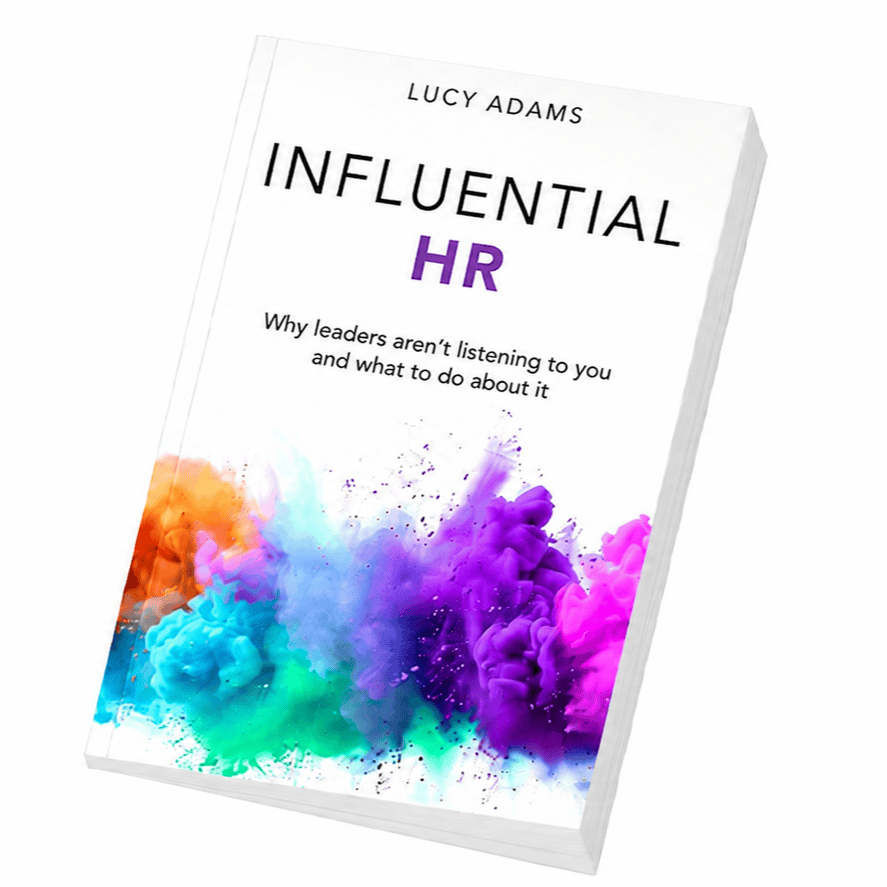
The third book in Lucy Adams’ series for forward-thinking HR professionals explores why HR struggles to influence leaders — and how to build the confidence, credibility and authority to create real change.


