

The great work quiz
A practical check on whether your organisation creates the right conditions for great work
Thanks for taking the quiz.
Your results offer a snapshot of how work is actually experienced in your organisation.
Great work depends on people being trusted to use judgement and take responsibility, on work being shaped around what different people and teams need to perform at their best, and on leadership and HR being designed around how humans really think and decide, not around annual cycles and frameworks.
When those conditions are in place, performance improves, friction reduces and organisations adapt faster.
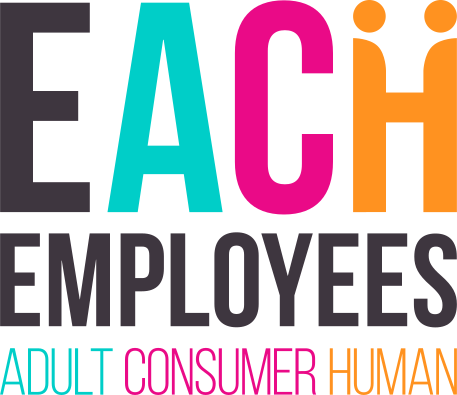
At Disruptive HR, we use our EACH framework to look at work through this lens. It stands for treating employees as Adults, Consumers and Human beings.
The sections below explore what your results may be pointing to in each area, and suggest a small number of practical shifts you could make next.
Trust, judgement and ownership
If a parental approach to people feels familiar, it is not unusual. Many workplaces have treated employees like children for decades, and HR often reflects that.
Sometimes this shows up as care. We spell out how to behave, what good looks like and how things should be done. We create guidance for every scenario and step in early so no one gets it wrong. It’s meant to be helpful, but it reduces the need for people to think and decide for themselves.
At other times it shows up as control. Policies are written to cover every possible scenario. Rules are introduced for everyone when one person makes a mistake. Decisions are escalated and approvals added, not because they improve the work, but because they make us feel safer.
The cost is higher than we admit. Innovation, risk-taking and challenge begin to disappear, even though these are exactly the qualities needed in a disrupted world. The rare rogue is never fully prevented, but everyone else ends up paying the price. Managers and employees do not develop judgement because they are rarely asked to use it. And trust never fully develops, even though research consistently links it to stronger engagement and productivity.
Over time, HR can end up policing rules rather than strengthening performance.
Treating employees as adults does not mean lowering standards. It means being clear about what good looks like and trusting capable people to use their judgement. That shift can feel uncomfortable, but it builds accountability, confidence and stronger performance over time.
Three things you could try
Start from the assumption that most people want to do a good job, and check whether your policies reflect that. If they are written for the worst case, ask what would change if you designed them for the responsible majority.
Choose one policy that has grown heavier over time and simplify it. Strip it back to a short set of expectations that are clear about what good looks like, and remove the detail that exists mainly to control edge cases.
Look at one approval step that slows work down and ask whether it genuinely improves decisions or simply spreads accountability. If it is there for reassurance rather than quality, test removing it and see what actually happens.
Insight, choice and relevance
If your organisation tends to take a one-size-fits-all approach to HR, it is not surprising. For years, HR has been rewarded for consistency and scale, and the simplest way to achieve that has been through standardisation. One policy. One process. One standard way of doing things. It feels efficient and under control.
The problem is that one-size-fits-all rarely works in real life. People do not experience work in the same way because people are not the same. They have different roles, different pressures and different lives outside work, so they need different things to do great work.
When everything is designed to be identical, impact starts to fade. HR initiatives struggle to cut through. Leaders disengage because the solution does not quite fit their context. Time and money are invested, but behaviour does not shift. What was intended to be fair and scalable can end up feeling distant or generic.
There is another way. Instead of assuming that rolling out a policy improves work, HR can get closer to how people actually experience it. It can notice where things feel harder than they should, test small changes and adjust based on what genuinely helps performance.
This also means building sensible choice into how people engage. Choice does not mean creating complexity. It means recognising that different people may need different approaches to perform at their best.
When HR works in this way, its practices feel more relevant and more useful. Leaders are more likely to use them, and people are more likely to engage with them because they actually help them do their jobs better.

Three things you could try
Replace one annual survey question with a short pulse or team conversation about what is making work easier or harder right now, and share what you learn quickly.
Identify one HR process that treats every team the same and ask where flexibility would improve impact. Give leaders discretion in how they apply it.Â
Offer the same initiative in two formats, such as a short video and a concise written version. Different people process information in different ways, and good design reflects that.
Leadership and HR that reflect real people
Many HR approaches are not designed around how humans actually think, decide and perform at work. They are built around annual cycles, templates and systems instead, as if behaviour follows a neat process map.
Work is personal. It is emotional. People bring how they feel about their role, their manager and the organisation into every conversation and decision. When systems ignore that, they can look thorough but fail to influence what people do day to day.
When calendars and templates start driving behaviour, leadership can drift away from the reality of work. Conversations happen because the process requires them, not because they are timely or needed. Recognition is tied to formal moments rather than everyday effort. Difficult issues can sit untouched until the next scheduled review. Over time, leaders begin to rely on the system instead of stepping into the conversations that build trust, confidence and better performance.
Performance, development and engagement are built in daily interactions. They grow through clear expectations, honest feedback and recognition in the moment. People learn and improve through small, practical experiences linked to real work, not through occasional formal events. When leadership is reduced to a cycle, motivation dips and accountability weakens.
A more human approach keeps leadership close to the work. It expects leaders to use judgement, act early and have real conversations. It focuses HR on giving leaders simple tools and practical insight so they feel confident responding in the moment, rather than building another layer of process.
The result is leadership that feels more natural and more effective, and work that feels clearer because people are led as human beings, not managed through a timetable.
Three things you could try
Pause one scheduled people conversation and ask whether it needs to happen because the calendar says so, or because something genuinely needs attention.Â
Replace one piece of process training with a practical session where leaders work through real scenarios they are facing. Focus on judgement, timing and language, not on how to complete the paperwork.
Remove one template or script that over-structures a human conversation. Replace it with a small set of prompts that encourage clarity, honesty and listening, and trust leaders to use their judgement.
Want help putting this into practice?
If you want support from us, here’s a few good places to start:Â
- CPO Programme. For senior HR leaders shaping the direction of HR and the wider people strategy.
- Disruptive HR Club. Live and on-demand training, and practical tools you can use straight away.
- HRBP Programme. For HR business partners who want to step up their influence and focus on what drives performance.
- Disruptive Leaders. On-demand training for managers who want modern leadership thinking they can apply immediately.