

The social and political landscape is getting more complicated and divided—things like Trump, Gaza, climate change, and so-called wokeism are just a few examples. And all that tension is spilling into the workplace. With misinformation spreading fast, people stuck in their own online bubbles, and fading trust in traditional institutions, employees are showing up with all kinds of different—and often conflicting—opinions.
For employers and HR teams, this growing divide makes it harder to keep things running smoothly and respectfully. It’s tougher to encourage open, honest conversations, and disagreements can escalate quickly, leading to conflict, disengagement, or even people leaving. If it’s not handled well, it can seriously mess with team dynamics, hurt productivity, and damage the overall culture.
Joining Lucy on this week’s episode to discuss these issues and to offer her insights is Edel Holliday-Quinn – the Chief Leadership Psychologist and founder of the Centre for Leadership Psychology. Edel shares her tips for encouraging ‘courageous conversations’ that welcome diverse perspectives and balancing empathy with action.
Chapters
(00:03) Navigating Workplace Polarization and Authenticity
(14:24) Building Psychological Safety for Diversity
(20:57) Navigating DEI Challenges in Organizations
Contact Edel https://www.linkedin.com/in/edel-quinn/
00:03 – Lucy Adams (Host)
Welcome to HR Disrupted with me, lucy Adams. Each episode will explore innovative approaches for leaders and HR professionals and challenge the status quo with inspiring but practical people strategies. So if you’re looking for fresh ideas, tips and our take on the latest HR trends, subscribe wherever you get your podcasts. So I’ve been really looking forward to this episode. It’s a really meaty topic.
00:37
You know we’ve got kind of the social and the political climate is getting more complicated, more divided, whether it’s Trump or Gaza, climate change, so-called wokeism you know just a few examples. But it’s spilling over into the workplace and you know, with misinformation spreading fast, online echo chambers reinforcing people’s beliefs and trust in traditional institutions fading, employees are tending to come to work with very different and often conflicting viewpoints. And for employers and HR teams, you know this growing polarisation makes it much harder to maintain a cohesive, respectful environment. You know it’s tougher to encourage open communication. Tensions can quickly escalate and that can lead to conflict, disengagement or even people leaving the organization. You know, if it’s not managed well, this can impact team dynamics, productivity and the overall culture.
01:49
So with me to discuss these very meaty issues and to offer her insights is Adele Holiday Quinn, who is the chief leadership psychologist and founder of the Centre for Leadership Psychology. Welcome, adele, thank you for having me. Oh, it’s my pleasure, but before we get into these very challenging topics, can you just explain a little bit more about what you do and how did you get to do what you do now?
02:17 – Edel Holliday-Quinn (Guest)
Sure. So I’m an occupational psychologist by trade and I’ve really spent my whole career focusing largely on leadership. So, on leadership capability, I’ve worked for PwC, I’ve worked for Citibank as an SVP there, focusing around leadership, and my work has always been on looking at what are the innovative and cutting edge ways that we need to be thinking about in how we develop our leaders so that we can continue to be successful as an organization in the future. I’m doing my doctorate in crisis leadership and what I’m really curious about is what does it mean to be a leader in the world today? What are the crises that we are going to have to continue to manage and how can we, how can we solve for these crises? What are the things that we can do within our organizations to help solve for for broader, global crises? So that’s really what I’m what I’m passionate about and and what I’ll be talking about today.
03:15 – Lucy Adams (Host)
And do you think it’s getting tougher for leaders, or has it always been tough and it’s just that we kind of recognize it more?
03:22 – Edel Holliday-Quinn (Guest)
I think it probably is tougher for leaders. I think there’s a lot of pressure not just on delivering value internally, but broadly. What is your place in the world? How are you solving for climate? How are you thinking about these things in your value chains in a way that maybe we haven’t had to do before? So, in addition to being, you know, inspirational leader, engaging your teams and delivering, there’s a lot more expected, I think, of leaders today than than ever before, and I’m always very conscious when HR is doing something around well-being and you see leaders faces that they’re this sort of panic.
04:01 – Lucy Adams (Host)
You know, my God, I’m supposed to be a psychologist, I’m supposed to understand about these elements that you know. Excuse me, I’ll record that again. I’m always really conscious that when HR is doing something around well-being, you know, and you see the kind of panic in leaders’ eyes, it’s like, oh my God, am I expected to be a psychologist, a doctor? You know, shouldn’t all these human emotions just be kept out of the workplace? And, of course, they are expected to be thinking much more holistically about human, about the human condition and the issues that their people might be facing, in a way that they definitely weren’t a few years ago.
04:41 – Edel Holliday-Quinn (Guest)
And there was a time, I think, when when the workplace felt really separate, I think, from the broader world and the big debates happening out there. I think that time is over now, so the complexity of the outside world is kind of embedded in our work in a way that hasn’t been before and leaders are really feeling that, that heaviness.
04:59 – Lucy Adams (Host)
Let’s kind of dive into the topic for today. Then you know I often thank my lucky stars that I’m not in frontline HR anymore, and one of the reasons for this is that when I was a practicing HR director, this issue of the kind of outside world, the political and social tensions, the polarization just kind of it, really wasn’t on the agenda. It wasn’t something that we particularly talked about. Gender it wasn’t something that we particularly talked about. We just weren’t really worrying about kind of resulting tensions amongst employees. Why do you think this has become more of an issue now? Because there were polarization of views, but why has it become a workplace issue?
05:45 – Edel Holliday-Quinn (Guest)
I think, as political divides and global conflict and identity movements. These were just social issues, but they’ve really become organisational issues and for me, I think, at the heart of that is polarisation. And for anyone who’s unfamiliar with that term, it’s essentially the kind of growing distance between people’s beliefs and values and their worldviews. So it’s not just that we disagree more than we have before, it’s that we’re disagreeing much more intensely and what we’re seeing is there’s a lot less tolerance for those who see the world differently to us, and that’s a really growing emotional divide and it’s showing, you know, we are more connected than we’ve ever been before with social media and because of that it’s it’s showing up in our day-to-day lives and maybe it didn’t before um, as humans.
06:35
So therefore, that kind of growing emotional divide is showing up in our meetings, it’s showing up in our team dynamics. You know, people might be more cautious or they might be more confrontational. They’re feeling this pressure to either express or maybe the pressure to stay silent. And actually I think it’s really interesting for HR because we’re kind of maybe being asked to be a peacekeeper or a coach and kind of a guardian of culture all at once coach and kind of a guardian of culture all all at once. I think the other key, key piece of this is around authenticity. So we’ve spent years talking about bringing your whole self to work, which is a really lovely sentiment, but I think in some ways we misunderstand that sentiment it’s like we don’t really want the whole self.
07:21 – Lucy Adams (Host)
The whole self is actually quite unpleasant. Can you leave bits of it at home? That’s interesting actually. We’re right, you know, what we meant was to kind of bring your experiences and your personalities, but we didn’t want you to bring all the conflict that goes with that absolutely and it.
07:37 – Edel Holliday-Quinn (Guest)
I think when we think about it, how we think about authenticity, is probably not the right way to think about it in work, because what, what it really means, is a real way and that’s relational. So when I often think about it at work, it should be about contextual authenticity. So you can be yourself, but you need to also understand and respect the dynamics around you. So you know, for HR that might mean creating conditions where people feel safe enough to be honest and vulnerable, but there needs to be boundaries there in how that authenticity shows up. So we’ve kind of we’re going to create this problem for ourselves a little bit, um, but but not in a negative way, because we know there’s a lot of positivity in there being different perspectives absolutely. But it’s how we navigate that, how we manage that and how we avoid it becoming something that’s toxic or difficult.
08:23 – Lucy Adams (Host)
So when you talk about kind of boundaries, putting in boundaries, what might that look like? Because it’s difficult, isn’t it? You know you’re kind of letting the genie out of the bottle. You’re saying it’s okay, we want you to be yourself, we want to hear from you. We value this diverse range of perspectives, but they need to be put across in this way or phrased that way. Is that the kind of thing that you mean in terms of being HR, being able to help with that, giving guidance to leaders around what those guardrails might look like? Have you kind of got any examples of those kind of boundaries or guardrails?
09:06 – Edel Holliday-Quinn (Guest)
Yeah, I mean I think we need to accept it’s inevitable. First of all, I think that’s really important because when you’re bringing people together from different backgrounds and beliefs and identities and we’re encouraging them to be themselves, we’re going to get conflict. The challenge we have is how do we respond, how do we create those boundaries? And I think our instinct is to shut things down quickly or treat something as a compliance issue if we feel like something has crossed a boundary. But we might want to think about things like restorative practice. Um, this is playing. What that means.
09:37
Yeah, it’s something ben and jerry’s do actually really, really well, and it’s it’s a structured way of bringing people together where you will explore harm and acknowledge impact and you’ll find a way forward. So Ben and Jerry’s have created these forums where people have these difficult conversations in a way that aligns their values without escalating, but also without avoiding it. And then the boundary pieces we need to have really good clarity and are non-negotiables and not be shy about those. So people need to know the lines. At what point does a personal view become a values violation? At what point does an expression become exclusion? And H1 needs to be really clear about that, about what’s tolerated, but also what’s not, and that will allow trust, that will build trust.
10:24
But it’s not an easy thing to do. We have to start investing in this space in a way that we just haven’t before. Really being very clear on what our non-negotiables are and our purpose should help us with that, you know, really kind of getting or anchoring ourselves in purpose. I think the other thing is important to recognize is about identity fatigue. So this is a sense that people, especially those in underrepresented groups, they can feel pressure to constantly perform their identity. Being authentic should also mean having a choice not to explain or defend who you are every day, and I think true inclusion will allow for this.
11:03 – Lucy Adams (Host)
It’ll allow for the voice and allow for the privacy, and that’s the balance that we want to try to achieve by creating those boundaries. They’re sensing that there is a kind of high level of antagonism or there are what they would deem to see as inappropriate comments. What would you suggest leaders and managers do and clearly HR can play a role in this to kind of help navigate Teams working together whilst retaining their identity, their views, as you say, not shutting it down, but allowing for that dialogue? What would you say the kind of practical strategies that can help with this?
12:00 – Edel Holliday-Quinn (Guest)
Yeah, that’s a great question, I think. I think at a broad kind of contextual perspective, the most powerful tool we we’ve seen this is helping teams to be re-anchored in shared purpose. So when people feel pulled apart by ideology or identity, you want to bring them back to why are we actually here? And that can be really grounding. So what are we actually trying to achieve together? What do we value collectively? And asking those questions and revisiting those think is really really important.
12:32
But but also in the day-to-day can be really hard as a manager if you’re coming up against these and you’re not too sure how do I navigate this? So we do need to really build out managers capability around managing conflict and just building up our fluency around conflict, because you know, I’ve been doing management development for years but I haven’t spent a huge amount of time training managers to manage this kind of tension, because what they need to learn is how do you stop defaulting to avoidance? How do you stop defaulting to shutdown? What are the micro skills? You know? How do I ask a curious question instead of a defensive one?
13:09 – Lucy Adams (Host)
um, how do I give me an example of what you would mean by a curious question rather than a defensive question?
13:15 – Edel Holliday-Quinn (Guest)
yeah. So you might maybe not question, but you might want to say, you know, I’m not sure I agree, but I’m, but I’m open to understanding you know so. So rather than saying, well, that’s just not how we do it here, you know, you know, tell me more about that. You know, tell me, well, that’s just not how we do it here, tell me more about that. Tell me more why that’s a concern of yours. So being curious is, for me, just a fantastic leadership trait. For me, it really is a differentiator between great leaders and exceptional leaders, and that applies to everything, including things like managing conflict. Can you reframe your language? And that’s so hard for leaders to do.
13:50 – Lucy Adams (Host)
I was talking to somebody about this the other day because I think it was EY who did some analysis of the higher performing teams and they looked at what was it that the leaders did differently in the higher performing teams against the average or the poorer performing teams, and actually actually there weren’t massive amounts of differences.
14:09
But there was one constant and that was that the leaders of the higher performing teams asked great questions, that they’re um, so they kind of developed this mindset which is that lead with questions and it’s so hard. You know, if you’re a very kind of red leader like I am very task oriented, very kind of like come on, come, come on, come on, let’s do it, let’s do it Very action oriented, just trying to pause and ask a question before you get into your default conversational style, you know just that kind of helping leaders with those kind of and I think HR can be very practical here you know, instead of saying this, ask that you know those kind of not listening, not asking questions to shut things down, but asking questions to genuinely understand and to probe and to open it up and I think timing is important with this and I think you know partly why we’re talking about this today is that managers are going to be feeling this now.
15:23 – Edel Holliday-Quinn (Guest)
You know, I certainly had this, you know, in in my previous role. I had things come up about unconscious bias and I thought, oh, I don’t, I don’t know how, you know, I certainly had this, you know, in in my previous role. I had things come up about unconscious bias and I thought, oh, I don’t, I don’t know how. You know, I believe this exists, but someone who’s based in another country and they’ve got a different perspective and they have more debate around these ideas and topics well, how do I, how do I have this conversation? Because it’s this is who we are, but actually your perspective is different.
15:47
And, um, we do, I think, need to be on the front foot with this, with helping managers manage this, because, also, it’s it’s a risk to the organization, you know. So we, we need to to start thinking about this now, and I think courage is as a part of it. You know we talk a lot about creating safe spaces. We want, we know we want safe spaces, but brave spaces are just as important, right? We need to be able to allow people to speak up and manage that well, even if it’s uncomfortable, so that we’re all agreeing to do it respectively, but with structure and if we’re on the front foot with that we’re thinking about that now that will only enable us to manage it in the best possible way, I think that’s absolutely right.
16:26 – Lucy Adams (Host)
They’re kind of courageous conversations, I managing the best possible way. I think that’s absolutely right, that kind of courageous conversations. I think it was Bank of America who described their approach to some of the sort of DEI conversations they were having. They kind of labeled it that kind of courageous conversations because you, as a leader or a manager, you’re kicking something off. You’re not, you’re not entirely sure whether there’s going to be huge amounts of emotion associated with this, you’re frightened of the language and getting it wrong, and so I think that kind of sense of you know, don’t shut it down, be brave, step into it, be clear of your guardrails, but recognize that you shouldn’t be avoiding it, and the more that you are on the front foot with this as a leader and a manager, the better it will be. Is that a kind of fair summation?
17:17 – Edel Holliday-Quinn (Guest)
Yeah, absolutely, and I think HR will need to help, you know, be partners with that, be proactive partners in that capability building, because you just don’t want this conflict to start to escalate. We need to be ready for in in real time. You know how do I handle that political comment that’s going to potentially derail a meeting, and how do I respond when someone challenges my leadership based on my values, you know? Um, so so I, I I would recommend that we look at our listening systems as well. Around that. You know, how are you listening to your?
17:51 – Lucy Adams (Host)
to just explain what you mean by a listening system.
17:55 – Edel Holliday-Quinn (Guest)
So are you doing pulse surveys, engagement surveys? How are you gathering data on what people are thinking and feeling? You know, are you deep diving into some of those surveys and having some sessions where you’re getting, you know, facilitated conversations, team retrospectives, because a lot of polarisation is silent until it explodes, so it might just be happening away without you really recognising. You need to catch it early and I think part of that is being able to define early on how do we want a team to work together, so not just what we do, but how do we relate, what are our shared behavioural agreements? And that will go a long way in reducing friction and giving people a kind of framework to really fall back on. Because you know, we don’t want to stop the diverse thinking, because we know that’s an advantage for us in terms of performance and all sorts of things. But in teams it only works in teams that feel safe. So if we don’t have that psychological safety, then that diversity will become threatening people who experience it as a threat.
18:58 – Lucy Adams (Host)
So talk to me a bit about psychological safety, because perhaps not all our listeners will be familiar with the term. It’s being used quite a lot in employment circles, in HR, and there are huge benefits to creating an environment where people feel psychologically safe. But can you just kind of define it, your version of what psychological safety looks like?
19:21 – Edel Holliday-Quinn (Guest)
Yeah, absolutely. The language, I think, is a little divisive because it sounds it’s a little intellectual sounding. You know psychological safety, but I think on a really basic level it’s just the idea that employees will feel safe within the context with their working perspectives, maybe challenge other perspectives, raise their voice when they want to be open-minded to change, and it allows them to be more innovative because they’re more likely to take a chance that they’ll manage risks better. So it really allows them to feel like, okay, I’m going to be able to raise a concern here that can manage a risk because I know it won’t get shut down.
20:07
I feel that safety within my team and we know there’s a huge amount of evidence for how impactful it can be to have a team where people do feel psychologically safe. And this goes back a little bit to the authenticity, to kind of to be themselves, you know, to be themselves in the organization, to feel like they can bring part of themselves to work, and it’s hugely, hugely impactful and it really for me, it’s the core at a lot of this. If you have psychological safety, it will enable you to manage this much, much better than if you have a team that doesn’t feel psychologically safe. It’s at the core of a lot of this work. So if you can build psychological safety in your team, it will enable you to navigate and manage all of this complexity in a much, much better way.
20:57 – Lucy Adams (Host)
A lady I used to work with. She always used to kind of frame team dynamics in the she used to talk about like a flat share. You know, when you kind of maybe left home or you went to university and you had a flat share. Maybe left home or you went to university and you had a flat share. It’s like you, you wouldn’t necessarily choose, you wouldn’t have chosen to share a house or a flat with these people. But you are and they’re going to have different experiences and different backgrounds and some of them will leave the top off the milk and some of them won’t tidy up and some of them will behave differently to you. But somehow you’ve got to get along and I think you know that kind of sense of where does it? Where is it important to have ground rules around behaviour and but at the same time allowing people some degree of freedom to live their lives and to be themselves. That’s kind of where we’re trying to help leaders get to, and there’s no manual for this is there? There’s no. Just do steps one to five and it’ll all be fine. It is grey, it is dirty, sometimes it is uncomfortable, but those leaders who are able to at least surface some of these issues, discuss them and get them people engaging with it. It’s definitely going to help them rather than suppressing, because I like what you said that it’s silent until it isn’t and then it becomes a problem.
22:21
I think one of those areas where people have historically felt anxious about saying the wrong thing, engaging in a debate has been DEI.
22:32
We did a podcast a little while ago about you know the kind of the reaction from the.
22:38
You know the Trump administration and some of the post announcement executive orders, you know chief execs rolling back on DEI commitments, and our position from Disruptive HR was that, yeah, some of it might be blatant opportunism to get rid of some commitments that they didn’t believe in in the first place, but actually there are some issues with DEI as a kind of a movement that perhaps has created some level of alienation, conflict, tension, shaming etc. And I think this is one of those areas where actually you know, dei has become a bit of a flashpoint, increasing scepticism, legal challenges, but at the same time, we know that DEI is really important and is vital to organisations. How would you see it would be important for HR teams or organisations to adapt or rethink their approach to inclusion in the kind of current climate. Should they be doing that or should they just hold strong despite global pressures to shift focus? What would your advice be to organisations who are perhaps pausing and saying should we rethink our approach to DEI?
24:05 – Edel Holliday-Quinn (Guest)
Yeah, it’s such an interesting topic because in itself it’s so polarising, even in HR. When I talk to HR colleagues about DEI, some people don’t feel comfortable or know the words to use to talk about what they like about it, what they don’t like about it, what they think works, what they don’t think works. In itself it’s such a complex topic into conversations like just now.
24:30 – Lucy Adams (Host)
I feel my stomach knotting. I’m very conscious that things I might say might, without any intent on my part, might be, you know, offensive to some, or not going far enough for others, or and it does feel like one of those areas, ironically, which is incredibly alienating.
24:49 – Edel Holliday-Quinn (Guest)
You know, it’s like inclusion is the most alienating part of what we do in HR and it’s like it shouldn’t be this way no, and and, and we shouldn’t feel shy to say that, because I think that’s where we failed with DEI, and you know it’s not, it’s not the blame on the DEI team, it’s because all of HR have to do this together. None of these things work in isolation. So so it’s where we, I think we failed. You know, with it that we are still feeling this incredible, this incredible tension. Just talking about it, yeah, you know, we all done work in this space, whether directly or indirectly, but we are seeing such a clear shift, right, I think the push is from away from the symbolic dei, because I think that’s where we struggle to needing to be much more strategic and have embedded inclusion. You know, the language is involving, the delivery is involving, but the intention change.
25:40
I think we just need to do it differently. The how needs to change, but at the core of it, that intention needs to stay the same, and I don’t think organisations should back down, I think they need to. You know, we’ve spent years, you know, know, exploring these kind of evidence-based practices that we build in hr, and we should feel really proud of that. But but I do think we need to reframe it. So less emphasis on optics, more emphasis on fairness, dignity, psychological safety. We want much less performative allyship and much more everyday accountability. So for me, I think they should hold strong, but they have to evolve the how when you say performative allyship, what would you mean?
26:20
um, I think just more in organizations investing in DEI or saying they’re investing in DEI and then some other practices just not really aligning with that, so so so, saying what you, saying what you’re going to do, and actually do it, or me, you know, mean it, you know this is something that you say is a value, then mean that, you know. And if it doesn’t feel like a value, why not? How can you get it to a place where it actually is? It does feel meaningful and it doesn’t feel like a scary thing to talk about. For for people who are in HR, you know exactly.
26:50 – Lucy Adams (Host)
You think we’re scared. What help has the rest of the organization got? I couldn’t agree with you more. I think those organizations who have appeared to just row back on di without really reframing it and recommitting, I think are going to have real problems further down the line if the, if the political climate shifts again and their staff will be saying, well, you know where the hell were you? You know it’s the first sign of trouble and you kind of abandon the DEI ship.
27:23
However, I think those organisations that say, look, this is a fantastic opportunity to recommit and to say why has it failed? In which case it’s not that the intent was wrong, it’s that the practices didn’t support it effectively. And there are lots of things that we’re seeing using nudge-based approaches, using AI and technology to help take the human out of the equation, using the conversation, just as you described earlier, but reframing those conversations in a way where everybody feels they can have a role, make it less about minority groups and more about a broader inclusion. So I think that that can be really. This could be so exciting for DEI if we take it, if we take that opportunity.
28:16 – Edel Holliday-Quinn (Guest)
I agree, and I think it’s at the heart of that polarisation, because if we can really refocus it on what it needs to be, which is about you know away from this identity only model and into you know belonging, you know that built, which is built through our experience, how decisions are made, how people are listened to, how difference is actually treated that will really enable us to manage polarization much better, because it brings back to these you know our core universal values are. You know fairness, trust, dignity, psychological safety. These are things everybody wants, regardless of your belief system, and that’s ultimately how we’re going to build bridges instead of walls, which is really key for how we look at DI going forward, I think.
28:59 – Lucy Adams (Host)
So just to wrap things up and kind of bring us full circle back to where we started, you know, if, let’s say, a manager’s listening to this and they’ve got a team and somebody in the team is causing real issues because of their strong either political or environmental beliefs, but it’s really causing some trouble because people are feeling that they you know that they’re, they’re being shouted down, or that they don’t feel they can speak up, or they just disagree but don’t quite know how to handle it, and so maybe there’s some tensions arising. What would you say to that manager? What would be the first things they should, they should think about doing?
29:37 – Edel Holliday-Quinn (Guest)
um, I think it’s something about managing. It’s. It’s not either, or I think it’s both. So I think we can create space for people to reflect and learn and make it clear that some behaviors aren aren’t okay. So I think we can do both, but from a behavioural psychology standpoint. People need clarity, they need to understand consequence, but they also need support. So I think, rather than punishment, we need to think about restorative work here. Restorative conversations, helping someone understand their impact, not just their intention, and being really clear on the organis, organizational non-negotiables is so important because ultimately that will protect the psychological safety for everyone. But but it it’s such it is difficult, it is a complex place to be and I would say reach out and try to to to build your own capability around managing conflict and that will really set you up for success with managing these conversations not to shy away from them, to be open and curious about them as and when they come up. Thanks.
30:43 – Lucy Adams (Host)
Adele, let’s wrap that up there. It’s been fascinating talking to you. Thank you so much for joining me today. Where can people reach you? They can reach me via my website, which is clpsychologycouk and we’ll put that in the show notes for the podcast when it comes out. Thanks again, adele. Thank you so much for joining us and thanks everyone for listening.

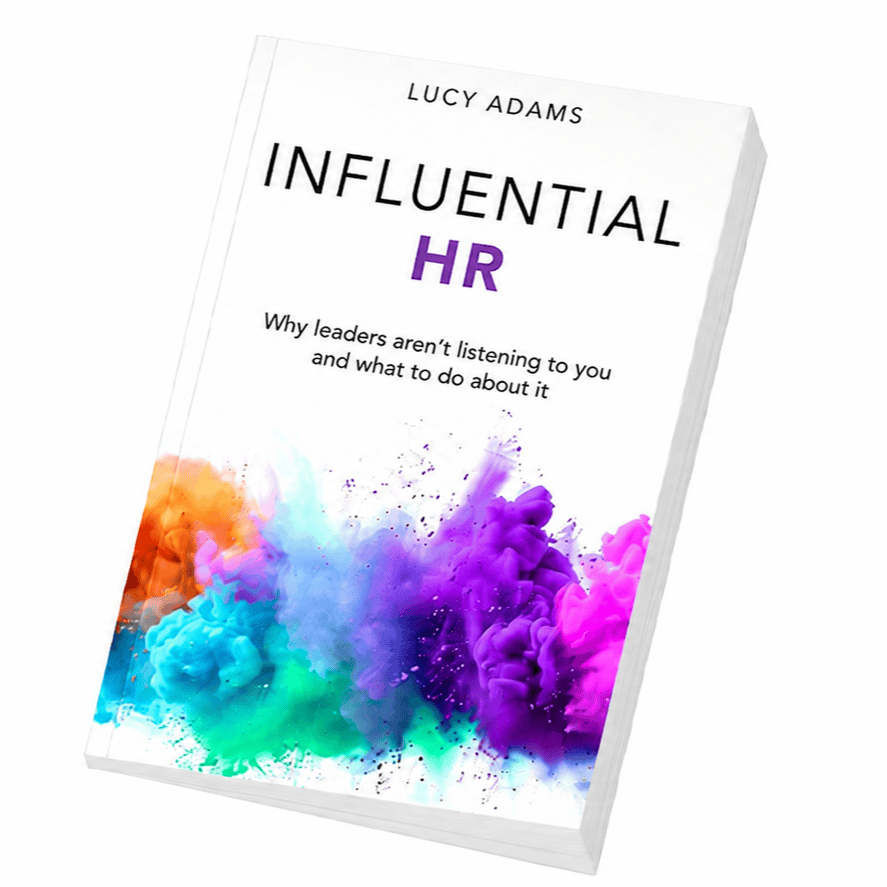
The third book in Lucy Adams’ series for forward-thinking HR professionals explores why HR struggles to influence leaders — and how to build the confidence, credibility and authority to create real change.


