
Storytelling to support leadership communications has been around for a while now. And whilst it’s often seen as an effective way of getting our message across, what does it really mean to be a great storyteller – and how does it work on a practical level in a business? It could be that you are trying to help your leaders communicate the strategic priorities for the coming year or you want your own HR comms to have more impact. In this episode we’re going to really break it down for you and to do that Lucy has enlisted the support of someone who has straddled the world of leadership and engagement – and actual proper storytelling as a published author – Simon Wright.
This episode of HR Disrupted looks at how storytelling can change the way we communicate at work, especially in HR and leadership. It explores how stories go beyond facts and figures to create emotional connection, build trust, and help people really understand and care about what’s being said. Instead of treating storytelling as something fluffy or ‘extra’, the episode shows how it can be a powerful tool for getting messages to stick and for helping people feel part of something bigger.
The episode explores how storytelling isn’t just for creative types, it’s something anyone can use to make their communication more meaningful. Whether you’re explaining a new strategy or trying to build team connections, telling a story helps people understand not just what you’re doing, but why it matters. It looks at how good storytelling often starts with vulnerability and honesty and shares tips to bring storytelling into everyday communication without it feeling forced or awkward. HR and leaders need to see storytelling not as a ‘nice to have’, but as a core part of how we inspire, influence and build stronger, more connected workplaces.
Discover Simon Wright’s novels – The Red Scarf Series – and contact him at https://simonwrightbooks.com/
00:03 – Lucy Adams (Host)
Welcome to HR Disrupted with me, lucy Adams.
00:07
Each episode will explore innovative approaches for leaders and HR professionals and challenge the status quo with inspiring but practical people strategies. So if you’re looking for fresh ideas, tips and our take on the latest HR trends, subscribe wherever you get your podcasts. So storytelling to support leadership communications has been around for a while now and, whilst it’s often seen as an effective way of getting our message across, what does it actually mean to be a great storyteller and how does it work on to be a great storyteller and how does it work on a practical level in a business? So it could be that you’re just trying to help your leaders communicate the strategic priorities for the coming year, or you just want your own HR communications to have a bit more impact. In this episode, we’re going to really break it down for you and to help me do that is someone who is fairly uniquely, I think, have straddled the world of leadership and engagement and actual, proper storytelling, as in a proper novelist. So someone who really knows what he’s talking about. Welcome, simon Wright.
01:23 – Simon Wright (Guest)
Oh, lucy, thank you so much. I’m very happy to be here, but, as Keith Richards once said, I’m happy to be anywhere these days. Thank you for having me.
01:33 – Lucy Adams (Host)
It’s a real pleasure. Now, we should confess we do know each other and we do see each other socially. So we’ll try and keep the bants out of the conversation. Try and keep it professional, although I should point out that the last time I saw you we were bopping away to Human League in Kew Gardens.
01:55 – Simon Wright (Guest)
Yeah, I should point out, it was you that dragged me down the front.
01:58 – Lucy Adams (Host)
Yeah, what a great night. Ok, let’s get into it. I just want to talk about you first of all, because it’s not a typical CV, is it? You know you’ve had careers in large corporations, you’ve worked on a consultancy basis and you are a published novelist. You’ve recently completed the Treadscarf trilogy, translated the Treadscarf trilogy. Just take us a bit through that journey. Were you always a frustrated novelist and had to do the corporate stuff to pay the mortgage? Or was this something that kind of came in later life? Or how did you become a novelist from being a corporate animal?
02:43 – Simon Wright (Guest)
So good questions. I’m not sure if I’m honest, I’m not sure I wholly know the answer to it. I do believe that we all are budding novelists. We all have a story that not just a story to tell, but a story that at some level, we want to impart.
02:59
For me, I cut my teeth on customer service management and leadership in British Airways. I spent 13 years there. I was lucky to be there when they were rightfully referred to as the world’s favorite airline and they were investing in the greatest minds in the world. And we got exposed to all of that thinking Harvard Business School, you name it everywhere. So I learned a lot there, mainly about customer service leadership, both in the terminals at Heathrow and then later working within HR and within learning and development and running large-scale change programs, which BA became really well known for. And then at some point I decided I wanted to try and look at this from a different angle, maybe a more creative angle. So I jumped ship and went to work for an agency one of the agencies that had been supporting us on the change programs, and I then moved from one agency to another.
03:59 – Lucy Adams (Host)
Really, enjoying it. I hadn’t realized that you’d gone from working with that agency and employing that agency to then actually being poached.
04:09 – Simon Wright (Guest)
I hadn’t realized that’s how you made the choice a more creative muscle, which I’d always tried to do in BA but, you know, within certain limitations, I guess and so I did start telling stories more in that context. We would create small videos for organizations that were designed to inspire, over three or four minutes, and lots of other ways where some sometimes written stories as well. And I did that for a whole bunch of years with various agencies and then a whole bunch more years on my own, I think, and that’s certainly when our paths crossed. We did some work together, but increasingly I found myself thinking what excites me most is the opportunity to uh, to uh, turn a blank sheet into something.
05:07
And uh, and I think if you go to friends that knew me back in british show as, they would say, yeah, he did always hanker to write in some way, shape or form. And you’re absolutely right, the reason why I didn’t was because I felt I needed to pay the bills and, whereas a lot of writers can kind of come home from a long day’s work and then sit and pound away at the typewriter for three hours, I never felt I could get my mind into it. So I needed to create the space, uh, to be able to properly take a run at it.
05:36
You know, and that’s what I’ve been doing for the last couple years and do you find writing difficult?
05:41 – Lucy Adams (Host)
you know, is it something that you have to kind of sit and work at? Or do you work on the basis of you’re suddenly inspired and it just kind of comes pouring out of you?
05:53 – Simon Wright (Guest)
I don’t think it’s ever that.
05:54 – Lucy Adams (Host)
Yeah.
05:55 – Simon Wright (Guest)
I mean good days and bad days, Lucy. So on a good day, I mean, I still treat it very much as a job. So you know, I turn up every morning to it and on a good day I’ll still be writing well into the evening because the idea is coming and coming and I just want to chase it and keep going with it. And then other days I’ll just stare out of this window that I’m looking at and search for inspiration and write a whole paragraph that I later delete. So so, yeah, it’s, uh, it’s, it’s good days and bad days, but but actually even the bad days I quite like, because I’m wrestling with it and I enjoy the wrestling. You know it’s kind of well, we’ll.
06:38 – Lucy Adams (Host)
We’ll no doubt pick up on the books later on, but, um, I kind of want to root this, obviously for our listeners, in the art of the practical. Many of them who will be listening will be HR professionals, some business leaders who don’t have responsibility for HR, but they do for their people. But they’ll be working in environments where they might be thinking, yes, storytelling is not something that we do. They might be engineers or they might be. They were working with scientists or manufacturing organizations and I really want us to kind of reflect on where this could work in real life environments that most people who will be listening to this will be at. So let’s get into storytelling as a means of communication. I kind of just want to kick off with real basics. What do you mean by storytelling? What is storytelling?
07:43 – Simon Wright (Guest)
Okay. So I think the first main point I want to make and probably the last point I’ll want to make, is the biggest revelation I ever had was that storytelling is a communication that involves both a storyteller and a receiver, a listener, a viewer, a reader, and without that it’s not really storytelling, it’s just doodling. There’s a relationship in play here, and, I think, particularly organizationally. Once we understand that storytelling is in the hands of those that are receiving it as much as the teller, then we start to get the very nature of it. Sure, it’s about bringing messages to life and making a connection that will trigger activity and action and specific outcomes that we’re looking for, but I’m most interested in how it makes the receiver feel, the listener, the viewer, the reader.
08:47
For me, stories remind us that we’re not alone. What they do is they talk to us in a way that says I get that, I feel that I’ve had that, I’ve experienced that, I understand that point, and that connection makes us feel less alone and makes us want to be part of what is being told. Um, it’s, it’s right back to campfire stuff, isn’t it? Yeah, this, this, what we’re doing now, this is today’s campfire, but forever, forever. Since we learned to communicate. We gathered and we told stories to connect. I mean, at the very least. At the very least, stories enrich our lives, and that’s that’s a pretty good thing to be doing, isn’t it?
09:36 – Lucy Adams (Host)
I’m very interested by this idea that storytelling is not one way but is very much a kind of, you know, connected experience and mutual experience. And I think for many leaders or HR professionals, they know they’ve got to convey some messaging and sometimes it just feels like it’s about getting through, it, doesn’t it? It feels like, you know, I’ve just got to tell them about this strategy or I’ve got to give them this bad piece of news or this good piece of news, but I’ve just got to get my message over, and I think what I’m hearing you say is that, regardless of the message, it’s always got to be thought through as a kind of connected experience, not one way, not broadcast.
10:27 – Simon Wright (Guest)
Yeah, I absolutely agree with that. I think obviously we’re trying to. There’s always some transfer of ownership going on. If I’m standing up and talking to a bunch of people and I have an agenda by the end of that, what I want is for it to be their agenda, but they have to find their place in it. They have to find their relationship with that material, which will not be the same as my relationship with that material, and my job, I guess, is to help them to find that, help them to care. A few years ago, uh sky were launching a new uh uh broadcasting platform called atlantic. You may well be familiar with it I know well and they they did an amazing promo for it.
11:17
What one might expect is uh of sky saying listen, we’ve got a new channel, it’s called atlantic. It’s going to be amazing. Here’s 60 seconds of programming that we have spent millions and millions buying or making and we’re going to show you the best of it now. But they didn’t do that. Instead, they got a master storyteller in Dustin Hoffman and they plunked him on top of a building looking out on the landscape.
11:41 – Lucy Adams (Host)
Oh yeah, I remember it.
11:43 – Simon Wright (Guest)
You get it. And he said his first word was to camera, was stories. And then he talked about stories and right in the middle of it and it was a lovely piece, it was a beautifully written piece and right in the middle of it he said but isn’t that what a great story does? It makes you feel, and for me that’s that is at the heart of corporate storytelling is when you get to that and I’m not saying you don’t have to have provided the data first, but when you get to that, when you start to make people feel, then they’re finding their connection, and then I’m just kind of one of my own humiliations, which are always good to share.
12:29 – Lucy Adams (Host)
I can remember my first presentation to the leadership audience of the BBC and just before I was about to go on, my director general. So the chief exec of the BBC said to me now, lucy, just remember, all of the people in the audience are used to be journalists, right? So regardless of whether they’ve ended up in radio or television, nearly all of them were journalists at one stage. And so they like data, they like facts, they like evidence. They are not going to be swayed by your pink and fluffy HR stuff. They are not going to be swayed by your pink and fluffy HR stuff. And so I duly went out and kind of stripped out any kind of emotion and gave them, you know, data and facts. And I absolutely bombed, you know.
13:16
Immediately they went into their kind of full investigative journalist mode and were quizzing me on the facts and debating the data and the sources and the methodology, and I just completely lost them. So I think for the lesson for me for that was that, yes, they may be in a profession where their DNA it is about data engineers, scientists, journalists, lawyers, accountants but actually it doesn’t matter. They all still love a story, don’t they?
13:53 – Simon Wright (Guest)
Right. So it’s particularly interesting about the assumptions we make about our audience, isn’t it? And I think maybe I’m going to slightly divert here for a moment when I was in British Airways, the last thing right towards the end of that time there, they made a very, very famous advert called Global, and the advert featured hundreds of people dressed as a pair of lips and an eye and everything, and they were coming together on this big sandy area and everything, and it was a spectacular advert. And it finished with I think it was John Hurt in voiceover, saying every year the world’s favourite airline brings 24 million people together. And it was a brilliant, brilliant ad. And the last thing I did before I left British Airways was to make an internal interpretation of that. And what we did was we went into the terminals early one morning, five, six o’clock, and we shot meet and greet. Many years later, I feel that my treatment got stolen.
14:55 – Lucy Adams (Host)
I know where you’re going. You look alive actually.
14:58 – Simon Wright (Guest)
I’m parking there and we just shot it. And we shot all this meet and greet, these beautiful moments, and at the end of our film we just said every year, the world’s favorite airline brings all these people together and you are the ones that create these moments. And then we showed it to baggage loaders and you know all kinds of communities, and you know all kinds of communities and, without fail, they would shed a tear because it said you think you’re doing this down in the bowels of Heathrow, but you’re not. You’re doing this and this is special. And that was an emotional message. You know it wasn’t a. You’re not loading bears correctly. Let’s show you how to do it. It wasn’t about that, you know, and I think that’s the other side of what you were just talking about and I think that’s very powerful.
15:47 – Lucy Adams (Host)
Yeah, so I think you’re absolutely right. You know, when I hear HR people often talking about, oh well, they’re engineers, so they won’t respond to emotion or whatever. They cry at films, they laugh at jokes, they, you know, they are completely capable at jokes. They are completely capable, and I think there’s a risk, isn’t there, that we make assumptions and tailor our message in the wrong way, which is, well, the DNA of their profession is logic analysis data. Therefore, that’s what they’re going to respond to on a human level, and, of course, what we’re trying to get people to do is to act in some way, isn’t it? It could be that we’re trying to improve performance or quality, or save money, or collaborate with each other, or whatever it is we’re trying to do. We’re trying to to get them to do something, and I think what I’m hearing you say is that they’ve got to feel something before they want to do it the data informs, informs all of our IQ, but the EQ messages, they touch our heart and it’s that that triggers choice and new choices become action.
17:00 – Simon Wright (Guest)
And that is definitely a heart driven thing, and I think stories go right to the heart of that.
17:09 – Lucy Adams (Host)
And that’s quite scary for leaders, isn’t it? That’s quite potentially quite scary, and I want to come on to that. But before we get into how we can help our leaders and equip them with greater storytelling either capacity or inclination, because you’re making yourself a bit vulnerable, I think Can we just kind of break down storytelling, yes, to help our listeners think about the stories they might want to tell. Is there basically one type of story or is there a structure to a story? How do stories?
17:45 – Simon Wright (Guest)
work. That’s a really that’s a really good question is there and I think there are probably 100 answers to that and you know you, you can google those really easily and you’ll get lots of frameworks and everything. And I I work with pretty simple frameworks, so I it’s straight off the bat. From a structure point of view, I always think funnel, I think we start here, but we have to finish at a level of specificity that is going to convert into action. So all stories have like a beginning, a middle and an end Beginning, middle, end. Well, at least they did, until Tarantino came along and said we’re going to start in the middle, we’ll do a bit of beginning, end, end. They did, until Tarantino came along and said we’re going to start in the middle, we’ll do a bit of beginning, end and end. For us mere mortals beginning, middle, end. But it also is why big picture rationale. You’ve got to answer that. If you want to keep people in the room, you’ve got to have answered the why question. But then, of course, the what, and finally we get down to action again with the how.
18:44
We start organizationally. We often then go to what does this mean closer to home in our department, but we have to end with the individual. We think big picture, vision, and then we go to strategy and then we go to behavior. What are we asking you to do? What do you want to do? What are you going to choose to do? So it’s nice to always have that framework in the back of your head, but I don’t think that in itself helps us to tell, to even form a great story or become a great storyteller. I also tend to abide by a kind of a mantra of four phases. In my four phases, if we think about the approach to storytelling, I always start with the idea of love at first sight. So like, go on, you’ll remember this. Uh, I’m sure you will this. Like you know, in the old days when we went on holiday at the airport, you’d always stop off at wh smith’s, wouldn’t?
19:38 – Lucy Adams (Host)
oh god, yeah by 14 books.
19:40 – Simon Wright (Guest)
Three for two deals, wouldn’t they? And you’d load up with loads of books, right? And then you’d get out on holiday and you’d be lying there with your pina colada.
19:48
I see you as a pina colada girl definitely always a pina colada, and you’d open up your first book and you’d get into it and one of two things would happen. You’d either think after a few pages I hope, I hope this is going to kind of pick up a bit, because otherwise I’ve got a whole bunch of books down here or you’d think this is for me, this is for me. You’d connect, wouldn’t you?
20:11 – Lucy Adams (Host)
My Kindle is filled with books that are about 3% in. You know, it’s that kind of Does that include my books.
20:23 – Simon Wright (Guest)
So I think we all understand that principle of you have to engage people up front. You have to say this is for you, this is for you, you are going to love this, this is important to you, right? Part two is like what I call murder in act one. If you’re writing a whodunit, okay, there’s no point in it.
20:40 – Lucy Adams (Host)
I’ve just got visions of HR professionals listening to this, thinking about you know, they’ve got pension reform coming up and they’ve got love at first sight. Murder in Act One.
20:50 – Simon Wright (Guest)
And you know, if love at first sight is, I’ve got to engage my people, I’ve got to send a message to them saying this is something you’re going to be interested in. Then murder in Act One. Well, you know, like when you come back from holiday, right, you say to your friends I read this amazing book on holiday. What’s the first question? They ask you what’s it about? What’s it about? They don’t say really, where is it set? What would it come like? They say what’s it about? Because that’s what we want to know. So murder in Act One is headlines. It’s like these are the headlines you need to know. This is what we’re talking about. Then, of course, you have part three, which is the plot thickens. This is the twists and turns, this is the detail, hopefully, that makes us lean in, that makes us care, that makes us want to interrogate. And then, finally, of course, you have happy ever after. Now, I don’t think all stories end happily. I don’t think all great stories end happily or need to end happily, but I do think that we want, we seek resolution. We seek, we want to understand and in organization, this means I need to understand what’s being asked of me. I need to understand what happens next? What happens next? And I think that if we can get people to that point now, we’re starting to transfer the story, because the interesting thing is at this point, I think people are engaging with the storyteller, they are identifying with the storyteller.
22:19
You earlier reminded me of a story where I was working with um, a health, a large health care organization, uh, with a strong clinical bias, a lot owned hospitals and stuff, and we did a. We developed a big story on a new strategy and we then worked up a launch campaign which involved going into cinemas great storytelling environments, you know bes. Great storytelling environments, you know bespoke storytelling environments where we would get a number of senior players to talk a bit about the new strategy and what it meant to them. And I remember I did a load of coaching with each of the key. We did a morning session and then we repeated in the afternoon because there was a certain capacity to the cinema and it was the same players for both. I would spend. I spent a lot of time with each of the key players trying to examine their relationship with the story and how they could impart it in a way where people would start to care themselves.
23:12
And I remember being told uh about one particular clinical director and everyone said to me you’re going to have trouble with her. She’s hard, she’s difficult and she was brilliant. She got it. She understood what I was suggesting about her daughter and her role in healthcare. She spoke about her grandfather who was a medic in World War I, and the more she spoke about those things, the more people leaned in and got it and everyone else then followed suit, except the CEO, who never received.
24:01
We never did the session together. Every time he said, look, I’ve got my PowerPoint deck, I’m going to do that, and he did that and he watched everyone else doing something markedly different and in the afternoon he changed and he told a story about why he was leading this healthcare company and it blew people away and it was quite emotional to watch. You know, as these very senior people that we often think of as operating in a stratospheric, almost non-human level, became overwhelmingly human. And I think everyone, we each have that capacity, lucy, to share that you said earlier. Maybe you have to make yourself a bit vulnerable. You said I love that because I ones who can show vulnerability, humility, that they just are so comfortable with it that immediately you connect with them.
25:11 – Lucy Adams (Host)
But it’s the confident ones who are most comfortable with it.
25:16 – Simon Wright (Guest)
And I think that at the heart of that, and maybe one of the key words of this discussion, is authenticity, which, by definition, is different for each of us. Right, we each have our own authentic self and the degree to which we come to understand that and I guess I’m straying into EQ territory now Come to understand that and are then prepared to share that, that makes life really interesting.
25:44 – Lucy Adams (Host)
I should just say that I remember I was talking to the HR Director of Discovery and she was talking about how, prior to lockdown, you know, the default communication mechanism was the town hall and the chief exec would stand up and do the town hall and it was heavily scripted and lots of information and PowerPoints and scripts and all of that.
26:08
And then of course, lockdown sort of drove a truck through that and there’s the chief exec doing a Zoom call. The kids are running in, the cat’s walking over the desk. He’s talking about how he’s put on weight during lockdown. But she said it humanized him and connected him to his team and to the wider organization in a way that those formal slick town halls had never done. And I think you know we’re often in hr asked to produce these scripts for managers because we can’t possibly trust them to, you know, communicate the messages themselves and so we write it all for them and then you see these poor people trying to deliver it with a bit of emotion or a bit of feeling or a bit of you know kind of energy. There is no energy there when they’re just reading someone else’s script.
27:06 – Simon Wright (Guest)
Yes, because it’s someone else’s words. By definition, exactly.
27:09 – Lucy Adams (Host)
Can you share you gave the example of the healthcare company there really powerful and just share maybe a couple of other examples where you’ve seen this work really well, either with HR teams helping their leaders to be better at this or leaders delivering messages in different ways. Have you got a couple of examples?
27:31 – Simon Wright (Guest)
Yeah, I think I’ve certainly got examples of how, once strategy becomes somewhat, shall we say, anecdotalised, then it becomes accessible. So this is now we’re getting a bit more into technique, and I think that becomes really interesting. So I mean, uh one. That one that springs immediately to mind is I was doing some case study, creating some case study material to support a session, or focused on a company called service master, a massive organization in the states. They have some representation in the UK as well, but mainly in the States, and they do a lot of municipal cleaning contracts, hotels, government buildings, hospitals, banks, blah, blah, blah, and they’ve done some extraordinary work, servicemaster, and have a very fascinating philosophy and ethos. There’s a ServiceMaster Estro, which is a specific way, philosophy and ethos. Like there’s a service master Estro which is a specific way to use a mop and it’s, you know, they’ve got control of that, of how that’s used. You can’t use the mop the way they do it, and so you can see the eye for detail there straight away.
28:39
And I wanted to capture some of that and I wanted to create a video as a kind of kickoff for a session that I would then be, uh, teaching and um. So I, I got to. I got introduced to a lady called Maria, who’s a cleaner in one of the hospitals where they had a contract, and, uh and uh, we followed her around, we did lots of filming and then we needed to do some quick top and tailings. So I explained to her english wasn’t her first language, but but it but her english was sure as hell a lot better than my mexican. So so that we so we decided to do it in english.
29:10
So I said explain to her what I was going to do. And I said listen, I need, I’m going to ask you what you do. And, and here’s, here’s the answer, you know, I gave her her own answer, which you know I do this, I do, you know, listen, or I clean, I clean toilets, I wash walls, I clean, so great, good to go roll cameras, action. So, maria, um, perhaps we could start with you just, uh, describing a bit of what it is you actually do, and without missing a beat. Without missing a beat, maria said I help doctors save lives.
29:42 – Lucy Adams (Host)
Yeah.
29:43 – Simon Wright (Guest)
And I went to my eternal discredit. I went cut, cut, cut, no, no, no.
29:50 – Lucy Adams (Host)
That’s not what you do, Maria.
29:51 – Simon Wright (Guest)
You use the moth. It was passed me by and I’m like, oh no, and it was only later, of course. As I reflected I thought, oh wow. So I think we can be a bit skeptical, a bit cynical even about that response. Right, it kind of sits with the apocryphal cleaner at NASA, doesn’t it? That helps put men on it yeah.
30:12
But I watched this woman say this and it was core for her. It was at the center of someone working on minimum wage. It was doing fundamental duties cleaning toilets and somehow she had found she was hardwired to the higher purpose of this organisation. A story had been told to her in a way that she could find her connection to it. So you’ve got that at one level real connection around purpose. Then, at another level, I remember sitting in uh.
30:48
I could share loads of other examples where I completely made a mess of things, but I’m not gonna do that. This is one where I was just spectating. I was sitting in on a, an induction, uh, with um, with a mcdonald’s and uh, and there was a whole bunch of young boys and girls who were being inducted into the McDonald’s way and I was really interested to see, you know, in a franchise kind of business, how this worked. And it was a pivotal moment where the guy that was running the course lifted up this yellow carton and opened it up and here was this perfect sort of a Big Mac unlike any Big Mac I’ve ever seen, and he said so okay, so come on then. What’s this worth? And hands went up all over the place. You know it’s $3.99, $4.99 as part of a meal, $5.49 if you go large. They had it all.
31:42 – Lucy Adams (Host)
They knew they had all the they knew their stuff yeah wow, and he went.
31:46 – Simon Wright (Guest)
no, he said so, uh, this, this burger is worth around 21 and a half thousand pounds and they’re like what he said. Uh, on average, the average customer that comes into McDonald’s over a lifetime will spend around £21,500 on Big Macs. And if you have a customer in front of you who is dissatisfied and says you know what, I’m going down the road to Burger King, I’m out of here. I will never darken your door again. It is not 399 walking out the door, it is 21,500 pounds walking out the door. Now, this was an anecdote, but more than any other data on that day, this was the thing that the kids remembered. And, okay, this isn’t so much about this kind of authentic sharing of self, but what it does do, is it? It takes facts around customer retention and we’ve all got plenty of data on that and converted it into something that was memorable, that was accessible, that’s really interesting.
32:50 – Lucy Adams (Host)
So it’s not that the data, facts, logic don’t have any place in this and it’s all got to be about feelings and relationships and emotion. It’s actually how do you change that? Just as you were speaking, I was reminded I’ve just come back from a trip in um where we went on one of these tours of an old sort of uh, moorish fort in you know from I don’t know 200 bc or something. Well, it’s not my thing really. I like a bit of history, but I like people-based history. I don’t really like here’s the gun turret. It wouldn’t be a gun turret when 200 bc. You can see.
33:31
I’m really at the limits of my understanding, but the way he did this, this tour guide, was to get us to imagine that we were soldiers trying to attack this impregnable fort. And so here’s where the oil is going to be falling on you. Here’s how you come and you, you’re blinded by the light because you’re going from light to dark. And then suddenly you know this is where the arrows were. Oh my God, god, it was unbelievable. And so the facts were the same. The facts were all the same if he’d done the. Here’s the window, here’s where the oil was poured over. But suddenly we were these soldiers. You really, we were these soldiers trying to attack this impregnable fort, and we were there with him on this journey. It was genius. You’d have loved it, absolutely loved it. Wish I’d seen you in action there a moorish soldier.
34:27
I’m seeking it out in your life so let’s start to wind things up a little bit and just kind of get you know if listeners are kind of thinking well, I like the sound of this. I think our communications could be more real, more authentic, more story-based. As I said, it could be that they’re trying to help their leaders, or it could be that they’re trying to, you know, think about their own comms. Where do they go from here? What should they be thinking about?
35:00 – Simon Wright (Guest)
So I guess maybe there are some abiding principles that are useful to have in the back of your mind all the time, and I said at the beginning that this is one I’d want to come back to, and so, maybe more than any other point, one I would want to emphasize is that at the heart of storytelling, we are shifting our focus from input to impact. If you think about it, mostly in the past, when people have been communicating and you’ve alluded to it a number of times in this session all the energy goes into the PowerPoint pack, all the energy goes into the data, all the energy goes into what is it I want to say? Forget what you might want to hear, what is it I want to get across, what is it I want to impart? And if we change that and say, forget all that and get into what is the impact I want to have, I think that one principle changes everything. It changes the way we prepare, the way we speak, what we share, how vulnerable we make ourselves and a hundred other things. So for me, that would be an abiding principle. The second one would be fundamentally ensuring a balance between, between and we’ve alluded a lot to this. Haven’t we between iq driven uh communication and eq driven communication.
36:25
I said earlier, data satisfies the analytical part, but stories touch our hearts, so it’s a it’s about I don’t think you can ignore, we’ve said, and you can’t ignore the iq stuff. It’s it, it gets you in the room, yeah, uh, and it keeps them in the room, but it it doesn’t, it doesn’t seal the deal. Um, uh, I think again, we have another key focus would be we have to be true to ourself. We have to find our own voice. We have to be authentic. When we are, people know, and when we aren’t, then people will feel let down In extreme, people will feel betrayed. I mean, just look at the salt path debacle that’s going on at the minute. Oh God, yeah, the scale of betrayal that people may or may not be feeling following the Observer article, which may or may not be true, but at the minute we’re seeing people reeling on it because that story touched people’s hearts and it prompted action and all sorts of things, and now people are questioning that.
37:40
Now, actually, you, you could make a case to say, well, you know, the journey you’re on is good journey, so don’t worry about that stuff. But that’s not what people they’re going to say no, I invested in that. So I think authenticity we we can’t underestimate that. You know I love the phrase human interest story, right, because surely every story is a human interest and if it isn’t, if it isn’t human, if it isn’t interesting, then it isn’t a story worth telling. We know that. You know your, your audience will, will know better than I ever could that how pivotal people engagement is in delivering strategy on an ongoing basis. And for me, engagement begins with having a great story well told. I think Maya Angelou put it best right when she said and if you get a quote, you may as well quote from the best when she said people will forget what you said, people will forget what you did, but people will never forget how you made them feel. And that is what we’re trying to achieve.
38:44 – Lucy Adams (Host)
Fantastic, simon. Thank you so much. Now I mentioned at the start that you are not just the author of one book, not the author of two, but a whole friggin trilogy. Trilogy, um, so uh, give us just an overview for people who might be interested in having a look and hopefully getting past the three percent on their kindle. Yeah, um, just give us an overview of the trilogy. Uh, the link to the uh, to the books will be in the show notes yeah.
39:11 – Simon Wright (Guest)
So a few years ago, in lockdown, uh, a friend brought me an article a Guardian article about a shipwreck salvage operation in the Levantine Basin. A bit like you and your Moorish thoughts, it’s not really my thing and he said I think there’s a book in this. You should write it. Anyway, to cut a long story short, so to speak, I ended up exploring the idea of why did this ship go down and what might be on it, and so the trilogy is about a race across centuries to control a powerful artifact, and half of the first book explores, through the eyes of a young Muslim boy who is a stowaway on board the ship called the Colossus, which is the title of the book, what happens on that ship and why it goes down. And the other half is the modern day salvage operation to bring that ship up and maybe recover something incredibly powerful. Recover something incredibly powerful.
40:20
And then, across the trilogy, we explore an ongoing journey for both Emir, our young Muslim boy, in 1630, and Daniel, our somewhat broken professor, in 2012-2014. So, yeah, a lot of people say to me particularly, funnily enough, female readers have said this is this is not the kind of book I would normally read, but it was recommended to me, I had to go and I really loved it, because, yes, it’s a swashbuckling adventure, but it’s not. It’s more than that, I think, and yeah, no, absolutely.
40:53 – Lucy Adams (Host)
The relationships in it Fantastic. The relationships in it fantastic. So, yeah, I mean, it had everything that I didn’t want, which is time travel kind of stuff, you know, that whole two different, several different centuries and shipwrecks and salvage operations. I mean it’s just like really, but I loved it, I absolutely loved it and I’ve loved this. So thank you so much for joining us. And where can people get hold of you if they want to connect with you?
41:28 – Simon Wright (Guest)
OK, so may as well go to my website, simonwrightbookscom. That’s probably the east place, and if you’re interested in the book, just go onto your Amazon search bar and type in the Colossus Simon Wright, and there I am.
41:39 – Lucy Adams (Host)
Fantastic. Thank you. Thank you, Lucy.

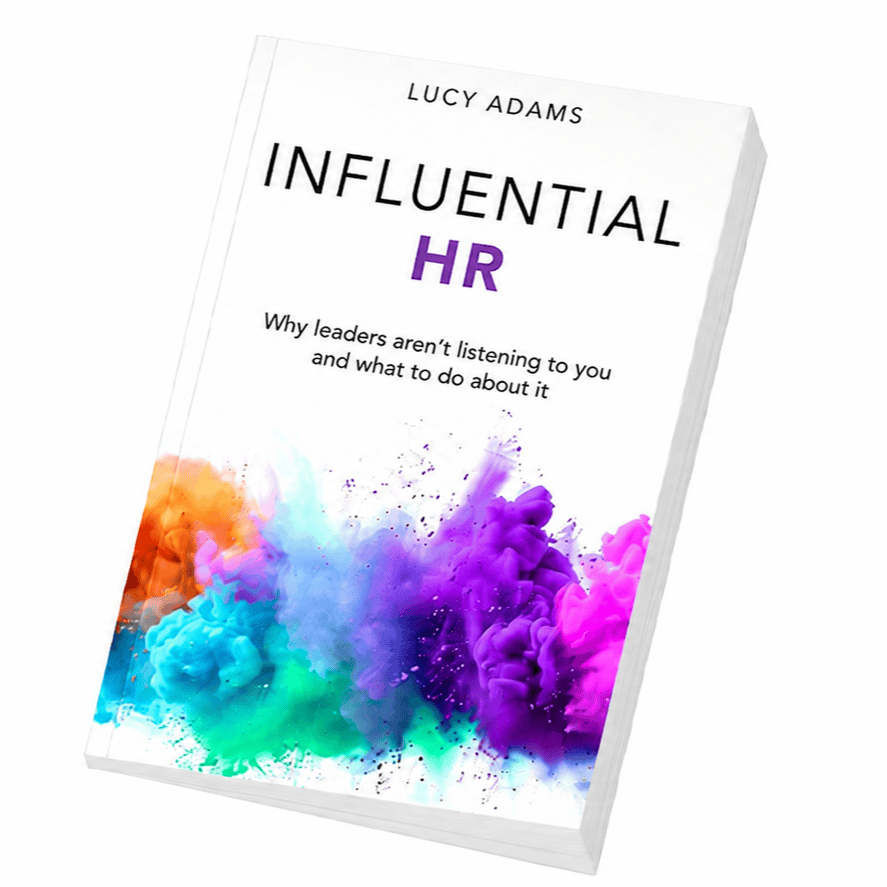
The third book in Lucy Adams’ series for forward-thinking HR professionals explores why HR struggles to influence leaders — and how to build the confidence, credibility and authority to create real change.


