

It seems as though there’s a news article every day about how the younger generation lack the resilience or work ethic of their parents. There’s even a nickname to sum up this apparent lack of discipline and disregard for the demands of the workplace – the so-called Snowflake generation. Do younger people present problems for employers in terms of laziness or being too fragile? Or is it just a myth?
With nearly 25 years of experience in secondary education, our guest Alex Atherton provides invaluable insights into the resilience and work ethic of today’s youth, offering a fresh perspective on whether the perception of Gen Z as fragile and lazy is a stereotype or reality.
Join us as we explore the evolving landscape of the Gen Z workforce, examining the challenges and solutions for both employers and employees. We highlight strategies for attracting and retaining young talent by fostering authenticity, transparency, and aligning company culture with the aspirations of Gen Z employees and examine the benefits and strategies for a diverse generational workforce.
Contact Alex info@alexatherton.com
00:03 – Lucy Adams (Host)
Welcome to HR Disrupted with me, Lucy Adams. Each episode will explore innovative approaches for leaders and HR professionals and challenge the status quo with inspiring but practical people strategies. So if you’re looking for fresh ideas, tips and our take on the latest HR trends, subscribe wherever you get your podcasts. So it seems as though there’s a news article every day about how the younger generation lack the resilience or the work ethic of their parents. You know, there’s even a nickname to sum up this apparent lack of discipline and disregards for the demands of the modern workplace, and you know the so-called snowflake generation. But do younger people present problems for employers in terms of laziness or being too fragile, or is this just a myth? Well, with me today to discuss this is an expert on this topic, and so a really big welcome to Alex Atherton, who is the author of the forthcoming book the Snowflake Myth. Hi, Alex.
01:18 – Alex Atherton (Guest)
Hi Lucy, Thank you for having me on.
01:22 – Lucy Adams (Host)
Oh, it’s lovely to have you on the show and before we get into it, maybe we should start by establishing your credentials as an expert in this area, or at least an important voice in this debate. So can you give our listeners just a brief summary of your background?
01:42 – Alex Atherton (Guest)
Okay, so for almost 25 years I worked in secondary schools. Just over half that time I was a head teacher. What?
01:50 – Lucy Adams (Host)
did you teach? What was your teaching subject?
01:54 – Alex Atherton (Guest)
Oh well, you could tell that I hadn’t really planned going into teaching as a profession, so I started out as a A-level government and politics teacher yeah which means that you teach that and then anything else that needs teaching, you’re also given it. So I’ve taught. I’ve taught history, geography, ict, rs, english.
02:19 – Lucy Adams (Host)
Um, it is amazing that actually I started um before I kind of worked out what I wanted to do. I did some teaching in six forms and teaching that kind of A-level group, so the kind of 16 to 18 year olds for listeners who are outside of the UK and similarly. I was history but they gave me politics. But they gave me politics, they gave me English and also communication skills for electrical installation engineers, the ones who were kind of on day release.
02:53
Right okay, I tell you what it was a very good grounding in how to manage a group of people. Yeah, exactly, exactly. So you were a teacher and then you became a head in a secondary school. Was that in the private sector? Was it in?
03:09 – Alex Atherton (Guest)
the state sector. So I started my career. I’m from Yorkshire, originally started my career in Manchester or Trafford, moved to London with a senior post, so my first headship two-thirds of my headship time was done in Tottenham, North London.
03:28 – Lucy Adams (Host)
So again for listeners who don’t know the UK, that’s not necessarily one of the most affluent areas.
03:35 – Alex Atherton (Guest)
No, no, it’s not, and it certainly wasn’t. Then at that point I also worked in central London as a head, which people thought I’d left to go to a more prosperous area with easier kids, but actually the percentage of kids on free school meals who qualified for them was higher. There they’re, in Tottenham. It was Baggy Trousers School, if you like for listeners of a certain age, where Suggs went to school and wrote a song about it. Basically, oh, he went to that school he went to that school yeah.
04:14 – Lucy Adams (Host)
All right. So for people who don’t know, check it out on Spotify. Madness is the band Baggy Trousers, and it was that school that you were in. Oh, my word, that must have been it, but fascinating it must be.
04:28 – Alex Atherton (Guest)
I mean, you bet you had a good time as well yeah, no, no, yeah, absolutely. Um, I also worked in a pupil referral unit for a little bit, so that’s really really challenging kids where they go when, um, when they’re not, when they’re not in school, um, or they’ve been, uh, have to be somewhere else for for a bit. So I worked a lot with gen z, who are now the youngest generation in the workplace and is it gen z or gen z? What do?
04:58
we call it it’s funny actually, because I started like all my video stuff that I did near the beginning says zed, yeah, um, but the more focus groups I did with, uh, the young people themselves, you know increasingly z, so I suppose it’s an americanism every time it’s a bit cooler, isn’t it?
05:21 – Lucy Adams (Host)
yeah, yeah, yeah, and also my daughter, who basically learned her alphabet from Sesame Street, me plonking her in front of her. While I was trying to get some work done, put her in front of Sesame Street. She used to say Z. So there you go. I think it’s fine. We’ll call it Gen Z, I ask people.
05:37 – Alex Atherton (Guest)
What do you want me to call them If I’m doing a speaking gig or something? Yeah, speaking gig or something, and there’s more and more Zs than used to be. It’s Zs that win, but there’s more Zs than there used to be. Put it that way, so it’s becoming increasingly common.
05:57 – Lucy Adams (Host)
Right, good, We’ll go with Gen Z. So you know this group. You’ve worked with this group both as younger and the group that have now become Gen Z. I can’t remember what we’re on at the moment. I think we’ve gone back to the start of the alphabet, haven’t we? Yes, so you know this group. How did you transition out of education? Why did you transition out of education?
06:16 – Alex Atherton (Guest)
Well, to cut a long story short, I found some notes to self about a year or two after I came out, which indicated I was thinking about this a lot more than I thought I was. But in effect, uh, you know, I have a daughter who’s now 13 at the time, uh, sort of early years of primary school, and by the time it got to the third week in a row of not seeing her awake from Sunday night to Friday night, that started to get on my nerves, so I gave myself a year to try and earn a living another way. That was all school improvement stuff. And then I, over time, have jettisoned pretty much all of that and do a lot of leadership, coaching, one toone with teams and talk and write about Gen Z.
07:10 – Lucy Adams (Host)
So you’ve got a book coming out, haven’t you?
07:12 – Alex Atherton (Guest)
I have yes.
07:13 – Lucy Adams (Host)
And the title of your book, the Snowflake Myth. That’s right, isn’t it, the Snowflake Myth? I mean, it does suggest by the name of it that you’re coming down on the side of the argument that young people we’ll call them Gen Z as a kind of catch all that. They’re actually not lazy, they’re not work shy, they’re not feeble, and they’re none of the labels that we keep reading about. So, before we can have a look at whether these labels have any validity at all, where do you think they’ve come from? What’s led to this generation attracting such negative perceptions that we keep reading about in the press?
07:53 – Alex Atherton (Guest)
Yeah, so there are different years given sometimes as to where Gen Z starts and ends, but I’m talking about those up to mid to late 20s now, so I think it’s always been a good story. Uh, young people are not as good, as you right.
08:12
I think that’s always been a good story and I have that as well yeah, and I was able to grow up, um, when I, you know, I wouldn’t have to do manual work necessarily, and moving to the tertiary sector and all of that, you’re soft, you don’t know who you’re born, you don’t have to fight in the war, all that kind of thing. So it’s not a new theme.
08:39 – Lucy Adams (Host)
There was that Monty Python sketch. Wasn’t there about. You know, I used to live in a cardboard box, bloody luxury.
08:46 – Alex Atherton (Guest)
That’s right. Yeah, yorkshireman’s sketch, yeah, I certainly recognise that from my youth, yeah, and I think that’s now been amplified by there’s a lot of clickbait with it. I think, yeah, and certainly in this day and age age, people who buy the printed press, you know certain demographic or certain websites, certain demographics, so there’s something there that appeals easy, target the um recipients or the well recipient of the message that you know, those on the other side of it you know less, less likely to read it. So I think there’s also that.
09:27
I think there’s a couple of other aspects as well, though I think there is perhaps amongst my own generation I consider myself right in the middle of Gen X there’s often a lack of understanding that young people coming through don’t necessarily want the same life as we had, or don’t want, and that can be accompanied by well, I had to go through this, so therefore, so should you Not particularly helpful, but also, I think, a dissonance with understanding the experience of Gen Z coming through and that actually, in a number of ways, is not better than what was before. It’s certainly not economically better in terms of life chances, could certainly be argued. It’s not better or definitely not a trajectory of well. It just gets easier and better for every generation. I know there’s some sweeping statements within that, but not just a lack of understanding, but also a lack of willing to understand as well. I find that quite a lot from employers.
10:37 – Lucy Adams (Host)
Yeah, it’s interesting, isn’t it? You know that sense of you know our generation it was very much about. We would be expected, and indeed would find it completely normal, to be thinking about buying our own home, being able to afford to move out, and yet, you know, we hear that they’re staying with their parents a lot longer. They’re perhaps can’t afford to go to, if they are going on to, university education they can’t afford to do that away from their parents home. So so, actually, a lot of the things that perhaps we took for granted, they’re not able to afford. Yeah.
11:17
But I think also I’d love to explore this idea of this view, that the things that perhaps we again, in terms of take for granted around hours of work, commitment to work, that that isn’t necessarily something that they want to sign up for. I mean, I think I you know, I’m certainly aware of that with my, with my own daughters, um, you know, amazed me that they they don’t necessarily think in the same way that I do about the hours you should be putting in, etc. They have a much clearer delineation between work and home and personal life. But it’s very difficult to know whether we’re just buying into these generalizations or not, because I think for me there’s something about how can you sum up an entire generation with a number of sweeping statements. There’s going to be so many differences within that generation, aren’t there?
12:18 – Alex Atherton (Guest)
Yeah, the differences within generations are always going to be bigger than the differences between. And you know, as 15 years is a rough period of time for the length of a generation, you know there’s enough change economic, social, political, technological that will mean outlook is going to be different, but within that, you know, you will of course have enormous variation.
12:43 – Lucy Adams (Host)
If we kind of buy into the idea that we can make some sweeping generalizations, because it’s our podcast.
12:49 – Alex Atherton (Guest)
We can do what we like.
12:51 – Lucy Adams (Host)
If you you know the advice that you give to leaders and employers now about getting the best from Gen Z and about how to hire them, how to develop them, you know what’s the advice that you give to employers to employers.
13:17 – Alex Atherton (Guest)
Yeah, one of the first things I say is about being really, really clear in everything about how you pitch yourself and how you sell yourself and really thorough in how you do so.
13:26
I think there’s still something about my generation seeing marketing as something that needs to be slick, or show them that bit, don’t show them that bit, you know, leave them with that image and all the rest of it. And Gen Z has got and I think this is a sweeping statement I can back up generally, their filtering speed around information and messaging is stupendous and they’ve had many years of doing it from a formative age. They can tell which employers don’t really mean what they say and even if they think they do mean what they say, they’ll do their research quickly to find out whether the experience of current or recent employees backs it up. So it’s not that I feel you have to put stacks of information in front of them and demand that they read it, but you do need to do all you can for transparency, and this generation has had clickbait in very large quantities thrown in their direction their entire conscious life. Unless you’re really clear about who you are and what the work is for and purpose, you are not going to stop the scroll.
14:42 – Lucy Adams (Host)
Is that, then, that they’re more cynical or just that they’re bullshit? Detectors are higher.
14:51 – Alex Atherton (Guest)
Both, both. I think detectors are higher, both, both, both. I think. I think there is I’ve found both in primary, secondary research a lot of resentment about older generations and what they describe as you know, hoarding.
15:07
Uh, you know the money and the capital, um, and all these kinds of things. You know I had, um, you know them say things to me like you know, were you taught about climate change at school? You know, were you taught about ice caps and all this kind of thing? Yes, I was. Well, why hasn’t your generation done anything about it then? Yeah, so there’s almost. You know, if you’ve had your chance, if you could back away from the area, we’ll take it from here. And you know, you combine problems like that that they’ve got to solve and it will be on them, I think, eventually, if not already. You combine that with the general economic inheritance and at this end you talk about well, can they buy a flat or buy a you know whatever, or even can they afford to save for any of this? At the other end is how many of them are ever going to be able to afford to retire?
16:01
yeah you know. So these are real, quite genuine grievances, and I think that is part of why they are less willing to go the extra mile. You know, give you my time for free, all those kinds of, because they’re already at the bad end of an economic deal. I’m not saying that none of them do, but also you’ve got well over a quarter of a million Gen Z now registered at Companies House.
16:33 – Lucy Adams (Host)
Wow.
16:34 – Alex Atherton (Guest)
That’s in the UK obviously yeah.
16:36
They are growing quickly. Every survey I can find indicates actually, quite a large majority now want their own business, but it’s not that they expect that necessarily to be the main gig or maybe a combination of them are, but it’s also because they need two streams of income to have any chance of meeting the cost of living. It’s also about spreading your bets, so spreading the risk the next time something happens that apparently could never have been foreseen. You know, covid pandemic, global financial crash? Um, well, you, whatever it is. So when the employee leaves on the dot and there’s resentment from the managers and so on, well, they might be going to the gym, going home or chilling out, or they might be working on their business.
17:25 – Lucy Adams (Host)
It’s very interesting as we talk to a lot of HR teams and employers, business leaders, about embracing the side gig. Um, you know again our generation. If you wanted to have a business on the side, it was almost seen as a a lack of commitment to your current business. It was an indulgence it was you know and you had to ask permission.
17:49
Um, and typically the answer might be, well, you can do it in your own time. But the answer might be, well, you can do it in your own time, but the answer would be we’re not going to be supportive of it, Whereas we’re seeing organizations like HubSpot, Nestle, et cetera. They realize that if they want to retain this generation, they’ve got to embrace it. And not only that the benefits of embracing it, the skills that they’re learning you talk about registering as their own company, the finance information they get for that, the skills of running something, the responsibility. So actually sort of thinking differently about these side gigs. Yeah, it might mean that you only get them four days a week working with you, but it could be a huge positive four days a week working with you, but it’s a.
18:37 – Alex Atherton (Guest)
It could be a huge positive right you could have. You could be a medium-sized company with five CEOs on the payroll and four of them are running their own thing. Yeah, now there’s a lot there that an organization can use and cultivate. And sometimes I talk to employers who reel off all the things you said at the start of this about you. Know, they’re lazy, they’re feeble or whatever, and quite a lot of the time I say to them I think you’ve probably appointed the wrong people, and they say, well, that’s all who applied? Well then you have to look at how you’re pitching yourself to others, because you need to know how many people clicked on the advert, didn’t follow through. You know how appealing a prospect are you to someone who is, you know, a go-getter, wanting to make things happen, wanting to develop things and all the rest of it. Why should, with the barriers to entry so low, why should the best and brightest of Gen Z want to work for you?
19:33 – Lucy Adams (Host)
And how do employers react when you tell them that?
19:38 – Alex Atherton (Guest)
Well, when it’s coming from someone in his 50s and so on, they tend to absorb it a bit more. But I’ve actually found that within the room or the aftershave or whatever, they will have honest conversations. There was somebody I was talking to a group of bankers and they said look, all of our websites have all got a black background and the words integrity and big white letters on it. Somewhere it’s just paraphrasing, yeah. But she said you know, we see through that. Why do we think they won’t? And if they’re shopping around, it means nothing. They need to feel some authenticity and, even better, they need to feel a sense of an organization will say these are the things we need to improve. We want employees who can help us solve these problems if they wish to do so, and that’s a very different approach, isn’t it?
20:41 – Lucy Adams (Host)
As you say, most hiring teams will be thinking about themselves as a marketing arm of the organization and it’s about presenting your organization in the very best possible light, as opposed to something that we definitely advocate within Disruptive HR, which is that authenticity, that humility. Hr, which is that authenticity, that humility and also and it’ll be useful to get your perspective on this, alex actually, you know, getting people within the organization to be the voice, the recruiting arm, not necessarily the marketing side, but actual other Gen Z employees who can talk honestly, equipping them, empowering them to have the honest conversation directly.
21:26 – Alex Atherton (Guest)
Yeah, get them out on a, you know well A. Have a TikTok account while it’s still here or whatever it might be, but be seen to take it seriously and use video. I mean, you know you can fake a video not as easily as audio, but certainly just words on the printed page don’t mean as much these days, and for a lot of Gen Z, tiktok is the search engine of choice. You know not Google or not anything else. You know words in black and white, not anything else. You know words in black and white. If you’ve got multiple sources of recent employees, new employees talking about their experiences and it all matches up, you’re creating something quite you know, quite potent.
22:15 – Lucy Adams (Host)
Yeah, and.
22:15 – Alex Atherton (Guest)
I think organisations that really go for that and alongside that, you know, tell some stories that maybe aren’t so easy. Yeah, you know where you had to do a bit of. You said we did and therefore we did this, and so on. That does resonate because it’s real If you just present one side of the story.
22:33 – Lucy Adams (Host)
Yeah, this kind of we’re all perfect, it’s all marvellous.
22:36
Yeah, yeah, I mean I was very taken. I think it was Ogilvy the. I mean I was very taken. I think it was Ogilvy the advertising agency, and this was during Black Lives Matter, so a few years ago now. But they, you know a lot of companies were going out there and saying, oh, look at what we do, and aren’t we marvelous? And you know our commitment to diversity and so on. But what they did was actually to put out a statement saying we failed. Yeah, and you don’t often see that, but I thought that’s so powerful because that that’s a way of actually establishing at least some trust that from then you can go on and build but it’s a rare thing, isn’t it?
23:17 – Alex Atherton (Guest)
that genuine humility that, no, like trust journey is steeper than than it’s ever been. Um, and you, you just can’t get enough humility. I think it’s not good enough to say, um, how important edi is to you and all these things. If then you click and look at the the top table and you see something different, you know, if they’re going to see that, then at least say we know this is what we currently look like. Yeah, this is what this tier looks like and this is why and this is where we’re going, and here is this program, and we design something with the people who want to do it and people who have done it and so on actually really lay this stuff out, yeah, so transparency, authenticity, being really clear who you are inviting their help and meaning it.
24:12 – Lucy Adams (Host)
Don’t invite them to help and then ignore them. What about the retention and development side? I mean, one of the things I get from business leaders is oh, they want to get promoted so quickly. They’ve got an enhanced sense of their own abilities and I don’t know enough about it to wonder whether that’s true and that this generation do want to be promoted more quickly and perhaps at a rate that wouldn’t be appropriate, or whether actually it’s always been like that and the younger generation have always wanted to get on yeah, I think there’s a.
24:50 – Alex Atherton (Guest)
There’s a bit of both. I mean, if you do attract really strong people, then they’re, then they’re going to. Academically, gen z is off the scale. Off the scale compared to anything that came before, you know.
25:05 – Lucy Adams (Host)
So that’s not just what you know. The newspapers say about falling academic standards.
25:10 – Alex Atherton (Guest)
They are genuinely smart it’s a clickbait story, but if I take a percentage of first class degrees, for potential degrees that were first class, doubled over the course of the 2010s. All right, now you could look at right, you pay a lot for university and they’re competing and all these kinds of things, but that’s not an accident. I think they are very diligent. What I do say to employers, though, is retention starts from day one. All right, you really have to be on that. Don’t just give them the spiel about here’s our values, here’s our thing and thinking right, they’ve heard from the boss, I’ll see him around.
25:48
This generation is very used to the repetition of messages, and if you don’t keep repeating it, and if others around the organization don’t keep repeating it, then either might think well, you didn’t mean it, or I’m not hearing it from elsewhere, or, worse than that, it’s now moved on to something else and you haven’t told us yeah so you know, organizations that are really up front about this stuff and they will notice themselves repeating it more than the audience, um, I think can be in a much, a much stronger position and, even better, better make the future clear.
26:26
This is what your first full year could look like, your second, your third, your fourth. Here’s some case studies. Here’s why we think this is an appropriate trajectory. But, yeah, there’s people who get through quickly and there’s people who just want a nine to five job and to do it well and they’re not interested in that at all, because there’s there’s a lot of gen z not interested in middle management, that that that is probably now at least as big a problem as just recruitment and retention.
26:55 – Lucy Adams (Host)
That’s really interesting I’m also interesting about, you know, hybrid working. We’re seeing a lot in the press now about mandating return to work, and a lot of business leaders that I talk to who are uncomfortable about too much working from home will often cite the fact that we’ve got these young people who work for us and they need to be in the office because they need the social aspect. It’s how they learn um is by observing, and if you’re cutting that off, then you’re doing them a disservice. But on the other hand, we’re hearing but actually they want to work from home. And you know, do you have any stats or research or or even just your own personal experience?
27:42 – Alex Atherton (Guest)
it is complex, right, I don’t know, in hr it’s, you know it’s a long running topic. I would say it was gen z that were, on average, first back in the office after covid, after the lockdowns, and if you’re living in a smaller space, on average you know. If you’re, if you’re living in the same, if you’re working the same room that you’re sleeping in, you know all those kinds of things. But but also they know they need the soft skills. Right, generally, the range of workplaces they’ve been in before their first proper job, if I call it that, is a lot lower than before. So you know the Saturday jobs and those things, yeah, so you know the sort of saturday jobs and those things. Yeah, um, on average they’re doing fewer of them and they’re not getting the work experience out of school and in the same way as they did.
28:29
I think there is more of that now. I think that is a generational thing. By the time the last gen z come through, they may have had a better experience. So they don’t necessarily have the the reference points for it either. So, um, I think there is an imbalance between the academic credentials they’re coming in with and the personal development actually, and that the school curriculum, particularly in england, is quite a big reason for that. Excuse me, but also I think what they’re contending with on their phones and the volume of content that’s coming through that and the nature of what they’re dealing with and having to filter isn’t helping that. The mental health crisis is not made up, it is real and the numbers of young people with a mental health disorder I you know, diagnosed, not you know. I watched a YouTube video and I think this the numbers continue to grow, to go up, as they hit 20 and in the early 20s.
29:37 – Lucy Adams (Host)
I was reading something the other day which is that you know mental health issues. I was reading something the other day which is that you know mental health issues. This was actually in the kind of you know, teenage population, sort of 13 to 17. So younger than we’re talking about now, but was actually very stable up until 2012. And then, of course, the advent of the smartphone.
29:55 – Alex Atherton (Guest)
It’s, you know, it’s rocketed at it, yeah, when it traveled for, uh, young females of course, of 10 years between 2008 and 2018 and went up by 50 for for males. So you know, those are really significant. I do think the phones are a lot to do with that, but I also challenge. I just think it’s very convenient for the older generation to say it’s all about the technology, it’s not about your economic prospects, it’s not about whether you can afford to have your own place rent, let alone buy whether you can afford to have kids. You know average age of a first-time mother now beyond 30, there’s lots of them deciding not to, can’t afford it, don’t want to bring a child into this world. The birth rate in this country is falling off a cliff.
30:49 – Lucy Adams (Host)
Let’s move the conversation on and look at another issue that I find absolutely fascinating, and I really could do with some answers in a positive way, alex, because what a lot of business leaders will say to me is oh, one of the biggest issues we face is the multigenerational workforce. We’ve got these, you know, young, 20 year olds, and we’ve got 50 plus year olds, and they don’t understand each other and it’s a nightmare. And what can we do about it? And, on a personal level, I just think this can’t be a negative, can it?
31:26 – Alex Atherton (Guest)
A multi-generational workforce.
31:28 – Lucy Adams (Host)
Surely it’s got to be something that brings with it real bonuses for you as an employer. But what’s your sense? And have you seen any organizations that are doing this?
31:42 – Alex Atherton (Guest)
well, what is it that they do, instead of seeing this as a huge barrier or a problem, seeing it as something that could be hugely valuable yeah, I’d also stress that the reason it’s grown as an issue is because the percentage of 65 plus in the work in the workplace in a more than double than a couple of decades. So it wasn’t COVID that raised that suddenly. That’s been coming. It was under 5% and now more than 12% and going up. So you are looking at an age range 40, 50, even 60 years.
32:20
I think it’s another aspect of diversity that’s not always brought into that conversation. It’s often seen in isolation. The companies or the organisations I see at least tackling this and recognise that they’re trying to do something and they want to know what to do. They try to be very clear about what is the same for everybody, what has to be the same for everybody, rather than assume because you’re 20, 40, 60, you will have different values or you will see things differently. I don’t think that needs to be a long list, but as soon as people start getting treated differently because of their age, that definitely doesn’t sit well with the younger generation and it doesn’t help the older generation who think that might be a good idea anyway. I mean, when you start getting some reverse mentoring and all that kind of thing going on can be very good. But also it’s not allowing people just to sort of work or buddy up in their age group. If there’s a 25-year and a 75 year old in the same workplace, they are colleagues.
33:26
Yeah, Get them working together, you know, make sure there’s proper opportunities to have that dialogue and share experience and all those kinds of things. And it takes time to build that kind of culture that can make it make it happen. Yeah, Also, employees are generally very interested in what they’ve got in the organization and often leaders don’t look. So what percentage of each generation might you have? Say, all those in 30s, 40s, 50s? What have you got? What’s the intersectionality of that across ethnicity and whatever else? Because it can inspire some people on the ground to know that somebody is looking and therefore trying to quantify the problem they’re trying to solve to an extent, but also demonstrate the possibilities that they’ve got. So it needs some investment and ideally it needs to be driven from the floor as well.
34:24 – Lucy Adams (Host)
Yeah.
34:25 – Alex Atherton (Guest)
You know you’ve got to get to get that kind of collaboration which sees outcomes. You’ve got to create those opportunities for that dialogue to come. Yeah, I think that’s absolutely right.
34:36 – Lucy Adams (Host)
It’s all in the conversation, isn’t it?
34:38 – Alex Atherton (Guest)
It’s not necessarily big initiatives.
34:41 – Lucy Adams (Host)
I remember hearing about this bank who had done some work around. It was actually introverts and extroverts and their solution was really powerful but very simple. It was guest pairing, introverts and extroverts and getting them to talk about particular topics, how they would approach it. And it wasn’t about action, it was about understanding, it was just about hearing from each other. So I think sometimes we kind of leap into reverse mentoring, but actually sometimes it’s just about how would you see this? Because it can be so enlightening, can’t it? So I think there is a real value in that just facilitating the conversation, making it deliberate, making it safe to have. It doesn’t have to have loads of outcomes or actions. The outcome is a bit more understanding.
35:34 – Alex Atherton (Guest)
Yeah, and having sometimes a few boundaries on how communication operates.
35:40 – Lucy Adams (Host)
Yeah.
35:41 – Alex Atherton (Guest)
You know where was that conversation, which WhatsApp group, Slack channel, teams, chat. You know all those kinds of you. Less is more, I think, with that, because if you’re going to get people interacting in ways that aren’t verbal or synchronous, then you’ve got to make it straightforward to create that expectation everybody being involved.
36:02 – Lucy Adams (Host)
Yeah, I also like what you said about what’s going to be the same and also what’s going to be different. Where is their personal choice? Because I get very struck by some companies who still talk about, um, you know, the great pension scheme that they’ve got as being a real winner for for everybody to sign up and come and join them and, of course, as we know, that necessarily isn’t necessarily going to do it for somebody in their early 20s. Um, so, having that choice, having a choice around you know how they’re treated in different ways and being able to have that conversation, but also being clear about no, this is everybody gets this and everybody does that, but not making it too long.
36:42 – Alex Atherton (Guest)
That’s it. That’s it. These are the common threads.
36:45 – Lucy Adams (Host)
So, alex, really, really fascinating talking to you and quite it gives me a lot of optimism and hope. There’s so many negatives, isn’t there? We hear it about older workers too, about you know that they’re stuck in their ways, won’t embrace change, that they’re not great with digital and we did a podcast a couple of weeks ago which was looking at that and the fact that actually, that you know again, it’s very dangerous making huge assumptions about a whole generation. There are, as you said, there are more differences than there are similarities, but what you said, I think, is a really powerful endorsement of the fact that Gen Z are eminently employable. They might not do it quite the way we want them to do it, but it’s about conversation, it’s about engaging with them and and it’s all possible. So I just loved what you got to say. When’s the book coming out? Late spring, late spring 2025.
37:48
It’s late Easter, I’m holding on to that, so let me know as soon as it’s out, and we’ll make sure we do a bit on social media around it and I’ll be one of your first purchases.
38:01 – Alex Atherton (Guest)
Thank you very much, much appreciated.
38:02 – Lucy Adams (Host)
It’s been lovely to have you on the show. Thanks a lot, Alex.
38:05 – Alex Atherton (Guest)
Thanks for having me.
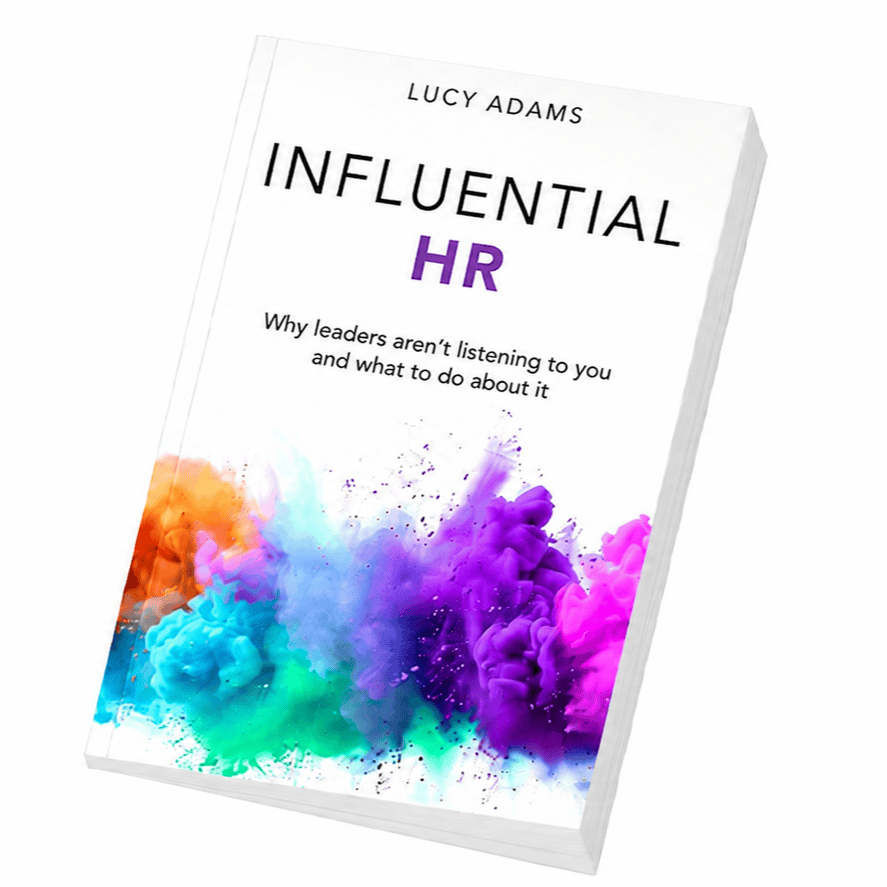
The third book in Lucy Adams’ series for forward-thinking HR professionals explores why HR struggles to influence leaders — and how to build the confidence, credibility and authority to create real change.


