

Is your organisation helping
people do good work?

A practical organisation health reflection from Disruptive HR.

Thanks for taking the quiz.

Your results give a snapshot of how work is really set up in your organisation right now, and what people are most likely experiencing day to day. 

If your results are strong, that’s worth celebrating as it suggests the way work is set up is helping people do good work more often than not.

If your results are mixed, that’s very common. Most organisations are still working with approaches to HR and leadership that were designed for control and consistency, not speed, judgement and innovation.

Changing how work is set up is one of the most powerful ways to improve performance, without asking people to work harder.

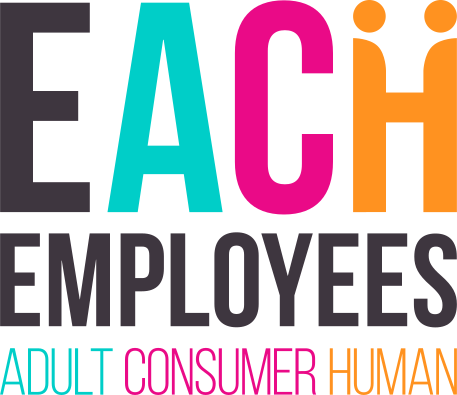
At Disruptive HR, we believe that treating employees as Adults, Consumers, and Human beings – what we call the EACH framework – can help you build an organisation that thrives in today’s fast-changing world.

The sections below explore what your results may be pointing to in each area and offer a small number of practical ideas you could try.


Trust, judgement and ownership

If your organisation tends to take a parental approach to its people, you’re not alone.

Many organisations have treated employees like children for decades, and HR often reflects that. There’s an underlying assumption that people, and particularly managers, can’t quite be trusted to handle the people side of work well.

Sometimes this parental instinct shows up as care. We tell people how to behave, what good looks like and how things should be done. We design frameworks, guidance and structures to steer behaviour in the right direction. We step in early and take responsibility, reducing the need for people to make their own calls. It’s meant to be helpful, but it treats capable adults as if they need instructing rather than trusting.

At other times, the parental approach shows up as control. We design the organisation around the fear that someone, somewhere, will do the wrong thing. Policies are written to cover every possible scenario. Rules are introduced for everyone when one person makes a mistake. Decisions are escalated and approvals added, not because they help the work, but to reduce perceived risk.

The downsides of this approach are significant. Innovation, challenge and sensible risk-taking are stifled. You still can’t truly protect the organisation from a minority, but you frustrate the majority. Managers and employees don’t build judgement because they’re rarely expected to use it. Trust erodes, engagement and productivity suffer, and HR ends up policing rules rather than doing work that adds real value.

Moving towards a more adult relationship can feel uncomfortable because it involves letting go of some control and certainty. But the benefits are substantial.

Three things you could try

  1. Start from the belief that the majority of people want to behave reasonably and responsibly
  2. Design policies that are lighter-touch and built around principles, not a rogue minority
  3. Create people processes that encourage ownership and accountability, rather than compliance

Insight, choice and relevance

If your organisation typically takes a one-size-fits-all approach to HR, that’s not surprising.

For years, HR has been rewarded for consistency and scale. One policy. One process. One version of “fair”. It looks neat and efficient on paper, but it ignores a simple reality. People don’t experience work in the same way because they aren’t the same. Roles differ. Context differs. What feels tidy centrally can feel clunky, frustrating or unhelpful in practice.

Organisations that treat employees as consumers take a different approach. They pay close attention to how work and people practices actually feel to use. They build insight into what different people value. And they design with choice, relevance and flexibility in mind.

This mirrors what effective consumer organisations do well They invest in understanding their customers. They recognise difference and personalise where possible and they involve end users in shaping products and services

The benefit of applying this thinking internally is that people practices are more likely to be trusted and used with intent, rather than applied mechanically.

Three things you could try

  1. Spend time understanding how different people actually experience work and HR processes

  2. Share insight with leaders about what people are saying and where approaches don’t reflect reality

  3. Introduce choice or flexibility in one area that is currently designed as one-size-fits-all

Leadership and HR that reflect real people

Many HR approaches to leadership and performance still aren’t designed around how humans actually think, feel and perform. Instead, they’re shaped by process.

When organisations haven’t trusted leaders to use judgement, the response has often been to give them systems to follow. Frameworks, cycles and templates that set out clear steps for how to manage performance, develop people or lead teams. The intention is understandable, but the effect is often the opposite of what was hoped for.

As process starts to dominate, leadership can become more distant and HR can end up managing cycles rather than shaping everyday experience. Leaders go through the motions. Conversations happen because the system requires them, not because they’re useful. Judgement gives way to compliance, and responsibility quietly shifts from the leader to the process itself.

This section explores whether leadership and HR in your organisation reflect how work really happens day to day, or whether systems and annual routines have taken their place. The impact is real, and most organisations are already living with it.

Organisations that put humans first make a different choice. They expect leaders to own how work feels in their teams. Performance, development and movement are talked about as part of everyday work, not saved for set moments in the year. HR acts as a people expert. Supporting judgement, offering insight and removing friction, rather than running the system on leaders’ behalf.

This doesn’t mean removing structure altogether. It means using structure to support judgement, not replace it.

Three things you could try

  1. Remove one template or form that exists mainly to reassure HR

  2. Be explicit that leaders own how work feels in their teams, not HR

  3. Give leaders simple prompts and insight that help them act in the moment

How we can help

If this reflection has raised questions about what’s helping people do good work, and what might be getting in the way, we can help.

At Disruptive HR, we work with organisations to rethink how work, leadership and people practices are set up. Not through big transformations or new frameworks, but through practical changes that make everyday work easier, faster and more effective.

You can explore our programmes and resources, or get in touch if a conversation would be useful.
hello@disruptivehr.com