

This week, the co-founders of Disruptive HR (and ex-CPOs themselves), Lucy Adams and Karen Moran, tackle the unique challenges faced by Chief People Officers (CPOs). They explore the scepticism often directed at CPOs and the pressure to conform to a metrics-heavy approach. They talk about the benefits of embracing a human-centric design for HR strategies and how shifting from rigid, traditional processes to adaptable, employee-centred practices, can enhance the CPO’s impact and credibility.
They discuss the challenges for CPOs of balancing operational tasks with strategic thinking amidst constant meetings and compliance demands. They share strategies to alleviate these pressures, such as empowering managers with self-management tools and adopting a product management approach for HR teams. Above all, the episode aims to equip CPOs with practical solutions to streamline their focus and enhance their influence within their organisations.
Chapters
(00:03) – Challenges and Solutions for HR Leaders
(14:01) – The Loneliness of HR Leaders
00:03 – Lucy Adams (Host)
Welcome to HR Disrupted with me, lucy Adams. Each episode will explore innovative approaches for leaders and HR professionals and challenge the status quo with inspiring but practical people strategies. So if you’re looking for fresh ideas, tips and our take on the latest HR trends, subscribe wherever you get your podcasts. So, hr Director, director of People, chief People Officer, vp of People and Culture there’s like so many different titles, but all with similar challenges and issues. So this podcast is all about the top job in HR and to help me explore these challenges and hopefully to offer some solutions, I’m joined by my co founder of Disruptive HR, karen Moran. Hello, how you doing? I’m good.
01:02 – Karen Moran (Host)
Thank you, Lucy.
01:04 – Lucy Adams (Host)
So I think we’ve agreed, haven’t we, that we’re going to refer to the top job as the CPO, aren’t we? Because it’s easy, yeah, and it kind of fits in, doesn’t it, with the rest of the C-suite. So we’ve got the CEO, we’ve got the CFO, we’ve got the CIO, et cetera, and it’s got the word people in it. You know which, hey? And whilst that might feel like a bit of a kind of non-issue, um, the people versus HR debate kind of neatly brings us, I think, to our first challenge, which is being responsible for people rather than finance or tech, et cetera. You know, sort of, whereas if you head up numbers or technology or logistics or procurement, like no one wants to challenge your expertise, do they? Like no one has any problems, kind of accepting your recommendations when you’ve done some research. And if you put forward your view, it’s like everybody accepts it if you’re in one of those. But when it comes to people, no one has any problem challenging our expertise, do they?
02:18
So I always remember there was a guy that I knew and he’d been I think he was head of logistics at Virgin Media and a guy that I knew and he’d been, I think he was head of logistics at Virgin Media and a guy called Morris hello, morris, if you’re listening and he was given the HR job. He didn’t have an HR background, but he. I was chatting to him one day and he said he said it just amazes me. So when I was head of logistics he said I would say, if I was being asked to do a recommendation to the board, I would like do my research and I would come with my proposal to the board and I would make my recommendations and nobody would say anything. They’d all be like yep, that sounds like a really good idea, morris. Now I’m head of people. He said I do the same. I do my research, I kind of draw up my proposals, I bring it to the board, I make my recommendations and everyone piles in as like oh no, that’s rubbish, a rubbish idea, you know.
03:13 – Karen Moran (Host)
And uh, yeah exactly so.
03:17 – Lucy Adams (Host)
I think that kind of sense of being the so-called expert of people can be challenging for CPOs. Everyone seems to have a point of view.
03:27 – Karen Moran (Host)
Yeah, and what’s our response as a CPO? I think we’ve tried to be more like them, haven’t we? You know, we’ve adopted the language we talk about human capital, we bring in the metrics, so we’ve got our engagement scores and our performance ratings and we’ve sort of wrapped ourselves up in a lot of process to try and perhaps be more like them. But I’m not sure it’s actually helped our credibility.
03:55 – Lucy Adams (Host)
No, I think you’re right.
03:57 – Karen Moran (Host)
And maybe we are better off embracing the fact and being proud of the fact that we know about people Brilliant, annoying, complicated, messy human beings the fact and being proud of the fact that we know about people brilliant, annoying, complicated, messy human beings, and maybe we should be happy that that’s our superpower you’re not suggesting that we should, as cpos, become like all trained psychologists or something no, no, it’s nice if you can, but you don’t.
04:23
You don’t have to be. And I think, if we think about some of the CPOs, that we know who we see having the most impact. They’re just the ones that are moving away from those kind of traditional processes and thinking about how can I design an approach to HR around how human beings think, feel, behave, are motivated. So you know, let’s take, for example, traditional performance management it being employee owned, involving frequent check-ins, no horrible ratings of meet expectations, changing traditional training programs. So away from the kind of you know we’re going to put you on a week’s course to micro learning, you know, five minute videos making the most of the talent you’ve already got inside your organization. So going much more for peer to peer learning. Moving away from those kind of horrible top down change programs that are kind of five years long to just adaptable small, bite-sized changes um you know, making use of early adopters, etc.
05:31
so I think all the changes that we’re seeing with traditional hr processes reflect that the most modern cpos are comfortable designing around human-centred approaches, how human beings think and feel, and they’re happy to say, yeah, I’m going to be the people expert.
05:53 – Lucy Adams (Host)
Yeah, I think you’re absolutely right. And of course, there’s always going to be some leaders aren’t there who won’t listen to us, even if we are embracing these human-centred approach. And I think for me this brings us to and I know you agree with me because we’ve talked about it but you know, I think arguably the most common issue amongst the CPOs that we meet and we meet a lot is that they worry, don’t they, that they just don’t have the influence that they would like to have. You know, they don’t feel that they’re listened to. They’re worrying that they’re not having any kind of impact. And I can really relate to this, you know, I remember getting my first CPO role and suddenly, you know, there I am in, like the big boys room.
06:36
And they were all men apart from me. You know these 50 year old plus something guys who were all chief execs. You know of their division, their respective business, and I was just kind of so nervous about being able to influence them to be heard.
06:56 – Karen Moran (Host)
Yeah, so what worked for you?
06:59 – Lucy Adams (Host)
Well, I think I think there was a couple of things. I suppose for me, the most important tip I would give CPOs who are new in role is just to get to know them. I mean like really get to know them, understand their business, get a strong sense of what drives them on an individual level. You know which buttons to press, which buttons to avoid, what worries them, what excites them and get a sense of what might make them change their mind. You know, I kind of started off working really hard on kind of business cases and trying to write a really great board paper, but you know, of course these weren’t going to change anyone’s mind. I would present data, but we know that most data is received in a way that we’re looking for confirmation of our own existing worldview. So that confirmation bias. You know, I would give a kind of one size fits all business case, this one board paper that was actually trying to cover off all of their objections or all of their needs and wants and buttons I should, should and shouldn’t be pressing. You know, this kind of narrow piece of analysis with data and a clear rationale was just never going to work and what I realised is that I actually needed a strategy for each of them. So my CEO at the time he was really driven by being able to beat the competition. So it was pointless me going to him with data around, say, performance management, and you know it’s not working, it’s not motivating people. But if I told him that our nearest and dearest competitors were doing something different, he would be on it like a flash. It would be like come on, let’s do it. So it was about really kind of tapping into what mattered to him.
08:58
There was another one that if I tried to roll anything out, they would always go on about how they were. If I try to roll anything out, they would always go on about how their business area was special and different. So I realized that I needed to reflect the fact that I had tailored it for them. Even if in the end it wasn’t wildly different, they had a sense that their needs were being met. So I think that would be my first tip is kind of really get to know them. So I think that would be my first tip is kind of really get to know them.
09:24
And then the second one is something that we talk to CPOs about a lot which is just don’t worry so much about the biggest resistors. We spend our lives diluting, compromising, delaying, giving up because the biggest resistors are making so much noise. You know, I was reflect on my time when I was at the BBC and I had this person who shall remain nameless, but he or she was like my nemesis right. Everything I tried to do, they would be very antagonistic, they’d be very vocal about how it wasn’t going to work. It wouldn’t work for their area of the organisation, and I would involve them in every consultation group. I would make sure that I’d kind of taken their views and adapt it and they would still, in the end, reject it.
10:20
So I think this kind of concept of going with the early adopters yeah, we’ve all got, haven’t we, a few managers or leaders in our organization who are a bit more open, a bit more curious? They might not be the greatest leaders in the world, but they are willing to work with us and so I think kind of working out who those early adopters might be, who are usually actually the ones who are frustrated with the status quo, and if we don’t meet their needs, then they go rogue and they kind of go off and do their own thing. But quite often I would ignore them to focus on the biggest resistors. Well, actually, I wish I’d spent more time with them and then get them to kind of, you know, talk about it and what’s working and get, get them to help promote it.
11:10
You know, we’ve even tried tactics with clients now where the biggest resistors you kind of openly exclude them yeah you know it’s kind of saying you don’t have to do this, don’t you worry about this, isn’t for you, um, and they hate that, don’t they? Because they’re they’re used to being the like, the problem child who gets all of the attention. So I think that I think those would be my two things. It’s like really get to know them. A one size fits all board paper is not going to convince everybody. You’ve got to think about individual strategies and you can only do that if you really really know them on a human level, them on a human level, um. And the second one would be, um, to kind of make sure that you’re not wasting your time, your talents your energies on the biggest resistors.
11:59 – Karen Moran (Host)
Yeah, I think um building on that. Obviously, if you’re thinking about larger groups of leaders, it’s it would be very difficult to have a strategy for each one of them, but yeah, yeah, you’ve got like 2 000 leaders.
12:10 – Lucy Adams (Host)
You’re not going to have 2 000 strategies, are you?
12:13 – Karen Moran (Host)
but we can use personas. So if we think about personas, you probably could could have maximum three, but that would probably work for you. So identifying three leader types and then just work through what would make them want to change and, of course, again going back to our using these early adopters, using peer-to-peer learning. Often it just resonates more with them than just hearing from us, and I think the other tactic is is giving them more options yeah there’s nothing more frustrating for our leaders when we’re kind of saying this is it, go and implement it in your area.
12:56
But actually if we can show and recognise that they are, that they’re all going to be different, that they are special, that particular business unit is special and giving them choices, I think really is powerful for us. So we could say, for example you know what? How do you want to adapt this approach to performance management that suits your area? Or why don’t you have your own survey tool that you can ask your team how things are going? Things like that will, I think, really help us get buy in.
13:26 – Lucy Adams (Host)
Yeah, and we kind of it means that we relax a little bit. You know, this idea that everybody’s got to do it in exactly the same way, I think, showing that we recognize the differences in the business. I was talking to one CPO recently and he was telling me that they have a really clear strategy that they never do mass rollouts of HR initiatives. You know, it’s all about recognising that they’ve got very different elements from warehousing to, you know, shops, retail to head office and so on. So, yeah, I absolutely agree with that. There’s another challenge that we hear a lot about and that their CPOs are struggling with, and it’s just the kind of the sheer amount of work that they’ve got to do, isn’t it?
14:12 – Karen Moran (Host)
Absolutely. I mean, God, we can think about our own experiences. It just feels like you’re spending all day in meetings. You’ve got all of this transactional stuff that somehow does need to be done and it’s hard to know that to take the time to look up and out. It’s almost like you feel that you’re you’re being naughty by taking that time to learn and grow and try and have kind of more innovative ideas, um, and you’re just often so tired, aren’t you?
14:44
yeah, and sometimes, if you’re not getting that pressure from your executives, it’s easy just to kind of go just carry on doing this, because it’s just a little bit easier, yeah. So what would your, your solution to that be?
15:01 – Lucy Adams (Host)
yeah, I mean, I remember it so vividly. You know that kind of remember. One day I had like 14, because they were, you know, broken into 20 minutes and half hours and stuff. You know 14 back-to-back meetings and you get back to your desk and you’re like, right, I need to have some big strategic thoughts here. So actually I’ll just go home and eat some chocolate, um.
15:23
So I think there’s a number of things that we can do as CPOs. I think one of the first things is being really clear. What can we actually stop doing? You know so much of what I used to do as a CPO and I know the same for you and other CPOs that we meet is that we are chasing compliance with some of our processes. You know we’re not the compliance officer, it’s. You know we talk a lot, don’t we, about this kind of adult to adult approach, but we don’t have to ensure compliance, we don’t? You know this kind of idea that, well, how will we know if they’ve done it? Well, ask people. You know, ask people if they’ve done it. But this idea that we’re always chasing and I think a lot of effort goes into that so, being clear what we can stop Also, do we have to own it.
16:19
You know we own the engagement survey, the annual reviews, all being owned and driven and monitored by HR. Could we actually just give the tools to managers and let them implement it? Now, of course there’s going to be some managers that won’t do it, but let’s face it, they’re probably having a. You know, their employees are probably having a poorer experience anyway, aren’t they? So making them do stuff, I don’t think, necessarily helps that experience.
16:58
I think we can be better at focusing on the outputs and outcomes that we want from leaders and managers, rather than and this is how you have to do it we can still measure it, but let’s measure accountability for the achievement of those outcomes.
17:12
You know that classic one that we both love, sap. You know where they said to their people leaders we want you to show appreciation, uh, lead with trust and coach your team, and we’re not going to tell you how to do it necessarily, but we are going to ensure that you’re meeting those outcomes and we’re going to do pulse surveys and check. When I first became a CPO, I remember going and asking very experienced CPOs, kind of just for some tips, and people gave me, I’m sure, lots and lots of useful advice. But there’s one bit of advice that really stands out and that was a guy who was a CPO at this big pharmaceutical company and he said Lucy said it’s very, very simple. He said just get good people in and bad people out. And I just thought I wish I’d stuck to that in some ways. I think it would.
18:15
I think I’d have been a much more effective CPO if I just focused on that. You know, good people in, bad people out. Unfortunately, I did get waylaid on all the other minutiae that we do. I think there’s another thing, probably final tip on this kind of how can we create more headspace, create more time is let’s learn from product designers, product manufacturers, that you only have two or three things on the go any one time. You know, and you and I, I mean we were terrible, weren’t we? We used to have our strategic plans, multiple priorities under each strategic priority. Remember when we’ve like put up all the yellow stickies along the filing cabinets, with each one had a um like a different color sticky.
19:04 – Karen Moran (Host)
Oh were they. I didn’t remember that.
19:06 – Lucy Adams (Host)
On the theme, oh my god, and this is really motivating, didn’t we?
19:13
we anticipated everyone coming up the stairs seeing this long line of stickies and going, wow, let me just get going. And of course everyone just wanted to go home immediately when they saw that it was just exhausting. So you know, I think the HR teams, the CPOs we see having a real impact, are much more aware that actually they can use sprint planning, focus on a small number of products at any one time and really kind of drive those rather than trying to focus on too much.
19:45 – Karen Moran (Host)
Yeah, I think as well. It’s probably worth us reflecting about how much our HR teams are still doing for managers. Yeah, it’s almost a bit of an elephant in the room and you know, we know that organizations are saying that leadership development is probably their biggest priority. Yet we’re not really helping this, are we? Because we’ve slipped into this kind of nursemaid role where we’re kind of doing everything for them because maybe we don’t trust them to do it right, or maybe it’s because it gives us a? You know, I know myself it gave me a sense of sort of my credibility was around being able to help them yeah, they kind of go oh, I couldn’t do it without you.
20:25 – Lucy Adams (Host)
Thank you, yeah. And then you realize all you’ve done is write up the notes from that grievance meeting or you’ve had that conversation that they should have been having.
20:34 – Karen Moran (Host)
So I think for CPOs, their focus has to be on getting their HR team or their business partners or whatever. The model is shifting toward much more of a consultancy and coaching style. So we’ve got to be building managers confidence and capability to handle their own people issues, which, of course, we know is going to have a much bigger impact on their team’s experience at work. You know us doing it for them is not helping that and it’s not giving them that accountability. I think we’ve kind of almost we’ve kind of made this problem in a way by being there for them and actually if we can build their confidence, they can do it themselves and they probably will do it really well. We’ve just got to let go a bit, yeah, I absolutely agree.
21:24 – Lucy Adams (Host)
OK, let’s kind of do look at a final challenge. I mean, obviously there are loads of challenges of being a CPA. I’m not suggesting that these are the only few that we’ve got to deal with, but I think one that doesn’t get mentioned very often is it’s actually really lonely being a CPO.
21:43
You know, you’re often having to kind of deal with lots of sensitive information, aren’t you? And so you can’t share that information. And, of course, everyone else is allowed to have a complete meltdown. But you’re expected to be a hundred percent resilient, aren’t you?
21:58 – Karen Moran (Host)
yeah, you’re not allowed to have any problems at all?
22:00
no, I can remember actually going through, um, a big office closure and it was about a year-long program and we were either relocating people to a different office or making redundancies. It was a brutal 12 months. But um, for me, I mean, everybody was going through a lot. So you kind of feel like, well, you know we’re all going through it, but I was the kind of HR villain. You know, I was the one delivering, you know, labeled as the person delivering the bad news. I was doing it to everybody and I can remember just feeling very excluded, you know so, because it was over 12 months, it’s all anybody wants to talk about. So you know, around the, you know the pubs at lunchtime, the water cooler moments, that’s all anybody wants to talk about.
22:47 – Lucy Adams (Host)
Did they all go quiet when you kind of walked in? Oh?
22:50 – Karen Moran (Host)
no, that’s so horrible not getting invited to the pub at lunchtime and you know, no one would talk openly in front of me and I and I did, and I kind of felt I understood where they were coming from because I was constantly being taken into rooms with the door closed and it was just. It wasn’t was not nice and it wasn’t nice to for people to see me as the face of something that they were really upset about. Yeah, particularly for me, because I know some people say that you have to be really tough in HR, but you know I hate not being liked. It was, it was, it was bad. It was bad, it was a brutal 12 months.
23:29 – Lucy Adams (Host)
And I don’t think there’s any easy answer. We’re always going to be dealing with sensitive and quite often difficult information and projects that will have an impact on people, sometimes positive, but, you know, often not positive, particularly, as you say, around restructures and things like that. So I don’t think there’s a really easy answer to that, things like that. So I don’t think there’s a really easy answer to that. But I think making sure that you’ve got a solid network of peers and having people outside of your organisation, not just inside and I think again back to what we were saying earlier if all you’re doing is looking in and down because you’re so busy, then you stop kind of connecting with other people. I remember when I was at the BBC I would go out for dinner probably once or twice a year with the HR director of Channel 4, the HR director of Sky and the HR director of ITV. For those people who were not listening in the UK, those are obviously the other main broadcasters in the UK pre Netflix.
24:31
Obviously the other main broadcasters in the UK, pre Netflix, yes, and. And we would go out for for dinner, and whoever was having the hardest time would, the others would pay for their dinner, and I did used to win quite often, but just the sheer joy of being able, in within reason, be able to share what was going on for me, for them, you know, quite often you’d end up laughing, you know, and I think also having a great team of people who are sharing that taking they can’t always take all of it away from you, but they can take some of it. And again, our team at the BBC was magnificent, for that wasn’t it, you know they were. Again we would end up laughing, can take some of it. And again, our team at the BBC was magnificent, for that wasn’t it, you know they were. Again we would end up laughing. We’d kind of start with our heads in our hands and, you know, particularly very difficult, challenging times, but, but we would end up laughing and you know you just felt this kind of renewed energy.
25:26
So I think there’s something about, you know, making sure that you’re looking after your own mental health and don’t imagine that you’ve got to be a superhero. You know, kind of take time for you to learn and connect and, as you said, you know we don’t always kind of seem to value ourselves highly enough to make time for this, but it will really help us in the long run, absolutely. So I think that’s probably it for today. We really hope that you’ve enjoyed this episode and if you are a CPO and you just want to share what’s going on for you, do get in touch with us. The contact info is in the podcast notes, but for now, goodbye, and see you next time.

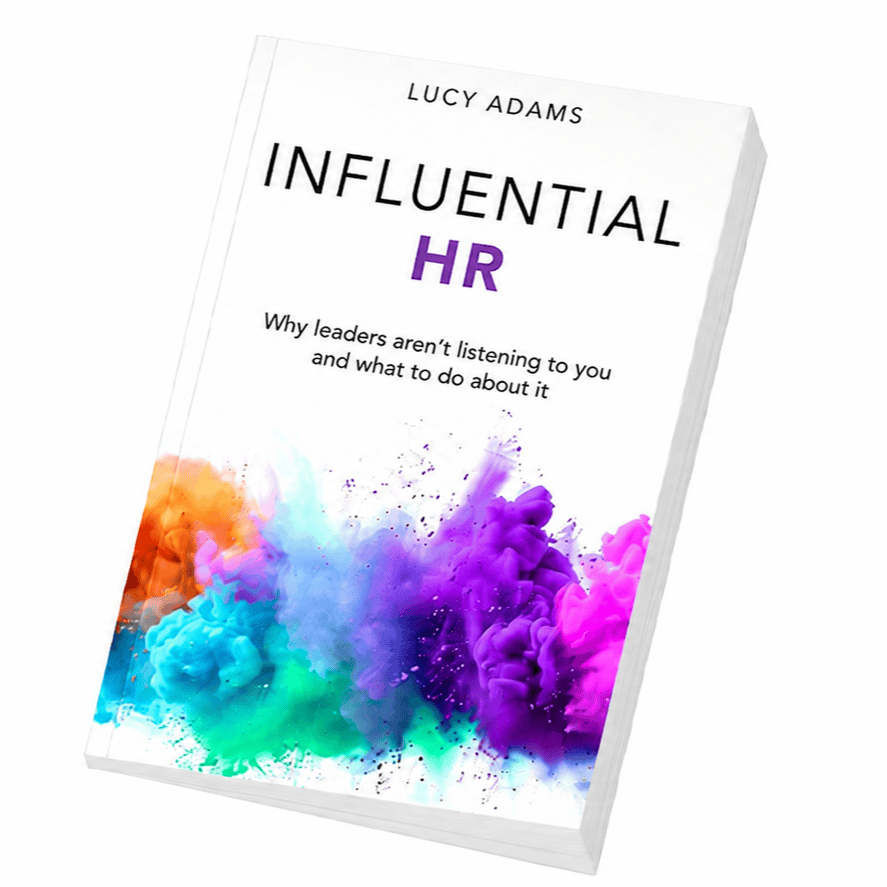
The third book in Lucy Adams’ series for forward-thinking HR professionals explores why HR struggles to influence leaders — and how to build the confidence, credibility and authority to create real change.


