

In this episode we explore the crucial and often overlooked issue of supporting family caregivers in the workplace. Stephanie Leung, CEO and founder of Karehero, who shares her personal journey from a high-flying career at Goldman Sachs to becoming an advocate for caregivers. Stephanie opens up about her experiences as a family caregiver from a young age and the challenges she faced balancing work and caregiving duties. With over 7 million people in the UK alone juggling these roles, it’s time we address the pressures they face and how employers can step up to support them.
Stephanie’s story highlights the pressing need for better support systems for working caregivers. Her experience underscores the often-unrecognized burden many employees carry, dedicating over 33 hours a week to unpaid care on top of their regular jobs. Stephanie emphasizes the need for organizations to adapt to the realities of an aging population and a shrinking birth rate. The importance of understanding individual needs within the workforce is paramount to retaining talent and preventing burnout. We explore how employers can create supportive environments for caregivers, ensuring that employees don’t have to choose between their careers and their loved ones.
Chapters
(00:03) – Supporting Family Caregivers in the Workplace
(14:01) – Business Solution for Family Caregiving
(25:14) – Supporting Working Family Caregivers
(33:53) – Future Workforce Care Challenges
Karehero https://www.karehero.com/
00:03 – Lucy Adams (Host)
Welcome to HR Disrupted with me, lucy Adams. Each episode will explore innovative approaches for leaders and HR professionals and challenge the status quo with inspiring but practical people strategies. So if you’re looking for fresh ideas, tips and our take on the latest HR trends, subscribe wherever you get your podcasts. Hi and welcome to HR Disrupted with me, lucy Adams.
00:33
Now there’s always loads of talk in the workplace about how we can adapt and cater for the needs of millennials or the parents of young children, how, as employers, we could do more to support them. But there’s actually an even bigger issue that doesn’t get spoken about very much. You know people in the workplace who are caring for a relative typically an elderly relative and there’s over 7 million of these just in the UK alone. So a huge, huge issue. But what are these issues? All right, so what does that actually look like for employees who are caring for relatives, and how can employers support employees who are going through this? And that’s what my guest today is here to talk about.
01:26
So a big welcome to Stephanie Leung, who is the CEO and founder of the company Karehero Heroes. So welcome, stephanie. Thank you, lucy, it’s great to be here, it’s great to have you on, and we usually start these podcasts just to get a bit of a sense of people’s journey, how they get got to doing the role that they’re doing, and I have to say, not many of my guests have quite a shift of direction, as you have had. So it would be great. Just share with us your kind of Karehero journey and ending up with Karehero and how you came to founder that.
02:08 – Stephanie Leung (Guest)
Great. No, thank you, lucy, and thank you for having me here today. So my journey to Karehero Karehero actually it’s almost full circle to where I started. So I’ve been a family carer since the age of 14. I grew up watching my parents get sicker, but mostly my father, and I found it was the common thread throughout my entire career. So I actually started out my career at Goldman Sachs and I started out in Tokyo and then London and spent a bit of time in New York as well, and throughout that, if something would happen at home. So family carers typically have a dependent within the family that is going through a medical issue or going through a chronic illness that requires this. And did your parents?
02:58 – Lucy Adams (Host)
move with you, or were you having to deal with the additional burden of the travel?
03:07 – Stephanie Leung (Guest)
to deal with the additional burden of the travel I’ve. Literally. I have many, many stories of me getting a phone call in the middle of the night, having to take time off, work, getting on a plane. In one incident I was in Boston and I remember it was snowing. I literally packed my bags, got in a cab and went to the airport and said get me the first ticket out of here and of course you know very expensive last minute tickets. But yeah, um it I. I have siblings, but it was, it was always. I was always the default family caregiver and it meant that many times I would have to rush to hospital. It didn’t matter which country I was in. I could be flying back from Asia for 13 hours. Um, and so I, I.
03:40 – Lucy Adams (Host)
This was always just on that because this is a very personal question actually, because I was the default carer for for my mom and I just wondered is that typical that even in a family with plenty of siblings, there’s always one that tends to either step up or is more in demand? I don’t know quite what it is, but is that typical?
04:04 – Stephanie Leung (Guest)
It is typical, unfortunately. So Karehero now deals with thousands of families going through this, and we typically see there’s one person in the family who is the default caregiver and, if I think about it from an HR perspective, it tends to be someone who is responsible, organised, able to multitask and just doesn’t drop the ball. And families, especially parents, are normally quite smart to know who that child is.
04:32 – Lucy Adams (Host)
That is so true with my mom.
04:34 – Stephanie Leung (Guest)
Absolutely. If you fault, they’ll realize.
04:37
Well, I’m going to ask the one who’s reliable to talk this out for me, and so you will get that phone call. If you happen to be that person, it’s the eldest daughter. We see that. Yeah, there we go. In my case, I’m the youngest daughter.
04:51
Um, however, what’s what’s interesting is, um, it is then quite hard for that person to explain what they’re going through to the rest of their family, and it makes extremely challenging when you’re trying to make decisions for your loved one where you’ve gone through the research, you’ve done all the hard work, you’ve looked at all the small print paperwork, legal, financial stuff, and then you need to make a family decision, and that is where it becomes extremely painful for many of these people who step up, because many of them don’t realize what they’ve had to go through and say, well, it can’t be that difficult or why do I have to think about this? And almost it creates a lot of family friction. We realize that is a dynamic the world over. What is more concerning, though, is the world is now. Every advanced economy in the world now has an elderly population crisis or an aging population crisis, and, just from stats alone, there are 55 million caregivers in the US who are juggling work and care. There are 10.6 million family caregivers in the UK, of which over 7 million of them are juggling work and care, and in the whole world there’s 100 million of them. Um, wow. And.
05:56
But the more disconcerting uh statistic on top of that is that we have a shrinking birth rate. So in the UK, 44% of families now only have one child. In continental Europe, 49.4% are families with only one child, and if you go to countries like Portugal or Bulgaria, it’s actually 65 plus percent. So it means the majority of families only have one child to rely on if something goes wrong with your parents and we’re seeing that the world over and this means that that person is increasingly having to figure out how do I keep my career and the well-being of my loved ones, and unfortunately, women normally either volunteer or bear the brunt. Unfortunately, women normally either volunteer or bear the brunt, and so it’s quite interesting that women are four times more likely to quit their job or go part time.
06:50
If they are, come see someone coming into a caring issue.
06:53
And if you’re married, your spouse, your partner, let’s say your husband, will tend to hand their own parents to you, and so you’re doing it anyway. So it’s quite interesting because we’ve spoken to many, many parents, sons, who don’t recognize that they’re a caregiver, even though they see their wife going through it, and I think that’s quite interesting. Yeah, and in the UK for sure, most women, if they are coming into caregiving, the typical age is 40s, and for a man, if they’re going to be a caregiver, it’s in their typically it’s in their 50s, and that’s because their spouse is unwell. However, what we’re seeing is 40% of family caregivers now are getting are younger than 40. And that’s because their spouse is unwell. However, what we’re seeing is 40 percent of family caregivers now are getting are younger than 40, and that’s because we we have many clients where they’re in their 20s and they’re looking after their mother because their mother has burnt out from caring for their parents, so they’re just builds and builds amazing stats and I want to dive into those.
07:55 – Lucy Adams (Host)
But but, I equally. I still want to hear about your journey. So, uh, there you are, goldman Sachs kind of you know high-flying corporate career and and you’re, you’re taking on the responsibility of caring for your parents, as you say, particularly your dad. So where did that go?
08:15 – Stephanie Leung (Guest)
yeah. So unfortunately, my career is checkered in in many ways. So, um, I went from. I went from banking to consulting. So strategy consulting actually was working out of boston um and I was almost sort of like a chief of staff for the uh, for the chairman of monitor group.
08:31
Um and for those who don’t know, it’s a, it was a um, it was founded by michael porter came out of Harvard Business School and even there, six months into my role, I had to quit my job and literally left the US to come back and look after my dad and I think I took about six months off. But the amazing thing and this was in the early 2000s the amazing thing about that, as I recollectect it now, is that my manager was amazing. He basically said take all the time you need. I had resigned. He refused to take my resignation and, um, and what was and it’s something I’ve lived that this experience is that when you go back, you are a hundred times more loyal to that company, completely because you’ve realized they were there for you when no one else was you. They and my manager called me every two months to check in on me.
09:20 – Lucy Adams (Host)
Just say how you’re doing and that’s not typical, is it not typical? But I think we recognize that there are these moments that matter, that define your view of your experience with that organization, and absolutely at the top of those moments that matter is you know you’ve given everything and then something goes wrong for you and you need that support. And how do they respond?
09:45 – Stephanie Leung (Guest)
and I think it’s such a defining moment yeah, what I loved about in is, as I think back to those times, I think people underestimate being a family caregiver is extremely tough and you want to remember your identity other than just being a family caregiver, because you almost get absorbed into that role and doctors will call you, you’re dealing with government forms and all sorts of things you need to remember there’s another human being there, not just, yeah, daughter or the son or the spouse or the partner, and it’s and and’s almost. You need to hang on to that for your own sanity, say, because it’s so tough. You know you’re going to burn out sometimes when you’re having some very difficult moments as the carer, and so for me, that was almost a reminder that there is a place that I can go back to. There is someone who recognizes me beyond you know, sitting next to a hospital bed or trying to set things up for your, for your loved one.
10:38
And I think that is what makes it very difficult, because women now well, not just women, but men as well if you become a family caregiver, many of them burn out but don’t come back into the workforce ever. So in the UK, for example, 600 people walk out of their job every day, but they’ve left the workforce permanently and that is a real shame for the economy. Because you think about productivity and then you couple that right now, for example, the UK is quite in particular. There’s almost 3 million people now on long term sick leave who are of working age, but they, but many of them, are either they’ve come into chronic illness themselves, but you think about all these people. They have a carer. That is a reflection of where the economy is. We lose over 8 billion pounds a year just on lost productivity due to the issue, and so it’s not small at all.
11:25
But back to my own journey. Essentially, I ended up working for almost 10 years in the States. I then went to work in Asia for almost seven, eight years. About 15 years ago I started taking on C-suite roles. So prior to starting this company, I was sitting in the C-suite of the Forbes top 20 company, helped manage McDonald’s as a global supply chain, as a customer, and then, when I came back to the UK, I sat on the leadership team for Uber and managed about 20 countries and sat on the NED board here.
12:01 – Lucy Adams (Host)
so I had a very and a particularly difficult time for Uber as well, wasn’t it? Because it was the time when transport for London for non-UK listeners that’s the kind of the regulatory body, yeah, the government, the regulatory body that that really had it in for Uber. At that point you know you couldn’t move a muscle.
12:22 – Stephanie Leung (Guest)
Yeah. So I was hired into Uber at a time when they morale was very low. Half the team had left. They had they were the licenses on probation and I was one of a few people who came from a corporate career and they said, right, we’re about to IPO, we need to straighten ourselves, and essentially we had to go back to court to retrieve our license, and so my one of my roles was to build up our safety, risk and compliance operations to be able to deal with, you know, any accusations about safety issues and things like this. So it was a very intense process. But even through that, in the background, I was going through caring issues and nobody knew, because you’re coming to work every day having to put your A game on, and so that was a pretty particularly challenging time.
13:04
And then we went through COVID. So, as you can imagine, during COVID everything stopped, and so we would wake up one day and say, right, all the cars have stopped today, what do we do? And there was an even even from employees perspective. They were going through their own personal crises as well, like stress was very high, people worried about their family. Um, one of the good things that have come out of covid is that people now realize family. You know who they are at home and their family. They do bring it to work and you have to and I think that hasn’t really returned.
13:34 – Lucy Adams (Host)
So a lot of things that the gains we made in COVID like you know, remote working and so on, some of them have been diluted over the years but since COVID. But I do think that sense of well being we’re not just, you know, automatons that come into an office and just pick up from there, but that sort of sense of the whole person. I think has largely remained.
14:00 – Stephanie Leung (Guest)
Yeah. So you asked me earlier how I then came into my journey at Karehero. So the tipping point for me was one Christmas. About three Christmases ago. Both my husband and my father became sick and they went into hospital at exactly the same time, but the hospitals were four hours apart, so I was driving up and down the country.
14:20
And my husband has traditionally been my pillar of support when my parents get sick. So I lost my pillar of support and I remember taking Zoom calls from my steering wheel. I was the COO of a company by then and I realized that it was really unsustainable. And it’s because I’ve been here before. I thought why did? Why does this keep coming back to me? Yeah, and I think the real aha moment for me was I I recall this distinctly I was sitting in a hospital car park, it was raining and I’d finished a call on my at my steering wheel. So I closed my phone and I just stared out the window for a good 10 minutes without saying a single word and I just saw my life flash before my eyes for the next 20 years and I I said to myself I am going to be back here again and again and again. This is not going away. And people around you at work might say, oh, don’t worry, take some time off.
15:10 – Lucy Adams (Host)
But really that’s not what you need and I, and I think you know and and no doubt there will be, because statistically they’re going to be you know, a large proportion of the people listening to this will have experienced it or are experiencing it.
15:24
Certainly I’ve experienced it and it’s that realization and and of course it’s obvious, but I think you have that I remember that aha moment for me as well, where you realize that this is not only not going to go away, it’s only going to get more difficult and challenging. You know, when you’re a parent of a young child and we’ve both been there when you’re a parent of a young child, yeah, every week you see them becoming more able, more independent, less reliant with your parents. When they’re sick, when they’re frail, it’s only going one way yeah and um, and you’re trying to prop things up, aren’t you? And you’re trying to um, and you know things used to drive me insane was the kind of the, the hospital appointment schedule. You know there is no sense of accommodating working relatives is there and I think that’s what made me quit my job.
16:20 – Stephanie Leung (Guest)
Actually, I kind of said this is a. It’s almost like a road I have to go through to get to the other side. I need to understand how I don’t get back here again. Yeah, and I thought the next time this happens, I don’t want to be stuck in a car with no solutions and no one to support me and um, so I essentially went through almost like an eight month soul-searching journey. Um, many people came forward with job offers and I turned them all down. Um, some of them were for, like, c-suite for public companies or companies about to IPO. I turned down a huge pay package for one where my husband thought I would I’d actually slightly lost the plot, but I realized that it wasn’t until one day I was invited to join a dinner and I ended up sitting next to the former chairman of NHS and I shared with him my experiences and he he had heard about me through through the grapevine and he knew that I had managed thousands of employees and millions of you know rides every year for uber.
17:20
And he said well, you know, you know how to solve for scale, steph, so what would you do, um, if you wanted to solve this. He said why don’t you look at it as a business? And I think that’s when, as I was explaining to him how I would solve this at scale, I realized that was the birth of Karehero, and and through there, oh, I’ve got goosebumps at that.
17:38 – Lucy Adams (Host)
That’s really, um, that’s amazing. That’s, as you say, that kind of alignment of something that you’re experiencing. That is incredibly troubling. But all of your wealth of expertise and applying that business mindset to what is a very human, personal problem, exactly, and I think what?
17:58 – Stephanie Leung (Guest)
um? What really surprised me was, as soon as I put my hand up and said I want to do this, lots of people came out of the woodwork and said this is a great idea, you should do this, and so we ended up um having people you know some of our investors is like the former ceo of bupa, the former chairman of comic relief, which is a very big charity here in the UK really well respected individuals, because all of them had gone through the caregiving journey and they understood that this is no longer something that you can just brush aside. So in the UK, for example, there’s now more adult dependents in the workforce than child dependents yeah, I mean.
18:33 – Lucy Adams (Host)
That stat just blows my mind, so it’s worth repeating. Just say it again.
18:38 – Stephanie Leung (Guest)
So there are now more adult dependents in the workforce than child dependents, which means that, essentially, when you come to work every day, you have someone in your mind that you are fully taking care of or supporting that care of, who is going to get more and more dependent on you, not more and more independent. And so back to your earlier point, lucy. Children grow up. I have a teenager. He’s going to grow up and he’s going to be more and more independent and you watch them flourish and go off and have great careers and get married and hopefully and things like this, With your parents or a loved one if they’re sick.
19:12
You are managing through their ups and downs and you’re trying to make their pain go away. You’re trying to handle all the bureaucracy that their care requires, and that is a it takes. I mean it’s a full-time job in many cases. We recently did a study with one of our clients um, carers are spending more than 33 hours a week on care outside of their day job, which is about 40 hours. So that’s like an eye banking job and they they’re not paid for it, they’re not recognized for it.
19:39 – Lucy Adams (Host)
So tell us I mean, I think this brings us nicely to Karehero and what you’re doing now Tell us what Hero and start to kind of link that to what could employers who are listening, start to think about what they might be able to do yeah.
19:59 – Stephanie Leung (Guest)
So I think there’s a couple of things that employers can do. Most employers do not have any adult dependent um support in their in their company in the uk today, which I think is pretty bad. Um, in the uh, in april, the 6th this year, the Carer’s Leave Act came into force in the UK, which means that for the first time in the country, an employer has to recognise someone who’s a family carer, so someone who’s actually got an adult dependent or a child dependent, but mostly for adult dependents that if they require support or they require flexibility, the employer needs to demonstrate that they have done enough to support them. You’re also allowed one week unpaid leave off every year. But frankly, that’s not great because, as you will know, having gone through this journey, it isn’t about taking you know, taking time off here or there.
20:53
It’s that it’s an ongoing issue and one week of unpaid leave is almost nothing. So we’ve seen some employers who’ve really embraced this and said well, actually we do want to put paid leave in. And one thing I think is really important to share is Sometimes HR leaders get a bit afraid because they’re like, well, you know, if I give two weeks paid leave off, they’re just going to take that as annual leave and go and sit on a tropical island somewhere and sit. We now have study and statistics to show that even if you did that in aggregate in one year, they will only take three days off, which is paid leave, which is paid leave.
21:26 – Lucy Adams (Host)
This is fascinating, isn’t it? You know this, this kind of idea that if we, if we try and support people, then they’ll abuse it and and, and, of course, there will be the odd rogue employee who might, but actually the vast majority of the people that work for you won’t. And, as you said earlier, what are you getting back in terms of their loyalty, their commitment?
21:51 – Stephanie Leung (Guest)
um, you know their retention of these great employees and, as I mentioned at the beginning, these are people who are really good at multitasking. I recently spoke to a lady who works in the civil service and she said some of the carers who are project leaders for her the some of the most resilient people you’ll ever meet. And and she said something to me which really struck a chord with me. And she said there’s very few circumstances within a working environment that you can create that level of life and death crisis or being able to operate through high stress situations. And she said if you’re a caregiver, you see that every day and what it means is you come back to work very resilient and you’re probably pretty calm underwater. So it’s quite interesting.
22:32
When I joined Uber, we did go through various difficult I mean, obviously COVID took everybody by surprise, but even going through our own regulatory things, I was throughout my career. I’ve sort of been quite well known for being quite calm under a crisis. So if you have crisis turnaround issues at work, I tend to just come in and say, right, how do we put this all together? And I realize this because I’ve been trained since birth to say this stuff coming at you, you have no idea what’s going on, but you have to get your wits about you really quickly think on your feet how to get organized, talk to multiple stakeholders to really put something together. And it’s because it’s life and death. It’s right. How do I intervene to make sure someone has a soft landing or a safe landing and that’s your loved one.
23:14
But you transfer those skills back into work. These are real assets and I think one of the things that bothers me sometimes is if someone’s not familiar with who’s a family caregiver and they think about this like, oh, you’re looking after an old person, fine, I don’t care about this. Like, oh, you’re looking after an old person, fine, I don’t care. Actually you’re sitting on really great human asset here of someone who can take a crisis and will think clearly because they’ve been through it and I’m not saying that’s everybody who’s been a carer will demonstrate these skills.
23:41
But they have had a lot of training in the background that wasn’t on corporate time, but they bring those skills back into the corporate workplace and they are incredibly reliable and and, as you know, as you’ve all sort of re-mentioned the loyalty you get for having been there as an employer for them when they have gone through that crisis or they’re looking after someone in the background. You can’t buy that. Like you know, you can double someone’s salary, but they’re not reliable or they have no loyalty to you. They’ll just walk, and I think you know we talk about the future of work, talent crises, shortages or even a war for talent. This is a really under spoken and almost, like you know, hidden gem here that we should be latching on to and celebrating and embracing, as opposed to oh, it’s another inconvenient thing that someone’s got to deal with.
24:34 – Lucy Adams (Host)
Tell me about how Karehero the gap that was evident to you as a carer.
24:42 – Stephanie Leung (Guest)
Yeah. So when I started Karehero I didn’t want to start a signposting service. There’s lots of charities that do that really well. Um, what I wanted to do was remove stigma from the workplace. So many carers don’t know their carers. They think they’re just being a good kid, they’re being a good partner, but they are. They are, but you know, you wouldn’t say that about a new mom, uh, or or even a woman going through menopause. You embrace that because of awareness and I think so. A lot of it is around wanting to be a company that works very closely with employers to remove that stigma, and it might be around.
25:14 – Lucy Adams (Host)
I’m interested in that this stigma is is there a? I mean I can’t think why there would be, but intuitively I kind of sense that there might be some shame around talking about this in the workplace. Is that backed up by the research that you’ve?
25:28 – Stephanie Leung (Guest)
done, yes, so well. Well, there’s two problems. One is that person may not realize they’re a caregiver. They just realize they’re really busy and they’re taking all their annual leave to go and look after someone and they come back feeling burnt out. So most people and I, if I look back at my own career, I would take a week off and someone would say, oh, how was your holiday? My holiday wasn’t a holiday, it was sorting out all the paperwork for my dad, trying to sort of like the list accumulates and then you need time off to go deal with it.
25:57
And then the second thing is even if you are a carer, you feel is it’s in this way, it’s very similar to parenting you feel that you, like, you don’t spend enough time looking after that person. You know they’re in pain and it’s not sexy to come to work and say, well, I had to bathe my mother, um, I had to feed my father with a spoon because he’s got Parkinson’s or advanced MS or he’s got dementia. Now, um, and you know, and recently we, we did some work on dementia it is, it is definitely um, quite uh, you know, it’s almost even quite personal to talk through, but we’ve met many people where they will talk to us about violence in the home, where mom didn’t recognize me last night and threw something at me. She thought I was a burglar and that’s not something you want to share with people.
26:45
Yeah, in one particularly uh, I hate to say this we’ve heard people have family groups at work as an ERG and someone brought it up something that happened at home with an adult dependent and they were actually asked to not talk about it because it could be triggering to other people and I thought that was a real shame. Because they don’t now.
27:07 – Lucy Adams (Host)
They don’t have a safe space to talk about Absolutely, and there’s something about the awareness raising, but but also quite practical support, not just signposting that Karehero does, yeah.
27:18 – Stephanie Leung (Guest)
So so when I built Karehero, I basically it’s quite selfish, really I said to myself the next time I’m behind the steering wheel in a car park, who do I want to call? What do I need in order to get me through this journey? And so we started analyzing everything that that journey entails and it’s it’s understanding. Do you have the legal framework to actually support your loved ones? So legal power of attorney is very important in this country. Without that, you actually can’t make decisions for your, for your, for your loved one. And then what’s interesting is that we deal with clients who are trying to figure out what kind of care structure or care setup they need, or even putting things in the house to help someone increase mobility in the house. And the first thing they ask is can I afford this? Is there any funding there? What can I afford to do? And so we realized what they need is help figuring that maze out Like what is government funding available? Is there funding available based on this person’s illness? And then 50% of this country who are eligible for care funding don’t apply, and that’s because they don’t know which forms to fill in. They don’t know how it’s going to impact the rest of their income. Let’s say they also see the form. It’s 40 pages long and they’ve already got no sleep. They’re trying to juggle the expectations of their boss, they’re probably ashamed to bring it to work and they’re feeling a bit burnt out. So it’s all this overwhelming journey. And what I said to myself was if we could start a company where, at the click of a button, you can talk to someone who will turn that spaghetti into a straight line for you and just walk you through each chapter of your journey and hold your hand the entire way, what would that journey look like? And essentially that’s what Karehero became. So we now sort out all the legal infrastructure for them. We look at all funding available to them. We actually then discuss options with them.
29:05
We have seen many people unfortunately come to us too late and they’ve, for example, sold their house to pay for care. They’ve made really life-changing decisions or they’ve quit their job already because they didn’t think any funding was available and therefore no one’s going to help their parents because they can’t afford it. Let me quit my job. And I think when that happens it’s really hard to do a U-turn, because once you come out of the workforce you almost lose confidence to come back in, and so we saw our goal as to really delay that decision or find alternatives.
29:37
We recently helped someone, for example, get all their care cupboard for free because we walk them through. These are your options, this is how you can apply for that, and they didn’t know they were about to hand in their resignation letter. Or someone who was about to pull out seven 000 pounds for a stairlift for their father and it turns out they couldn’t get that for free, through through various ways, through their local government. So it’s these life choices. Care is by far and especially in the us and you know some of your us listeners will recognize this intimately care is by far the most expensive thing you are going to have to pay for, and so being able to understand that layer of funding and that support and the ecosystem that you can plug into way before you have to go into your life savings is really important. And if your parents are retired, they don’t want to use their own money, but we’ve seen people actually watch their parents go bankrupt, um, and then have to step in.
30:31 – Lucy Adams (Host)
It’s really heart-wrenching okay, I’m just conscious of time. So, um, I’m just thinking, if, if, if there are employers, uh, either in the uk or in the us or elsewhere, who are listening to this, what would you say are two or three things they could do? Yeah, that could support people who are, uh, caring for adults who work for them.
30:56 – Stephanie Leung (Guest)
So the first thing I would say, which is probably a bit controversial is please don’t think it doesn’t apply to you. I I have spoken to some hr individuals who just don’t think it’s a real thing and and they say well, I ask people, they don’t. They said it’s not a thing and that’s because people don’t recognize their carer. But if you so one of the things we do is a diagnostic tool. The questions we ask are proxies to the behaviors that are going on. That actually means they’re a carer and I think, embracing that as a real thing, you’ll be surprised.
31:24
Many people think, oh, you have to be in your late fifties or 60s to be a carer. We’ve worked with plenty of people in the 20s and 30s a 30 year old, for example, whose father’s got early onset dementia. They’re young, they’re not just about old people. So I think, as an hr leader, specifically figuring out it is, it is as common as menopause and child care and all those things that we embrace. This is the. This is the future of your workforce. Most of your workforce is the bulk of your workforce is going to be between 40 and 55 in the in the coming years so don’t think that it doesn’t apply to you is the first thing yeah, and then because of that, I think the most important thing then is just is to take, give it a voice.
32:03
So start a, start an erg group or a you know dei, obviously sometimes worse with this. Start a in internal employee resource group that is specifically for family carers. Many people lump it into family and a baby bump, and that is is a is a great thing to celebrate new parents. You can commiserate about the lack of sleep and I’ve been there, like you know, it’s months for sure but it’s a very different issues, very different issue, very different life cycle and quite traumatic, because oftentimes you are getting the hospital phone calls in the middle of the night. High uncertainty.
32:36
People take two weeks off, and then I think the third thing is do people manage? Your training is critical, because even companies that have installed these things, if they end up on the wrong side of what we call the manager lottery, so you end up with a manager who’s not very empathetic. You can’t bring it up or they’ll just they won’t recognize the signs and they’ll just say, well, why do you need time off? Clearly it’s not a problem, and you end up then losing that employee. They’ll just quit, they’ll quite quit, and and then you wonder why.
33:05
You know you’re losing great talent and in the UK in particular, we now want more and more women to move into senior ranks. The biggest point people always say to me menopause is a big issue and it is, but actually what people don’t realise is the bulk of people coming into caring is also when they’re coming into menopause as well. So you’ve got your triple whammy almost, and they might be a sandwich carer. They’ve got teenage kids as well, as I’m like your typical. I’m going through that and and it is a lot of joys of being a female.
33:34
They’re just a sheer joy, yeah companies end up in so much pressure, especially public companies, that we don’t have enough female leaders. Um, like I remember uber, we used to have something called the um, I think it was the gender pay gap report. So most employees above I think it’s 100 employees you should have that report and they wonder why there’s not enough talent. Have we done enough to really root cause, soul for some of the life stages that we’re going through that are going to be increasingly prevalent in the workforce, whether we like it or not, the future of work is about the future of care and if we don’t recognize that about an individual, you know it’s all over. You’re going to lose great talent and you can fight for the 20 year olds or the 18 year olds coming into the workforce, but that pool is shrinking.
34:14 – Lucy Adams (Host)
The bulge is going to be absolutely yeah stephanie, that has been so interesting, so insightful, and thank you also for sharing so much of your own personal journey. It’s been absolutely brilliant. Um details of how to get hold of you will be in the post, but for now, thank you so much. Thank you so much, lucy.
34:35 – Stephanie Leung (Guest)
Great to be here.

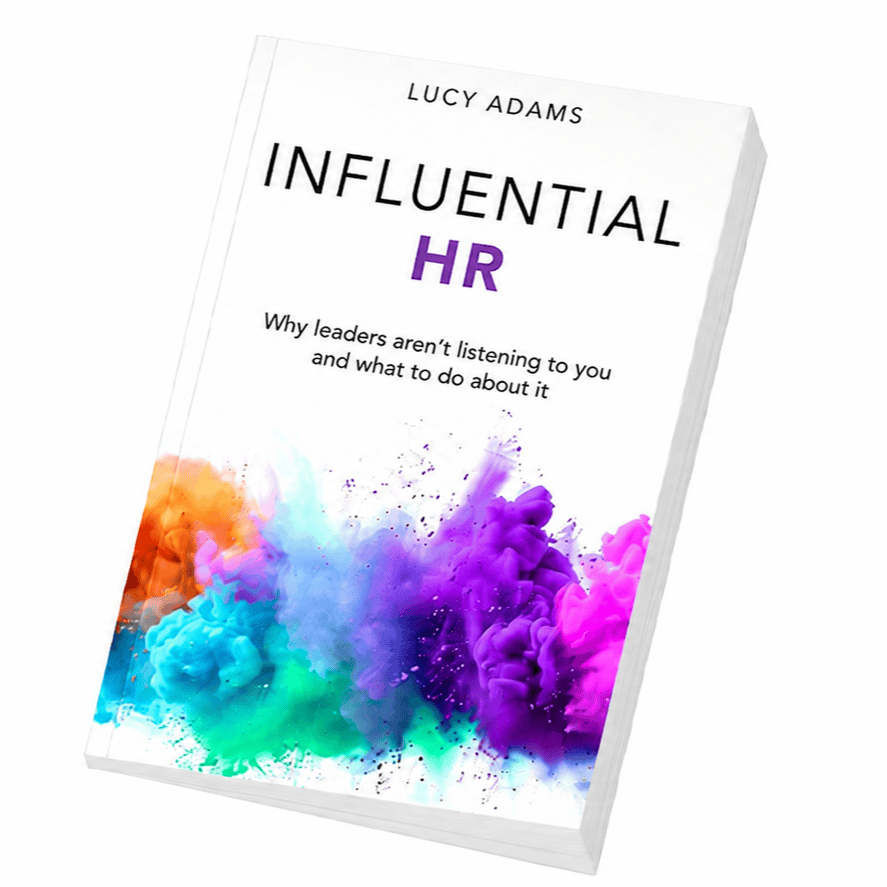
The third book in Lucy Adams’ series for forward-thinking HR professionals explores why HR struggles to influence leaders — and how to build the confidence, credibility and authority to create real change.


